• Hey Guest. Check out your NeoGAF Wrapped 2025 results here!

NVIDIA Says Its Future Gaming GPUs Will Bring A 1,000,000x Leap In Path Tracing Performance By Using RTX / AI Advances

I mean, you don't see console fanboys trolling about "fake frames" in some threads? They will start to like FG once it's available on their machines of choice.
PC fanboys were trolling about fake 4k on PS4 pro, before they started to suck Nvidia with DLSS. Do you have selective memory?
 
Last edited:
I was not talking specifically about this news.
I get that... I am just saying that in the last 7-8 years, contrary to what people may think, the biggest GPU tech innovation hasn't been RT, it was AI. Hell, its why AI was announced right alongside RT back in 2019 )or was it 2018).

Raster has peaked, funny enough, that peaked during the PS4XB1 gen. And even in that gen, we started to really see faux 4K being pushed. AI reconstruction was just the inevitable final form of that. And now AI-assisted rendering is going to show up in ever more prominent ways.

The shocking thing is that its taken AMD this long to release a GPU with actual AI hardware... but once they do, everything Nvidia can do with AI, so will said GPUs from AMD, even if AMD isn't the one developing the AI model that's driving it. Kinda like how Intel's XeSS can run on other GPUs. The only reason we don't see DLSS elsewhere isn't that they are using a "different" AI model, its because its written in a proprietary language only meant for their own AI cores. In contrast, AMD and Intel went the open source route.
 
PC fanboys were trolling about fake 4k on PS4 pro, before they started to suck Nvidia with DLSS. Do you have selective memory?

Just like they liked upscalers when they became standard on PCs.

People started to accept upscalers once their output became good.

I don't think masses when thrilled when DLSS1 sucked balls in 2019...

 
The overwhelming majority of this will be from just increasing frame generation multipliers. 100x MFG coming soon to a GPU near you.
 
Last edited:
Consoles are the reason amd is still alive
Consoles need cheap hardware that AMD provides.

But hopefully they are able to mount a good competition. They have a big competitor and unlikely they will get advantage like it happened with intel.

Still once they become good enough, they will be viable.
 
So you want consoles to cost $1,500?
For something that is gonna give me thousands of hours of entartainment for a bit short of a decade?

Sure.

I'm not a cheapskate when it comes to my main hobby.

Of course it must be worth and built with logic and balance, so not something like a ps5 pro that costed me 920 euros for a 40% gpu uplift and not much else.

And of course, it has to have an nvidia gpu but that was the whole point of the discussion.
 
Last edited:
Or have toggles.

Console games often have even the most basic features out of user control. How many games have CA/DOF/MB/Film grain etc. settings not available on consoles?

Wukong was forcing FG for anyone that wanted to have better fluidity than 30fps on 60Hz displays.
 
Console games often have even the most basic features out of user control. How many games have CA/DOF/MB/Film grain etc. settings not available on consoles?

Wukong was forcing FG for anyone that wanted to have better fluidity than 30fps on 60Hz displays.
Yet every single one has framerate toggles.

So yes, I would expect the same especially when people and sites like DF start making noise with it.

It will simply ask you if you want 30 fps or 60.

What if 30 is also achieved via frame gen.

This whole system will likely be baked in the system. Chances are DF will not be able to make out native resolution/ frame rate.
You're making assumptions just to make them. We are in a time where more and more toggles are becoming the norm on the consoles.

Next gen will probably expand as well.

But I know, FUD/Doom & Gloom is much more fun.
 
Yet every single one has framerate toggles.

So yes, I would expect the same especially when people and sites like DF start making noise with it.


You're making assumptions just to make them. We are in a time where more and more toggles are becoming the norm on the consoles.

Next gen will probably expand as well.

But I know, FUD/Doom & Gloom is much more fun.

There are games with zero options options like that.

But you are right, framerate toggles have become a norm this gen. But we will see if they will connect them to FG or kept separated.
 
Last edited:
oh wow! one million leaps

Z5ebABmqrihfb2aP.gif
 
Is the headline stating that future cards will have 1M times more Path Tracing performance than a card that doesn't have native RT support? Am I reading this right?
 
Last edited:
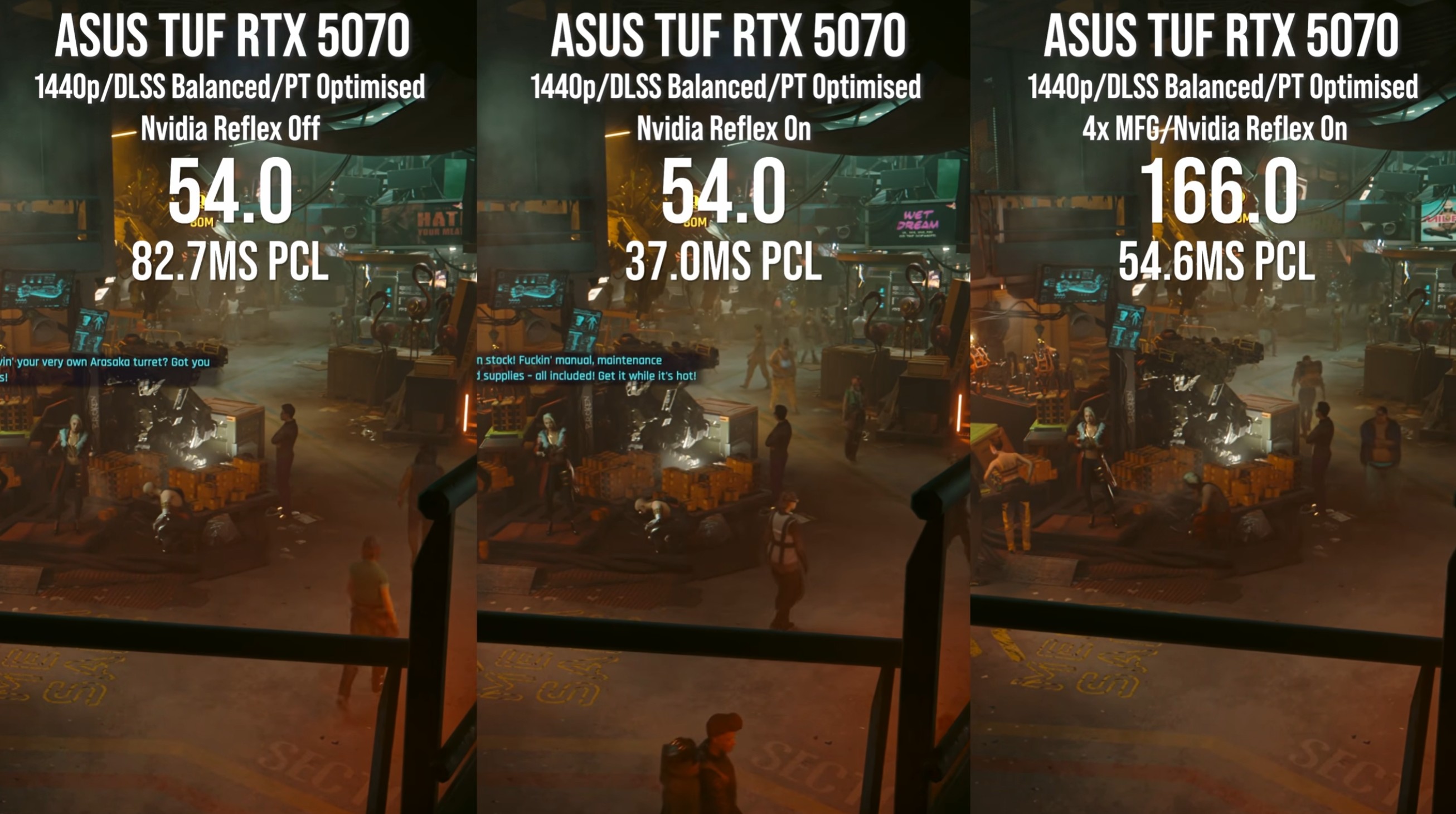
But when you enable reflex/anti lag 2 - latency drops so even with frame gen you can have lower latency than with off:

MVJ4OT3OCWdURGUc.jpg


You see that even with MFG you have lower latency than base game with reflex off (and that's how most console games behave as well). FG latency is WAY overblown.


Why would you have Reflex off? Even before it was called that in NVCPL I never had it off.

Your comparison is bizarre, the point of frame-gen is to increased perceived smoothness of motion, its at the expense of (much) higher latency than the output framerate and even the input framerate.

If you compare with it on or off on both the latency is obviously going to be higher on the frame gen example.

The main reason I enjoy higher framerates is the lower input latency, if a game has good motion blur then I just adjust to 30fps over time, 60fps would be preferable ofc but if its going to feel worse than 30fps then no thanks.

I've always maintained most people dont really understand input lag in displays and how the whole chain all added together is what matters, I'm glad these tests show that now.
 
Let's do some fun math.

My RTX 5090 can manage to play Quake 2 RTX with denoising off at 4k and deliver around 150 frames per second. Denoising is not the future it is a stop gap to make up for the lack of performance we have today.

Of those 150 frames, 0 of them are "complete." Each frame is a sporadic cluster of filled in pixels and A LOT of empty space. This is because to path trace every pixel in a 3840x2160 frame, it would take an enormous amount of processing. How much processing?

Quake 2 RTX allows you to freeze the game logic loop so everything pauses in place and you can start accumulating multiple frames worth of path traced rendering to get a fully processed frame without any denoising.

By default, the game will process 500 frames to achieve a fully rendered 3840x2160 frame free of noise. Sometimes 500 isn't enough, it can take thousands of these partially rendered frames to accumulate enough properly calculated pixels if the lighting conditions are extra demanding.

This means if we want to play Quake 2 RTX at 4k and get a solid 60 frames per second without any ugly denoising or render artifacts, we need to take 60 and multiply it by the number of frames it takes to get a single fully rendered frame which is a minimum of 500, and we get 30,000 frames per second worth of performance to play without denoising or any artifacts.

Since the 5090 can only deliver around 150 fps, we need to take 30,000 and divide it by 150 to get an idea of how much faster our imaginary future GPU needs to be in order to hit that 4k 60 mark. The result is a card that is 200x faster than an RTX 5090. For context, the RTX 5090 is only about 5x faster than a 1080 Ti in raw performance, and that GPU is 9 years old. Sure, when you start using DLSS and AI techniques you can fake your way to significantly faster performance, but it isn't true real processing power gains. It's imaginary, like frame generation.

All this and keep in mind we've been talking about Quake 2 RTX, a game with geometry and levels designed for a Pentium 1 200Mhz processor to handle with software rendering, and it isn't even a feature-complete path trace renderer as it's missing caustics which increase the processing requirements by orders of magnitude more. If a scene has caustics, you can increase that 500 frames to something absurd like 10,000 or more.

TLDR it's a pipe dream and this AI craze is to distract shareholders and the public from reality to keep line going

 
Last edited:
Consoles need cheap hardware that AMD provides.

But hopefully they are able to mount a good competition. They have a big competitor and unlikely they will get advantage like it happened with intel.

Still once they become good enough, they will be viable.
The only reason amd provides cheap hardware is because they cannot compete with Nvidia.

AMDS competitive pricing on hardware is a necessity for them. AMD is as dependent on consoles as vice versa.

AMD could have gained so much momentum now if they prices their cards well.

Instead, they want to copy Nvidia's pricing except they are delivering a worse product for the price.
 
Why would you have Reflex off? Even before it was called that in NVCPL I never had it off.

Your comparison is bizarre, the point of frame-gen is to increased perceived smoothness of motion, its at the expense of (much) higher latency than the output framerate and even the input framerate.

If you compare with it on or off on both the latency is obviously going to be higher on the frame gen example.

The main reason I enjoy higher framerates is the lower input latency, if a game has good motion blur then I just adjust to 30fps over time, 60fps would be preferable ofc but if its going to feel worse than 30fps then no thanks.

I've always maintained most people dont really understand input lag in displays and how the whole chain all added together is what matters, I'm glad these tests show that now.

People are playing with reflex off (for example console or AMD users) and they are FINE with latency the game has, but suddenly they are not fine when game with FG and Reflex has lower latency? Of course using reflex without frame gen will give you the lowest possible latency.

Also it became impossible to run the latest games at 4k native. Throw in ray/path tracing and people had no choice but to use upscaling.

When things like RT and Lumen started scaling with internal resolution - running those games in native 4k started to become extremly expensive. DLSS/FSR4 are so good that you won't notice the difference most of the time anyway.
 
Except DLSS is also fake "4k" but optional and native resolutions went nowhere. Big differences.


Every single one??? Not even on PC every single one has "toggles".
My comment was about quality, performance, balanced, high framerate modes. And of course a little hyperbole.

PC for the most part when not certain silly Japanese devs, has open frame-rate with vsync Hz locks. Of course I know you know this.
 
Last edited:
Good to hear it. Would be great if next-gen Nvidia GPUs doubled path tracing performance as that is the last area that really needs performance improvements, if they were able to pull this off, all current gen mid-range GPUs would basically become obsolete for path tracing.

hmm..as long as consoles keep using AMD the developers will make RT optional rather than in-built somehow.
I don't care about ray tracing at all. Gaming ain't cheap anyway.
Next-gen consoles will focus even more on ray tracing than current gen. If you don't turn on RT you will be using lower than PS6 settings.
 
Are they sure it wasn't about the price actually? A million times is just crazy shit for PT perf on dedicated hardware w/o some occult magic. Probably marketing bs anyhow, but nevertheless atm next Nvidia card is my top priority gaming hardware, RE9 influenced me...
 
It's quite easy to tell.


No one uses FG from 30 to 60 on PC, it's retarded. And Wukong devs were retarded as well.

Nvidia says about something like 40FPS+ being the lowest possible FPS for acceptable results with FG? And this is correct.
I use frame generation to go from 15-20 fps to 30 fps in AC shadows, works fine for me.
 
Last edited:
Apparently the real move is not going to be saving for the next NVIDIA card, it's building relationships with scalpers early so you can maybe get one for only regular robbery instead of deluxe robbery.
 
Apparently the real move is not going to be saving for the next NVIDIA card, it's building relationships with scalpers early so you can maybe get one for only regular robbery instead of deluxe robbery.

The funny (mostly sad) thing is is that the AIB partners are the ones scalping cards now. Like they're not even trying to hide it.

It all started with MSI back when RTX 3000 series cards started to become hard to come across.

Then you have shitty retailers like Newegg that forced bundles (i.e. sought after items, with random junk) to have a better chance of getting it once stock dried up.
 
Nvidia owes everything to DLSS. Yeah, no shit you see a massive performance uplift when you render the game at a fraction of the native resolution and upscale it.

(That's not to diminish from the achievement of modern upscaling like DLSS. It is extremely impressive how it can make a 720p base image look good on a 4K display. But it also represents a shortcut which has now been taken and has diminishing returns.)
 
Let's do some fun math.

My RTX 5090 can manage to play Quake 2 RTX with denoising off at 4k and deliver around 150 frames per second. Denoising is not the future it is a stop gap to make up for the lack of performance we have today.

Of those 150 frames, 0 of them are "complete." Each frame is a sporadic cluster of filled in pixels and A LOT of empty space. This is because to path trace every pixel in a 3840x2160 frame, it would take an enormous amount of processing. How much processing?

Quake 2 RTX allows you to freeze the game logic loop so everything pauses in place and you can start accumulating multiple frames worth of path traced rendering to get a fully processed frame without any denoising.

By default, the game will process 500 frames to achieve a fully rendered 3840x2160 frame free of noise. Sometimes 500 isn't enough, it can take thousands of these partially rendered frames to accumulate enough properly calculated pixels if the lighting conditions are extra demanding.

This means if we want to play Quake 2 RTX at 4k and get a solid 60 frames per second without any ugly denoising or render artifacts, we need to take 60 and multiply it by the number of frames it takes to get a single fully rendered frame which is a minimum of 500, and we get 30,000 frames per second worth of performance to play without denoising or any artifacts.

Since the 5090 can only deliver around 150 fps, we need to take 30,000 and divide it by 150 to get an idea of how much faster our imaginary future GPU needs to be in order to hit that 4k 60 mark. The result is a card that is 200x faster than an RTX 5090. For context, the RTX 5090 is only about 5x faster than a 1080 Ti in raw performance, and that GPU is 9 years old. Sure, when you start using DLSS and AI techniques you can fake your way to significantly faster performance, but it isn't true real processing power gains. It's imaginary, like frame generation.

All this and keep in mind we've been talking about Quake 2 RTX, a game with geometry and levels designed for a Pentium 1 200Mhz processor to handle with software rendering, and it isn't even a feature-complete path trace renderer as it's missing caustics which increase the processing requirements by orders of magnitude more. If a scene has caustics, you can increase that 500 frames to something absurd like 10,000 or more.

TLDR it's a pipe dream and this AI craze is to distract shareholders and the public from reality to keep line going
Thing is... none of that is relevant.

That kinda thinking.. or approach for that matter, is not just redundant but its also grossly short-sighted.

Its like, your goal is to make a car do 200M/hr, there is a way to do this with a small 200hp engine and a way to do it with a big 1000hp engine. Your reasoning here is that unless you do it with the 1000HP engine, then your 200M/hr isnt real. Even though, for all intents and purposes, you are doing 200M/hr.

But back to your example... technically, you don't need to render the frame 500+ times to get a true 4K path-traced image. What is actually happening is that you are basically shooting 500x more rays into the scene, so absolutely no render point is missed. Solution? You either have a 500x more power RT core in your GPU, or you do what is currently being done, which is to use AI denoisers.
But the key thing here is this, what the AI denoiser lets you do, is that instead of shooting literally thousands of rays per pixel to get your samples and ending up with 100s of billions of rays... per frame, you only need to shoot 1 or 2 rays per pixel and the AI denoiser approximates what the result should be like if you shot billiuons of rays. The difference in final resolve is ultimately so small that its flat out ridiculous to attempt to do it any other way. And its significantly cheaper (and more importantly faster) to just improve your AI model and hardware for even better results than to chase the native dream.

And that brings us to the other problem... the native dream was and has always been a lie. Its just one of those things that was just never feasible and makes no sense. Think about it, be it rendering native pixels, or pushing native rays to arrive at ground truth path tracing... even if you had hardware powerful enough to do it natively... can you imagine what you could do with that same hardware if you instead used only like 10% of your hardware to render a good enough image and let AI pick up the slack so youhave 90% of that hardware for everything else?

Everything else will always win.
 
Top Bottom