• Hey Guest. Check out your NeoGAF Wrapped 2025 results here!

ALTERNATE VIDEO GAME TIMELINE: The 5th Generation (Mega Thread)(Ongoing)

Your favorite home console of the 5th generation?


  • Total voters
    130
[AVGT: 5TH GEN (PART 0)]

==========================================

[DISCLOSURE]

*Certain AI tools (e.g Claude, Gemini, Deepseek) were used to help flesh out and refine technical aspects of various hardware featured in this series. This was done both to ensure realistic performance capabilities relative to BOM (Bill of Materials) pricing, and to help design unique architectural variety among system designs where, for those mainly modifications of existing real-world designs, stay true to the spirit and design philosophy of the original design (and related company/engineering teams) while making beneficial modifications.

*Certain AI tools (e.g Gemini, Deepseek, Open AI, Grok etc.) were used to help flesh out and expediate certain 3D renders for various hardware and peripherals contained within the posts of this series. However, all designs derive from initial sketches drawn/drafted by myself, which may have influence from design stylings of other real-world devices (e.g JVC Wondermega, NEC PC-Engine Duo R). These sketches will be contained with their relevant systems as proof.

*Certain simulated gameplay screenshots that are present throughout this series, have either been modified by myself in an image editing program, generated by an AI by referencing a sketch drawn by myself, or a combination of both. Footnotes to each image will provide the condition type of the image.

*And if not already obvious, yes, I have used AI to assist with certain aspects of this hypothetical timeline, but only mainly in regards to the data types already mentioned above. This was done to expediate parts of the project and help clarify certain ideas (particularly technical) that were beyond my realm of knowledge at the time. I am also only one person, and have other real-life responsibilities. There was zero chance I'd of made sufficient progress on this (after multiple rewrites, mind you) without some type of assistant for certain areas.

That said, the main bulk of everything pertaining to the timeline, i.e hardware & peripheral timeline developments, market performances, release dates, software concepts, most business arrangements, etc. and most importantly the final composition & presentation you are reading in these posts, were all done completely by me. Which will therefore require some period of weeks (maybe months) before this generation of the timeline is complete; a lot of what I have written down will have to be reorganized to a degree as I make these posts.


----------------------------------------------------------------------------------------------------------------------------------------------------------------------------------------------------------------------------------------------------------------------------------------------------------------------------------------------------------------------------------------------------------------------

images


[INTRO]

Hello all. For a while now, I've been working on an alternate video game timeline project, inspired by some of the ones I began reading on websites like AlternateHistory.com, where several of that website's community members have been coming up with various timelines for well over a decade, to various degrees of depth & completion. My original goal for this specific alternate timeline was to mainly focus on NEC/Hudson Soft in the 5th generation; however, over time it expanded to reach into future console generations (which will get their own threads similar to this one) and also throwing in a few new or reformed players that didn't exist in OTL.

The reason I started the timeline with the 5th generation (primarily; there are some development for the 4th generation as well, which most of you should be able to identify when you see them) is because IMO, that is the generation with the most amount of market volatility, at least tied with the (mainly American) gaming crash of the early 1980s. The volatility of the 5th gen (or mid-1990s to be more specific), however, represented magnitudes more opportunity for the industry, to go any number of ways. In hindsight, perhaps the industry would've been better off taking an offshoot direction, but that is neither here nor there.

I've attempted to give all the players involved in this a fair shake while also correcting some things I perceived as wrong or unfortunate in OTL, without getting too biased with it. Basically, every platform holder you will see featured in this series has their strengths and weaknesses, and over time as we move throughout the generations, each will pay some type of price for certain flaws & mistakes made at the time or earlier on.

My biggest goal with this series, at least at first, was to avoid the runaway effect of PlayStation with the gaming market (i.e PlayStation running away with the market from 1995-onward), and I feel that has been accomplished without doing anything too overly dramatic. I approached this and everything else you will see in this series with a high level of nuance, to both keep developments interesting and also to not end up biased towards one specific brand (and in the chance that seems to happen, don't let it happen for too long). You will still see major players enter and exit the main stage, just in matters different than in OTL.

This series (and those for future console generation installments) does get very technical in areas, particularly when fully divulging specifications of the various console hardware devices. Most likely, I will store downloadable links for PDF or TXT files containing the details in a given location, and those interested can download them from there to have as reference. If throughout the series there are any references to architectural features that sound alien, I would suggest pulling up those files and getting in-depth reads.

So, without further ado, I'd like to get things started. This series will be broken up into parts, parts corresponding to posts, so throughout the thread whenever you see a post from me that reads "[AVGT: 5th Gen (Part (N))]", just know that is an official part for the series, where things will be told in mostly sequential order. Otherwise, any other posts of mine ITT will just be regular 'ol posts. If possible, I'll hyperlink main entry posts so that people can jump along post entries for the series as they'd like, tho I'm not sure if GAF has such a feature built-in (I haven't looked yet nor have I tried it out).

Look forward to the first main post entry into the series, which should be around this weekend. While I might luck into having a post entry for the series on a weekday or two (really depends on schedule & complexity of the post), just know that at least one post entry each weekend will be a guaranteed lock going forward (or until further notice/an update).

Thank you for those who read the preamble; I'm excited to finally start posting this and see what ideas it hopefully gins up in the lot of you. Let's have fun reimagining the lifecycle of this industry (from the point of time where a majority of us here were likely kids)!

-----------------------------------------------------------------------------------------------------------------------------------------------------------------------------------------------------------

(Link to Part 1)
 
Last edited:
Got a free subscription in 1995 to Nintendo Power through an elementary school book sale bonus. While the sub was free, Nintendo knew what they were doing because I ended up giving them $300 for an N64 because the Nintendo Power propaganda machine worked on kid me. They made mega bank. Bought those $80 games like it was my job.

So Nintendo 64's my vote. Of the other consoles on the OP list, I've only ever played the Playstation and Sega Saturn. Never owned either of them.
 
Had to vote PS, it's the only one I owned. Loved that thing though.

Untitled-1.jpg


Is this a video series or are you going to update the thread with additional information? Either way, good luck with it. I look forward to seeing what you put together.
 
N64 by a landslide. It was the N64 library that got me into gaming:
PBwzrzEPHvAeF7G3.jpg
wlLMwlpNm6R7CJSs.jpg

eCL6vOMkXVuzhz3S.jpg
7NFBGKShTMjo5Kgw.jpg

But the series that really got me hooked on gaming for life were these two:
h6FPdUJ6YXByYcmE.jpg

HZ7OdsM5kmrgMfO3.jpg

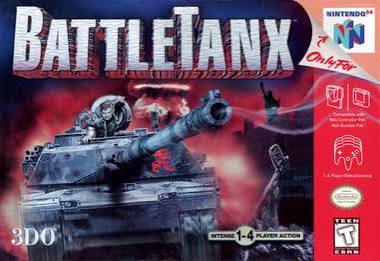
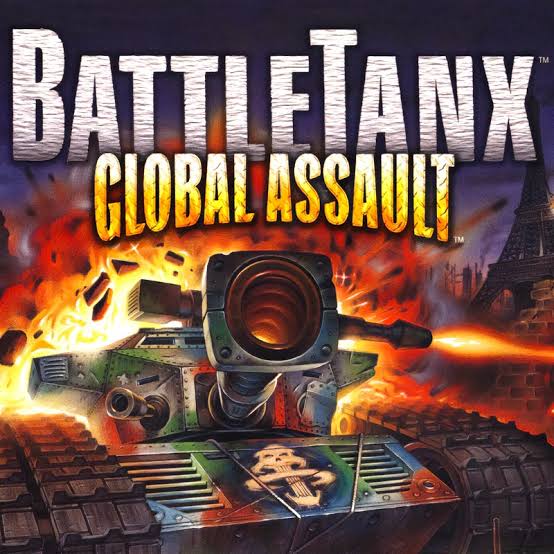
More than any other title that I played as a kid, this is the one that for some reason really stuck with me the most. I know a lot of people point to Mario, Zelda, Metal Gear Solid, Resident Evil, Final Fantasy, Sonic, etc as far as the franchises that got them to love this hobby, but Battletanx and especially Battletanx: Global Assault are two of my favorite games of all time. The soundtrack for Global Assault was also great


One of my favorite songs in a video game:
 
N64 by a landslide. It was the N64 library that got me into gaming:
PBwzrzEPHvAeF7G3.jpg
wlLMwlpNm6R7CJSs.jpg

eCL6vOMkXVuzhz3S.jpg
7NFBGKShTMjo5Kgw.jpg

But the series that really got me hooked on gaming for life were these two:
h6FPdUJ6YXByYcmE.jpg

HZ7OdsM5kmrgMfO3.jpg

More than any other title that I played as a kid, this is the one that for some reason really stuck with me the most. I know a lot of people point to Mario, Zelda, Metal Gear Solid, Resident Evil, Final Fantasy, Sonic, etc as far as the franchises that got them to love this hobby, but Battletanx and especially Battletanx: Global Assault are two of my favorite games of all time. The soundtrack for Global Assault was also great


One of my favorite songs in a video game:

Are those your YouTube videos? I watched one of those recently.
 
Last edited:
PlayStation for me. Mostly window shopping JRPGs and Metal Gear. I was nearing the end of high school and my time for gaming was fleeting, but I had a buddy who's family came into some money and one day he came over with a PSX and a giga-stack of most the big games. RE2, Metal Gear, Gran Turismo and Cool Boarders 2 were the ones that stood out. He left it at my house for months on end and I remember reading every word of the Gran Turismo driving philosophy instruction manual. Braking and entering, 100% traction philosophy. I still use this shit on the road today.

In some ways even though it's the gen I spent the least amount of time with while it reigned, those early PlayStation games are some of my most magical gaming memories. Not even for the actual time I spent with it, but what I imagined it could be. It's a bit of a meme now, but that Gran Turismo double CD case with those black back discs and deliberate gameplay felt grown as hell.
 
Last edited:
No 32X in the poll. Disappointed.

IMO it's kinda hard to classify that as a 5th-gen system. It was an add-on, technically, and for the Genesis at that.

Is there an updated consensus with people who view it as a 5th-gen console?

It hurts me to vote for PlayStation right now.

I feel that pain.

Penis station 1 where dreams were made.

Maybe that was the secret life hack to fix broken lasers the whole time 😲

Just the Square output on the PSX would be better than 85% of the contenders.

They definitely had their generational run that gen. Arguably at the height of their craft (late-era SFC should technically get lumped in there too b/c of stuff like Chrono Trigger).

Had to vote PS, it's the only one I owned. Loved that thing though.

Untitled-1.jpg


Is this a video series or are you going to update the thread with additional information? Either way, good luck with it. I look forward to seeing what you put together.

Nah, I don't make videos (unfortunately; maybe an idea for the future tho). It'll basically be post updates throughout the thread in the format stated by the OP. But I'll try having illustrations and screenshots of key things as I can, and make it all neat-looking and such.

If anyone wants to add details or various flourishes along the way, you're more than welcome to do so.
 
The PSX is uncontested in my mind. Final Fantasy (+ Tactics), MGS, Gran Turismo, Vagrant Story, Suikoden, Colony Wars, Tactics Ogre, Castlevania: SotN, Resident Evil, Tekken - the list goes on and on and on.

Many years of top tier, diverse, entertainment. Was a sad day when not even putting it upside down would load my games anymore.
 
We had a lot of 5th gen consoles, PS1, N64 and Amiga CD32 I had and my brother had the 3DO. All had some decent games but PS1 was a stand out for me.

The amount of hours I put into FFVII alone, I had way too much time on my hands. Let alone MGS, the Tekkens, Ridge Racers and Resident Evils. I could go on, but suffice it to say it was such a good time for gaming.

Nowadays nothing seems to really scratch that same itch. Everything seems play it safe and to tick boxes besides a handful of games.
 
(Link to Part 0)

[AVGT: 5TH GEN (PART 1)]

==================================================================


[1990]

(Q): "Wait a second! I thought you said this was a 5th generation timeline. Why are we way back in 1990!?"

(A): Good question. Truth is, in order to set certain things up properly, we need to dig further back in the years. Much like how you can't discuss the original PlayStation without also talking about the timeline for the Play Station, it's the same thing here. Don't worry tho; it'll all make sense in due time.

(Q): There ain't a lotta talk about consoles here, just mainly computers. What gives?

(A): Another good question. See, considering some of the companies involved here, you can guess that they are all very involved in the home computer market of this same time period. Considering various developments in the Japanese computer market during the 1990s, it is very important to talk about how some of these companies balance their strategies in that sector with their home console gaming ones, given certain synergies.


[MARCH]

sharp_logo_rgb_r2.png

>Following sluggish sales of the X68000 since its initial Japanese launch in 1987 and wanting to bolster profile of the product line, Japanese electronics manufacturer Sharp begin exploring ways to consolidate the computer's design into a cheaper, living room-friendly product that can take a chunk out of NEC's domestic computer market in Japan.

[JULY]

Neo-Geo-AES-Console-Set.png

>The initial release of SNK's Neo Geo AES (April 1990 in Japan) becomes the driving impetus behind Sharp's desire to simplify the X68000 into something more palatable for the home market. Early strong reception to the AES as well as demand from customers willing to buy one for several hundred dollars, influences Sharp to continue their own research into a scaled down X68000 design.

The guiding principal in this design is one wherein Sharp feels they can charge a similar or slightly higher price (still much cheaper than current X68000 computer towers, though) for a game-friendly computer with performance comparable to arcade systems (tho admittedly, less than the Neo Geo's 2D prowess) with the option of also transforming into a fuller home computer, a selling hook the Neo Geo AES does not have.

[OCTOBER]

>Early planning on the streamlined/simplified X68000 variant wraps up, with Sharp forming a new team from within the larger home computer team (including members of the X68000 engineering & product design group) to spearhead R&D. on the project undergoes various stages of development throughout the rest of 1990 and throughout all of 1991, until it is ready for an official reveal.

[NOVEMBER]

Tom-Kalinske.jpg
221px-MichaelKatz_1989.jpg.png

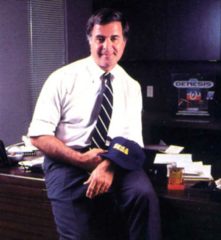
Incoming SoA CEO Tom Kalinske (Left); Outgoing SoA CEO Michael Katz (Right)


>Tom Kalinske joins SEGA of America as its new CEO, replacing the fledging Michael Katz. In spite of this, Michael Katz helps to get his successor up to speed with the current state of SOA, as he tenures his resignation and makes a full exit the following January 1991.

[DECEMBER]

>Some of the first rumors and whispers as to Sharp's work on a "cost-reduced" X68000 start to circulate among the Japanese trades, catching the ear of various rivals, including domestic market leader NEC. At present time, however, NEC have no immediate plans to counteract Sharp's developments; they enjoy a highly fruitful position in the Japanese computer market, and nothing regarding Sharp's plans have actually been officiated.

In spite of this, a couple members of NEC's HCG (Home Computer Group) do try keeping an eye on developments regarding Sharp, as the HCG are actively iterating on new SKUs for the PC-88 and PC-98 computer platforms. Developments in 1991, however, will catapult a more pressing response from the domestic computer giant to defend its empire.

-----------------------------------------------------------------------------------------------------------------------------------------------------------------------------------------------------------

[1991]

-999x-999.gif

NEC USA's Hisashi Kaneko (President & CEO,1989-1994)


[MAY]

>Michael Katz, having left SEGA of America several months prior, is hired by NEC Technologies USA Inc.'s President & CEO, Keith Schaefer, to replace Ken Wirt. Ken was the branch's Vice President and General Manager for the TurboGrafx-16 Group up until March 1991, at which point they departed the company. The main reason as to this departure, and in fact Michael's hiring, was due to very poor sales of the TurboGrafx-16 console.

Despite a modest bump over Holiday 1990, sales for the system had seen a rough decline throughout that year thanks to SEGA of America's marketing, strong software lineup, and relationship with EA's sports label. That Michael Katz managed Genesis's American operations at this time was not lost upon Keith, who saw an opportunity to bring Michael's expertise to NEC's side. With general senior Vice President Tom Martin's support, Keith would convince NEC USA's Hisashi Kaneko (President & CEO) to bring in Michael Katz as Ken Wirt's replacement to manage the TurboGrafx-16 Group.

The onboarding of Katz as the group's new VP & GM was of urgent requirement; word had it that management back at NEC Corporation (the main branch headquarters, located in Japan) were already considering divesting from the American home console market altogether. Although work was actively ongoing for a new PC-Engine variant (the PC-Engine Duo), plans to bring it to the West were not solidified. If there was no indication of substantive market improvement for TurboGrafx-16 by the end of Holiday 1991, divestiture from the American home console market was guaranteed.

[JULY]

Compaq-Logo-1982.png

>Compaq officially announce their intent to enter the Japanese computer market in July 1991. They are the first major American computer company to attempt a serious stake at the market, which up to this point has been dominated by domestic player NEC. In due time press (mainly in America) will come to dub this as the "Compaq Shock".

As such, NEC begin to take notice, but it's not until around early December 1991 that they set anything in motion.

>Also in July, Michael Katz drafts out a near-final business plan for what they call "Operation Turbo Mode", a multi-pronged market strategy to help the TurboGrafx recapture a portion of the American gaming market. "Operation Turbo Mode", or OTM, is technically split into two main phases, the first of which will be a trail run to be implemented during the Holiday 1991 shopping season.

If the trail run is successful, Katz hopes it will be the signal to convince NEC Corporation to bring the upcoming PC-Engine Duo to America. He also hopes it will secure funding & support to push through with the main phase in 1992, but both of these things hinge on market performance during the 1991 holiday season. Now all that's need are a couple of large retail chains to act as partners for the trail run.

[SEPTEMBER]

images
TurboGrafx16-Console-Set.jpg

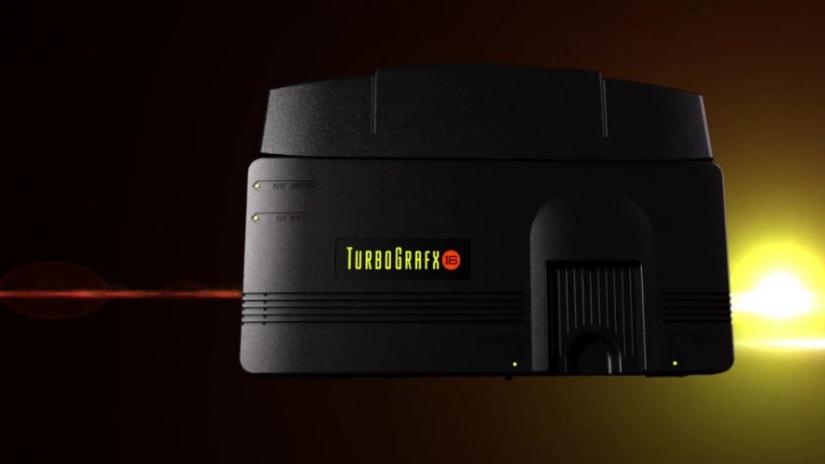
>The trail run for Michael Katz's "Operation Turbo Mode" (OTM) is set. NEC Home Electronics USA Inc. are able to get Toys R' Us on board for a stock of TurboGrafx units at a special $130 holiday pricing alongside two free pack-in games (customer's choice). By additionally subscribing to the official Turbo Worlds magazine for a 1-year period, the same customers can receive a $50 discount towards select future TurboGrafx products (i.e $10 vouchers towards upwards 5 games).

As the PC-Engine Duo does in fact later get a confirmed American release for 1992 (thanks to Holiday 1991 sales directly attributable to the trail run of Operation Turbo Mode), this discount also becomes valid towards that device. Meanwhile, those who subscribe to Turbo Worlds for 1 year and already have a registered TurboGrafx & CD-ROM unit are eligible for a $20 off voucher for the Super System HuCard (provides Super CD-ROM^2 functionality to CD-ROM^2 units), which is also confirmed for a stateside release around the same time the PC-Engine Duo gets its own confirmation (in Early 1992).

[OCTOBER]

Why-the-Sharp-X68000-was-one-of-the-most-powerful-gaming-systems-of-the-1980s.jpg

>Sharp officially reveal the cost-reduced X68000, otherwise known as the X68000-CC (Computer Console), in October 1991. Initially planned for the Japanese market, the company states the CC will be the cheapest, most affordable option for customers to enter the X68000 computer ecosystem, and do so with the conveniences of a living room gaming system.

Initial specifications are scarce, but the company confirms that via expansion modules, the CC will be able to upgrade functionality and be fully compatible with the current and upcoming range of X68000 software & peripherals. It will feature the same Motorola 68K, Zilog Z80, and Cynthia graphics chips pivotal to the current X68000 computer range, and also have support for X68000 floppy disk drive format, I/O (e.g keyboard & mouse), and support expansion primarily through a dual-cartridge slot interface.

Later in the same month, in an interview with a Japanese computer magazine, a Sharp representative is asked as to their pricing strategy for the X68000-CC. Their response is simple: they wish to offer something with comparable performance to SNK's Neo Geo AES (but with support for the larger array of X68000 software applications including games) but has the benefit of scalable upgradability into a fuller-fledged computer system. The company will reveal more on aspects of upgradability later on, but state that even with such factored in, they aim to "comfortably" undercut NEC's domestic computer offerings for the home market, and finally give the X68000 the install base it's deserved for so long.

[NOVEMBER]

images

>Fujitsu announce plans for a cost-reduced version of the venerable FM Towns computer in November 1991, seeking to have it ready for market by Late 1992 (slips into Early 1993) and "highly competitively priced" with Sharp's system. However, Fujitsu state that certain aspects of the device's functionality are actively being explored & decided upon: they are not quite certain it will have the fuller functionality of their FM Towns computer, either by default or via an add-on.

[DECEMBER]

nec-old3035.logowik.com.webp

>NEC Home Electronic Ltd's HCG (Home Computer Group) gets in contact with Hudson Soft in December 1991 to initiate a "side project venture", as a "just-in-case" against Compaq, Sharp, Fujitsu and others like Dell who seek to eat a hefty chunk out of NEC's domestic dominance of the Japanese home computer market. However, the HCG are very busy with work on various PC-88 and PC-98 SKUs, and do not have experience with low-cost/entry-level home electronics designs.

In other words, they need help on developing a computer product that can be price-competitive with what Sharp and Fujitsu aim to provide, let alone whatever PC device companies like Compaq bring to Japan in 1992. Hudson Soft have experience in this regard thanks to work on the PC-Engine; in fact, they are currently working on a design for what will later become the PC-Engine's successor, and have been doing such since Spring 1991 with NEC's own direct funding.

In the context of this, NEC set up an arrangement (and extra funding) between Hudson Soft and a sub-group of the HCG to adapt key aspects of the current in-development prototype (Project Tetsujin) into a PC-98-based cost-reduced home electronics device. This formally creates a fork in the development timeline for Hudson Soft on the proto-type; the current one (focused on a successor to the PC-Engine) now internally goes by Project Tetsujin E, while the new one (focused on applying aspects of that design to a PC-98 spec) goes by Project Tetsujin K.

While both Project Tetsujin E and Project Tetsujin K share various baseline technology, the former remains the domain of a predominantly Hudson Soft staff (with NEC's funding; thus, NEC own the technology rights to what's developed on both forks) while the latter eventually (and somewhat quickly) grows to have a main force of predominant HCG members forming a sub-group with some Hudson Soft staff, both sharing where needed. However, as NEC start to shift priority to Project Tetsujin K, some tensions develop with Hudson Soft since it means Project Tetsujin E development is somewhat slowed down; technologies related to it continue normal development pace, but testing & integration of those technologies prioritizes the more newly-found Project Tetsujin K as that is where NEC push a majority of the funding for the time being.

==================================================================

This concludes Part 1. Part 2 will pick up with 1992; from that point going forward, the years get gradually more dense with events, so future parts may only cover a few months of a given year or even just one given month (and in some cases, only one event in a given month). It'll just really depend.

We're still technically in the set-up stages, though, so things shouldn't get too dense just yet. From a glance at my notes, that's more something to expect around 1993 and definitely from 1994 and onwards as this generation gets into full swing. If you're wondering about things not mentioned specifically so far, such as the SFC/SNES, Sonic the Hedgehog, CD-i, Atari Lynx, Gameboy etc., well that's for two reasons. First is that this is a timeline for the 5th generation mainly (you will see some 4th-gen developments mainly around NEC/Turbo Technologies, and various 6th-gen developments later on), and second is that you can assume whatever happened with those platforms up to this point in OTL hold true in this ATL.

In other words, you still have SFC & SNES releasing as they do, Sonic still doing what it does, the whole MK censorship controversy plays out the same here, MEGA/SEGA-CD play out the same, etc. Now, there WILL be some changes with 3DO, SNK, Jaguar (well, more specifically Atari themselves), Saturn etc. in this timeline (not Amiga tho; sorry lads), but they are all more pertinent to 5th-generation developments and therefore expect to see those around the 1994-1996 time intervals (aka too early yet).

If you've got any ideas or questions, definitely feel free to share them. I'll have Part 2 ready most likely on Sunday. Let me know how you feel about Sharp actually doing something to make the X68000 more affordable, for example, and where you think things may develop (in relation to that and other events) going forward. Peace!
 
Last edited:
The PSX is uncontested in my mind. Final Fantasy (+ Tactics), MGS, Gran Turismo, Vagrant Story, Suikoden, Colony Wars, Tactics Ogre, Castlevania: SotN, Resident Evil, Tekken - the list goes on and on and on.

Many years of top tier, diverse, entertainment. Was a sad day when not even putting it upside down would load my games anymore.
PS1 was awesome, but the N64 was my childhood.

Fucking shame we'll never see that level of diversity of games from Sony from now on.

It is great that games like Suikoden and Tactics got remakes, but the originals need to be preserved too.
 
PS1 was awesome, but the N64 was my childhood.

Fucking shame we'll never see that level of diversity of games from Sony from now on.

It is great that games like Suikoden and Tactics got remakes, but the originals need to be preserved too.
The N64 was no slouch when it came to great games. Ogre Battle 64 alone is worth the cost of entry, I played through it some month ago. All it needed was some menu refinement/QoL and it would be a stone cold classic.

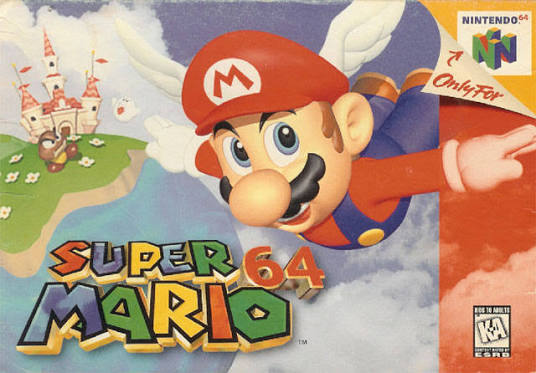
A friend had N64 and we had so much fun in Mario Kart and Super Smash Bros. Then you have Ocarina of Time, Star Fox and Mario 64, etc. I even think the Castlevania titles are kind of underrated, at least after experiencing the early PS1 Kings Field games. Japan was still trying to figure out and experimenting with 3D gameplay and design. So a bit of jank and fighting the controls is part of the charm. 😁

So yeah, that gen sure had a lot of fun and diverse titles. Indies has sort of picked up the mantle for experimentation, but it's not quite the same.
 
The N64 was no slouch when it came to great games. Ogre Battle 64 alone is worth the cost of entry, I played through it some month ago. All it needed was some menu refinement/QoL and it would be a stone cold classic.

A friend had N64 and we had so much fun in Mario Kart and Super Smash Bros. Then you have Ocarina of Time, Star Fox and Mario 64, etc. I even think the Castlevania titles are kind of underrated, at least after experiencing the early PS1 Kings Field games. Japan was still trying to figure out and experimenting with 3D gameplay and design. So a bit of jank and fighting the controls is part of the charm. 😁

So yeah, that gen sure had a lot of fun and diverse titles. Indies has sort of picked up the mantle for experimentation, but it's not quite the same.
Yeah, the N64 and PS1 were a goldmine of weird shit.

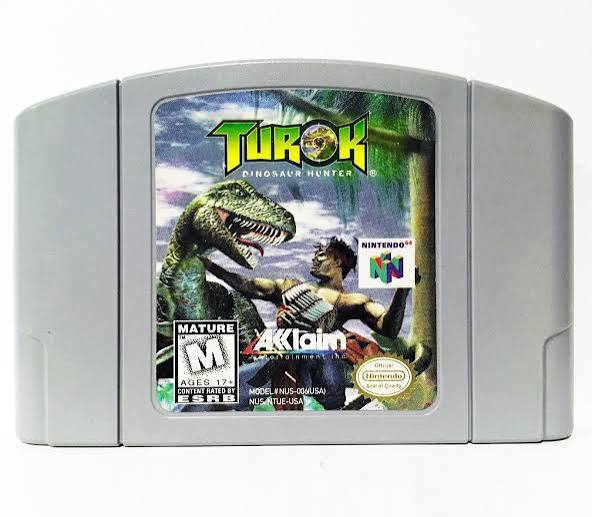
Diddy Kong Racing was another game that was just bizarre, but really fun. I also remember it having some pretty hard M rated games like Turok and how ridiculous some of it got like Turok 2 and the Cerebral Bore lol.

I played the PS1's games whenever I went to my uncle's house, but I never had one myself so I didn't have a whole lot of opportunities to play them as a kid, but I did play a lot of the old PS1 FF games on my PS2 though.
 
PS1 was awesome, but the N64 was my childhood.

Fucking shame we'll never see that level of diversity of games from Sony from now on.

It is great that games like Suikoden and Tactics got remakes, but the originals need to be preserved too.

Companies today would unfortunately rather infinitely remake new versions of these games (with changes sometimes in conflict with artistic choices of the originals) to resell over and over, than provide access to the originals in perpetuity.

Like I love what Capcom's doing with RE, and games like RE4 and CV (and hopefully RE5 in the future) getting remakes is okay since those games never got one. But I don't see a reason to remake the original RE yet again. They'll probably do it, though.

The N64 was no slouch when it came to great games. Ogre Battle 64 alone is worth the cost of entry, I played through it some month ago. All it needed was some menu refinement/QoL and it would be a stone cold classic.

I'm interested in playing this one some day, but first I have to complete the Shining Force III series (at least Scenarios 1-3; almost done with Scenario 2). Have heard some great things about Ogre Battle 64 and by default seems like the N64's best RPG experience.

Holy Heck. I didn't have any of these. I skipped a bunch of consoles it seems.
PC for many years.

DOS-era and early Windows (3.1, '95, '98) were filled with a shit ton of classics so I'm sure you were happy either way. I'd of liked to have played more of them when they came out, but we didn't even get our first PC until like 2001-2002 🤣.

So it was just console gaming until then (and mostly after; I mainly just played Newgrounds stuff on that PC). Genesis, PS1 & N64 😎
 
I loved my N64 - Mario 64 was insane to see and Jet Force Gemini was fantastic .

BUT I had to vote for PS1, FF9 and Metal Gear Solid were unbelievable experiences and that console boot up intro still gives me goosebumps.
 
I picked the Nintendo 64, just because it was the only one I really owned, and it was the console that got extra playtime because of how many great local multiplayer games I played with my friends. No one I knew who had a PS1 had the multitap to play with more than 1 other person.

That said, looking back the PS1 had the superior library in both breadth and variety, and with the dualshock controller added later the better pad. Technically I had the later mini-model for a short period, before young me learned the PS2 was gonna have backwards compatibility...then my parents sighed and returned it to get that. Most of the PS1 games I played through at friends' houses until I got the PS2.
 
(Link to Part 1)

[AVGT: 5TH GEN (PART 2)]

==================================================================


[1992]

[JANUARY]

image-asset.jpeg


The struggling TurboGrafx-16 finally catches a break.

>The trail run of Michael Katz's "Operation Turbo Mode" has turned out to be a hit. Despite only having one retail partner to help implement it (Toys 'R Us), the numbers generated are strong enough to convince superiors back in Japan to bring the PC-Engine Duo (recently released in Japan back in October 1991) to American shores.

Total American install base for the TurboGrafx-16 by EOY 1991 stood at 1.1 million units, out of cumulative lifetime shipment total of 1.3 million (for reference, in OTL TG-16 sales estimates in America by at earliest mid 1991 (likely EOY 1991) are said to be around 750K, out of a probable lifetime shipment total of 1.22 million). Internal guidance from the TurboGrafx-16 group were hopeful, putting the system at1.6 million sold-through by EOY 1992 for the market (conservative).

While these were modest compared to what SEGA were putting up with the Genesis (not to mention the success of Nintendo's recently-released SNES to the North American market back in Fall 1991), the OTM trail run managed these with a limited budget. Relative to that budget, the numbers were fantastic, and Katz's strategy ensured that the majority of purchasers over the holidays were to become dependable long-term customers in the ecosystem. Compared to the chaotic big-box buyback strategy SEGA relied on for Genesis (doing so at greater intensity post-SNES launch), Michael Katz's OTM stressed a more measured & stable fiscal strategy, one right in line with the conservative fiscal leanings of NEC Corporation back in Japan.

With "Operation Turbo Mode"'s trail a success, Michael Katz endears himself to Keith Schaefer, Tom Martin, and Hisashi Kaneko, getting approval to push ahead with some of its other aspects. Of the immediate moment, Katz seeks to get other retail partners on board to carry TurboGrafx stock in their stores, using OTM as a means of currying favor. He alongside Keith Schaefer are also preparing (with help from Tom Martin, on direction from Hisashi Kaneko) to outline and detail their results from the holiday trail run, and present them in a video conference call with NEC Home Electronics executives in Japan (the details of this report will back up the preliminary data sent in December 1991 and early January 1992). The full results of this data & presentation plays directly into what actions the Japanese side approve for the team in America.

As well, one of Katz's other actions in this month is helping come up with a new name for the TurboGrafx-16 Group, to that of Turbo Technologies Inc, as a renaming was already in the process by Keith Schaefer (along with a slight organizational reshuffling). The renaming would ideally help with purposes of branding among the public and communication with retail & publishing partners.

Keith Schaefer was also able to get a budget from Tom Martin (who in turn, is provided one from Hisashi Kaneko, who clears the decision with higher-ups at NEC Corporation in Japan) to seek additional revision to the unit. Unbeknown to Katz, Schaefer was quietly planning a career transition and planned to go work for Computer Curriculum Corporation as its President & CEO. The hiring of Michael Katz at the time back in 1991 was indeed for replacing a departing Ken Wirt, but Schaefer also wanted someone whom he felt could lead the TurboGrafx-16 group in his place, and seeing the initial Operation Turbo Mode trail run succeed solidified Katz as Schaefer's replacement.

[FEBRUARY]

images


An NEC PC-9821 multimedia computer. Think it a bulkier, less-refined version of what Project Tetsujin K aims to be.

>The Hudson Soft & HCG members working on Project Tetsujin K are further tasked by NEC to adapt components of the technology into an add-on card for the PC-98 computer line. In actuality, this was stipulated as part of the project initiative back in Late 1991, but active work on such begins February 1992.

Since this add-on card goes into main development later, it is not ready in time for the May 1992 presentation. However, due to the shared technology with Project Tetsujin K, the card has an expediated development pipeline, so that it can be ready for shipping by Late 1992, which becomes valuable in light of the "Compaq Shock" .

>Near the end of the month, the newly-renamed Turbo Technologies group back in America receive a set of directives from NEC Home Electronics executives back in Japan. The biggest of these decisions is that they have decided on Michael Katz to both lead the Turbo Technologies group altogether and function as NEC Technologies USA Inc's new President & CEO, which effectively pushes Keith Schaefer out of the picture. This would have been a shock, if Schaefer had not already expressed plans with Tom Martin back in Late 1991 of leaving for CCC.

Another decision was to in fact bring the PC-Engine Duo to the American market, letting Katz and the rest of the team come up with a name. The goal set was to have the system available to Americans by Late 1992 (either October or November), and for TTI to work with NEC USA's own Junji "Jim" Namiki in redesigning the look and certain parts of the PC-Engine Duo to keep it palatable with the American market (but avoid the overzealous redesign efforts of the TurboGrafx). It was starting to be known at the time that rival SEGA were gearing up for their own CD-based system, SEGA CD, to reach American shores by Late 1992. NEC wanted to either beat them to the punch or arrive at a similar time frame.

A final decision was set in terms of budget support for the TTI group, with a larger-than-expected funding provision. However, a hefty chunk of this came from Hudson Soft headquarters in California, as Hudson Soft had a vested interest in seeing the TurboGrafx platform succeed in the West and were equally impressed with Michael Katz's work in the OTM trail run.

With the growing expectations and PC-Engine Duo (to be renamed Turbo Duo for the Americas) mounting, however, Katz knew that he'd need to expand TTI in order to handle the load. This, especially since Keith Schaefer was now departing. Michael would get the help he'd need soon enough.

>While Hudson Soft & the HCDDG work on Project Tetsujin E (aka PC-Engine's successor), NEC Corporation's Semiconductor Solutions Division (SSD) are approached by SEGA of Japan for a possible deal. SEGA of Japan's home consumer design group, led by Hideki Sato, are interested in using the recently-revealed V810 RISC CPU in the company's in-development successor to the MegaDrive, currently going by internal codename GigaDrive. While NEC Corporation's Home Electronics group is actively working on the PC-Engine's successor (which, in turn, is naturally a rival to GigaDrive), NEC's SSD functions independently of the Home Electronics division, therefore can arrange deals separate from them even if that means doing so with a direct competitor.

The discussions between the SSD and SEGA of Japan are isolated and unknown to the Home Electronics division, therefore unknown to Hudson Soft and the HCDDG. SEGA of Japan are also weighing options of using the V60 as an alternate CPU; in fact, SEGA of Japan's AM2 had already arranged a deal with NEC's SSD to provide the V60 as the CPU for the upcoming Model 1 board, so it was natural if Sato's team came to know of this and took the V60 under consideration for GigaDrive.

Due to the nature of these talks, neither the Home Electronics division, HCDDG, or Hudson Soft would learn about SEGA's GigaDrive potentially using an NEC-based CPU until later in the year, via rumors in the press. Adding insult to injury, legal arrangements between SEGA of Japan and the SSD prevented the parties from getting any details or confirmation of the rumors, and would continue until far into Late 1993 (when SEGA of Japan officially reveal the Saturn in September alongside their partnership with another CPU provider, NEC rival Hitachi).

[MARCH]

>An internal debate carries on within NEC Home Electronics Ltd back in Japan, as to what timeframe is best for bringing the PC-Engine's successor to market. Given the current date and progress, they feel the successor could be ready by Late 1992 or Early 1993, but that period is looking to be occupied with the Project Tetsujin K. The market targets for Project Tetsujin K and E are different, but the marketing department within the Home Electronics division are concerned about competition among product offerings sharing a large amount of similar components, plus manufacturing costs for Project Tetsujin E at volume for a proper launch. They are also concerned that costs for a PC-Engine successor in Late 1992 would be nowhere near low enough to make it attractive to the market; even if the current plan is to have Project Tetsujin E serve the enthusiast slice of the gaming market, there is no gauge as to how large that segment actually is, or if NEC are already serving that segment with things like the recently-released PC-Engine Duo (thus suggesting those customers would not be interested in upgrading yet again only a year later).

Additionally, there is trepidation in pushing a PC-Engine successor in Late 1992 given the company has solidified plans to bring PC-Engine Duo to America; a Late 1992 or even Early 1993 Japanese release for a PC-Engine successor could create complications for TTI if they have to bring that to America in 1993 (both from a costs perspective and messaging POV); the Americans do not have experience with disc-based gaming on the level of the Japanese, and overburdening them right out of the gate could negate what growth their gaming operations have seen in America over the Late 1991 period.

For these and other reasons, Hudson Soft & the HCDDG are ultimately given a reprieve of sorts, as internal targets for bringing the PC-Engine's successor to the Japanese market are pushed back to Late 1993. This should give the teams more time to refine performance capabilities of Project Tetsujin E in relation to Sharp's X68000-CC and Fujitsu's FM Towns Marty, alongside SNK's Neo Geo AES, and figuring ways to do so while driving down expected costs to manageable levels. Both groups are eager to ensure that Project Tetsujin E either effortlessly competes with or outcompetes with the aforementioned systems (or SEGA's MegaDrive successor, which is currently in-development and rumors of which started circulating as far back as Late 1991).

[APRIL]


A recent Youtube interview featuring Steve Garwood himself. A must-watch if you want a detailed timeline of Turbo Technologies OTL.


>Steve Garwood, an individual with deep previous experience having worked at Universal Music & Video Distribution, is hired by Michael Katz to become the new Vice President & General Manager of TTI (previously known as the TurboGrafx-16 group). Garwood's name would come up as his employer of the time (a device & equipment manufacturing company with a regional retail chain) had someone high-up who came to know of Michael Katz through Keith Schaefer, and recommended Garwood thanks to his experience with Universal and, therefore, inherited knowledge of music & home video disc-based media supply chains. This would be sorely needed for the impending Turbo Duo, and Katz's media experience was limited to cartridges and the toy market.

That said, the employer who recommend him also get a perk out of the hiring, as they get a cut out of sales of products handled by TTI. Garwood's areas of expertise complement those of Michael's own, and will prove beneficial going forward with getting key software for the Turbo Duo alongside fine-tuning Operation Turbo Mode so it can be better leveraged in getting some of the larger, more nationwide retail chains to carry TurboGrafx and Turbo Duo products (and, all things going well, NEC's 32-bit successor).

[MAY]

rectangle_large_type_2_2cea1e091cb98cf57b4d3f1f9ecd5945.jpeg
DODxsLZNOVVUrQEm.png


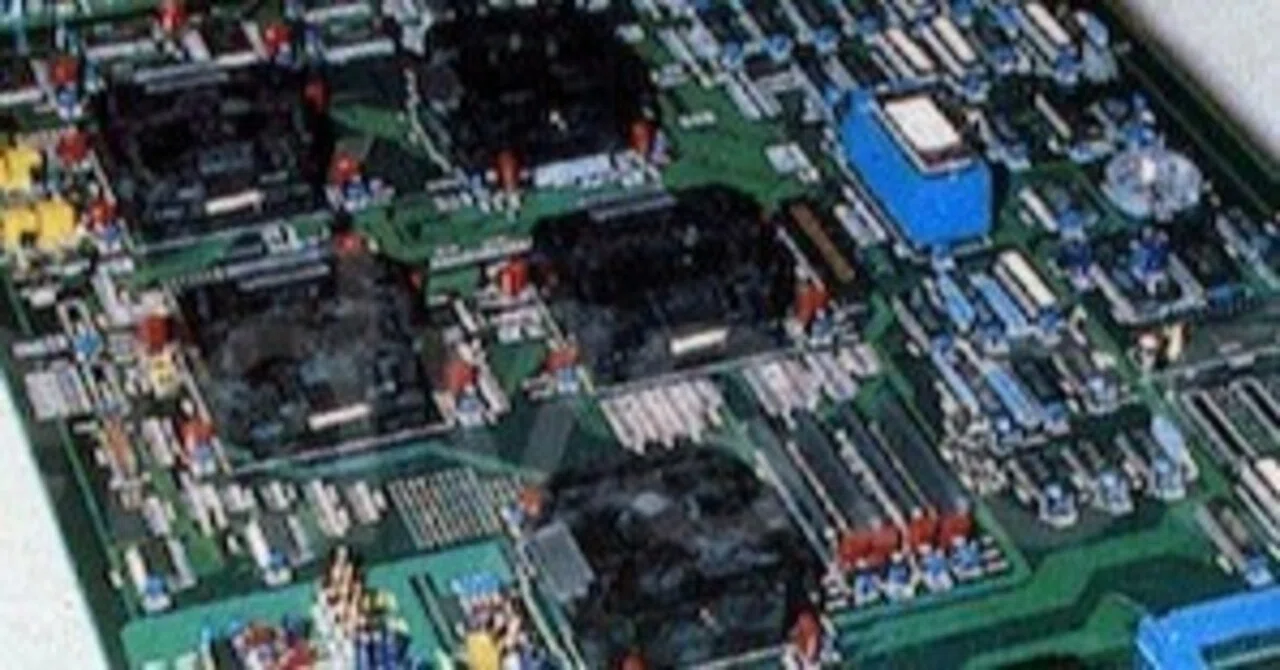
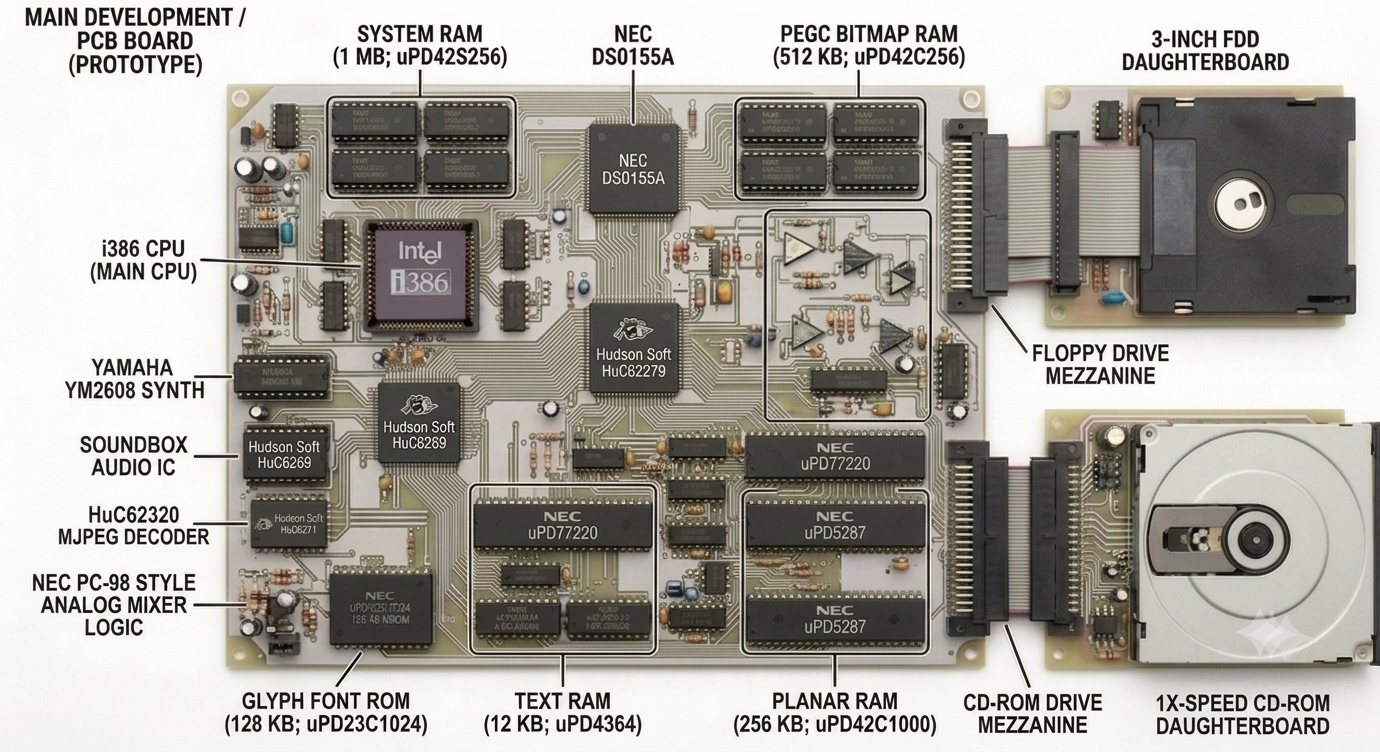
Initial Project Tetsujin K prototype board from May 1992 reveal event (left); more refined, near-final image of Project Tetsujin K integrated component board (right)

>Project Tetsujin K is revealed to press in May 1992 as an early prototype, positioned as an entry-level PC-98 compatible design via a multimedia system, and is specifically stated to NOT be a successor to the PC-Engine, though it shares some technology of a successor which is still in active development.

It features an i386 CPU (20 MHz), 1 MB of system RAM (upgradable to 8 MB), a 3-inch 2HD FD (floppy drive), 1x-speed CD-ROM drive, a PEGC blitter clocked at 15 MHz, HuC62320 CPU (manager slave CPU) clocked at 10 MHz, HuC6271 'Rainbow' MJPEG decoder, King ASIC (with 4x background scroll layers support), Soundbox audio processor (2 ADPCM/CD-DA channels + 6 PSG channels), Yamaha YM2608 FM synthesis chip, 2x uPD7220 display controllers (the PEGC blitter sits in compliment to them), 12 KB text RAM, 256 KB planar RAM (slave uPD7220 display controller), 512 KB PEGC graphics bitmap RAM, an analog mixer circuit (for the uPD7220s and PEGC blitter chip), 1x File Bay, and 1x Expansion Slot (located on the bottom, requiring the Expansion Docket), plus a glyph font ROM.

It also includes ports for a keyboard and a mouse, and a single PC-Engine style controller port. Lastly, since it's intended for a living room space, monitor support is replaced with a television out support, via RF, Composite, and S-Video. Questions regarding a release timeline for the Project Tetsujin K asked at the event are not directly answered; this is mainly due to NEC themselves still being unsure if the Late 1992 timeframe will be maintained.

*'Tetsujin' is Japanese for 'Iron Man'

[JUNE]

>While NEC originally intended for the Project Tetsujin K, now officially known as the PC-98 Kantan-I, to hit a Late 1992 date, some production issues end up forcing them to delay its launch into Early 1993. As an internal delay, the nature of the delay itself is never mentioned to the press; rather, NEC simply provide a release timeframe announcement for the PC-98 Kantan-I, stating it will be available to the market in Early 1993.

Alongside this, announcement is made of the equivalent add-in card for PC-98 computer systems, titled the PC-98 Kantan-EC, which currently has a release timeframe of Late 1992. Further details on the card alongside a reveal of the final design are set to be provided in successive press releases. However, it is widely expected that the EC will retain all of the performance features of the Kantan-I, just without the PC-98 components (since it will slot as a card in PC-98 systems directly).

*'Kantan' is Japanese for 'Easy'

(Link to Part 2 (2 of 2))
 
Last edited:
(Link to Part 2 (1 of 2))

[JULY]

>The HCDDG (Home Electronics + Hudson Soft engineer staff) continue working on the Project Tetsujin E design through the rest of 1992, iterating on its specification and measuring it up against the capabilities of the upcoming Sharp X68000-CC and Fujitsu FM Towns Marty. During this time, the design is not necessarily under the pressure to act as a means of potentially combating the increasing encroachment of DOS/V IBM PC-compatible clones in the entry-level side of the market at the low-end, as that's what the PC-98 Kantan-I is there for. However, this will start to change around mid-1993, which causes a further delay of the PC-Engine successor into the market (and is what galvanizes the creation of the Arcade CD-ROM^2 HuCard for PC-Engine Duo & TurboDuo).

Also at this time, PC-Engine BC is not planned for its successor, as senior executives at the Home Electronics division envision a future where the onboarding from PC-Engine to its successor is a bit more gradual (they still see the 16-bit and 32-bit markets as two separate markets). However, the impending X68000-CC is seen as a target to beat, while leveraging as many shared components of the two Project Tetsujin designs as possible to keep production costs of the console low.

[AUGUST]

MhPdpjWzorCY8hjY.png


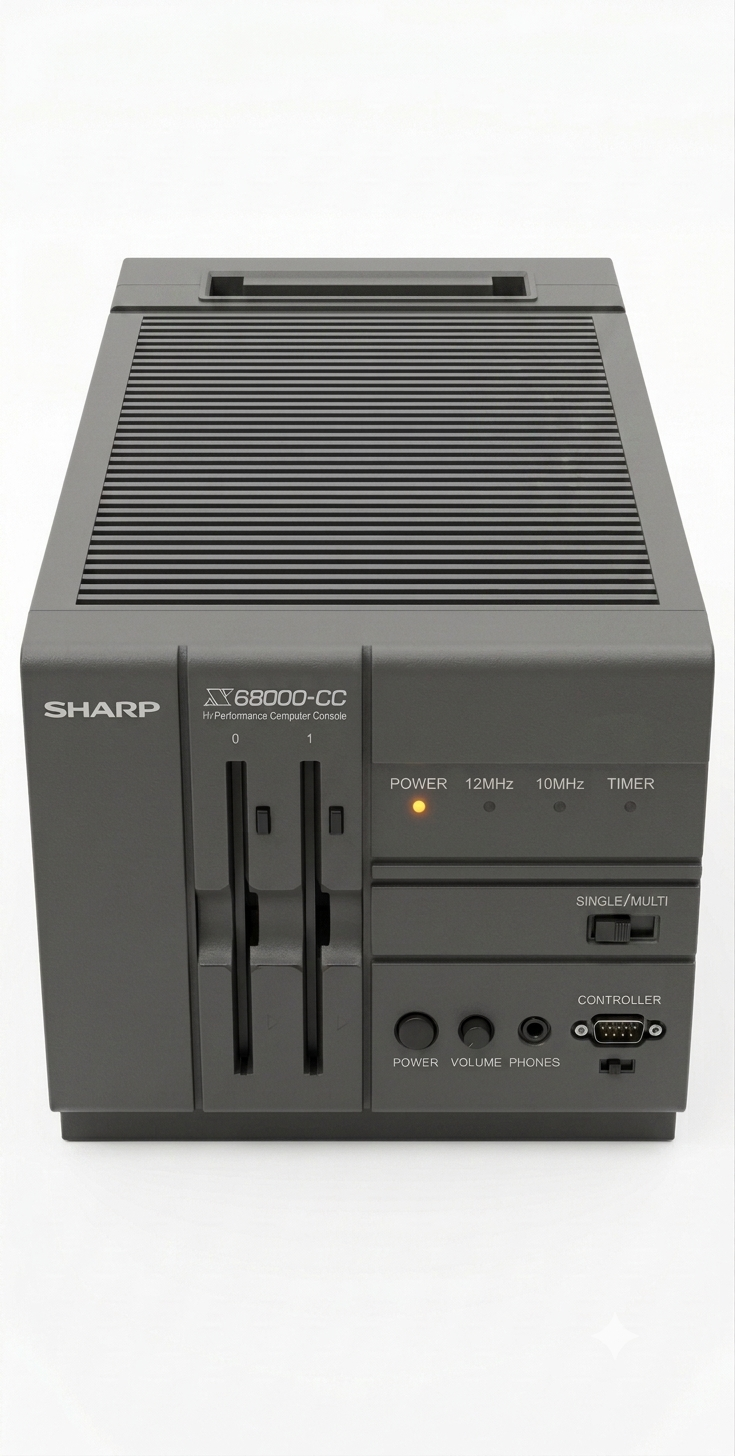
Sharp's X68000-CC (final, retail-ready design)

>The Sharp X68000-CC is released in August 1992 exclusively in Japan. It features a Motorola 68000 CPU @ 12 MHz (main CPU), Zilog Z80 @ 4 MHz, 1 MB of main CPU RAM, 1.064 MB VRAM (SRAM), an Enhanced Cynthia chip supporting up to 256 hardware sprites per frame, 65K palette (16-bit color) with up to 32K on-screen, Yamaha YM2151/OKI ADPCM/MIDI with 64 KB of audio RAM, a 2x-decked 2HD 3.5" FDD (floppy disc drive) and 2x cartridge slots (1 slot for a System BIOS ROM cart (1 MB ROM containing the Human68K OS + I/O Control System, 2 MB 'Silicon Disk' and File Compression ASIC), 1 slot on back for proprietary expansion chassis to fit in 96-pin X68000 add-on cards), plus a more standard dock for I/O. The proprietary expansion chassis allows for, among other things, a planned CD-ROM drive from Sharp that functions as an external drive, but can be physically integrated to "appear" as an internal system component.

Sharp prices the X68000-CC for an enthusiast gamer market, at around ¥150,100, or ~ $1199. It is positioned as an entry market point for gamers who are interested in X68000 titles but in a more console-like environment. What makes it particularly a threat to NEC, however, is that with the optional Master Cartridge, the X68000-CC basically becomes an entry-level X68000 at roughly $1,500, making them very competitive with the upcoming IBM PC-compatible DOS/V systems coming from companies like Compaq (i.e ProLinea) and cheaper than NEC's cheapest entry-level PC-9801 and upcoming PC-9821 computer products. What's more, preorder numbers for the X68000-CC have been surprisingly strong, at around 35K units, with Sharp projecting a potential shift of 75K units by the end of the year, which would represent almost half of ALL X68000 device sales from 1987 to 1992 on its own! Sharp are also positioning the X68000-CC as a rebrand of sorts for the X68000 computer line, and there are even rumors the company could be looking into a Western launch of the system with some cut-down features, at a later date.

[SEPTEMBER]

>In a somewhat late development, NEC have renamed the PC-98 Kantan-I (the standalone/all-in-one unit) to simply the PC-98 Kantan, while the 'I' sub-branding has been applied to a lower-cost (and lower-performance) version of the add-on card for PC-9801 and PC-9821 computer systems that will see its releases shortly after the higher-performance version of the card, still named the PC-98 Kantan-EC.

Apparently, the nomenclature changes were made the previous month, but news only gets out in the one following.

[OCTOBER]

images


The Turbo Duo sets its sights on the lucrative American gaming market

>TTI bring forth the Turbo Duo to American shores. Releasing in close proximity to SEGA of America's SEGA CD, the Turbo Duo retails for a similar price but has the advantage of fully integrating the TurboGrafx-16 hardware into its design (the SEGA CD is merely an add-on that still requires a Genesis, therefore an additional cost expense). As well, for users who picked up a $50 voucher late last year and up through Summer 1992 via purchasing a 1-year subscription to Turbo Worlds with the purchase of a TurboGrafx-16 (customers who already had registered TurboGrafx-16 units prior to Operation Turbo Mode starting were grandfathered in for a voucher throughout H1 1992 retroactively), the cost of a Turbo Duo to them would effectively be $249, making it an even better proposition versus the SEGA CD.

In spite of this, TTI made sure to also have a good supply for TurboGrafx-16 systems present as a lower-cost entry into the ecosystem; by the time of Turbo Duo's launch the group also managed to get KB Toys onboard as an additional retail partner for Operation Turbo Mode, and were within reach of netting a deal with CompUSA for similar. An additional layer was also in the process of being added to the plan wherein TurboGrafx-16 owners subscribed to Turbo Worlds and enrolled in a future membership plan (managed in conjunction with retail partners) could trade up to a Turbo Duo at a reduced cost.

Paired with a respectable (if modest) advertising campaign, and enhanced versions of Jackie Chan's Action Kung Fu (Turbo Duo version with larger graphics variety & Redbook audio OST) & Dungeons & Dragons: Order of the Griffith (Turbo Duo version is available November 1992), the Turbo Duo sees a decent launch. Combined with TurboGrafx-16, the platform's lifetime sales by EOY 1992 in the United States reach just shy of 2 million, beating internal guidance by roughly 400K.

[NOVEMBER]

NEC-SUPERTOWER.jpg


A commanding view of NEC Corporation's "Supertower" in Minato, Tokyo, Japan

>NEC finally releases PC-98 Kantan-EC (Extension Card) for PC-9821 computer systems. This card focuses on MJPEG video decoding capability, including the Hudson HuC6271 'Rainbow' MJPEG decoder, the 'King' ASIC (with 4 background scroll planes support), 2 MB KRAM*, and the Soundbox (with its 2 CD-DA/ADPCM channels + 6 PSG channels). As it is aimed at video production, the card also has the HuC62320 CPU onboard clocked at 15 MHz and afforded with 2 MB of main RAM; the King ASIC (controlled by the HuC62320 CPU) has an interface to a 1 MB ROM (storing video processing algorithm routines) and both outputs to a monitor (or optionally, standard CRT), plus analog Composite and S-Video input ports. It does not feature the VDC mixer, HuC6270 VDCs, and other similar chips. Priced at ¥44,200 (~ $349), it is meant to accelerate MJPEG FMV playback but mainly positioned as a premier video editing add-on card.

*A higher-priced version includes 4 MB of KRAM vs. the entry card's 2 MB.

NEC hope that the combination of the PC-98 add-on cards (Kantan-EC, Kantan-I) and Kantan will drive the future development of video production with MJPEG-compatible file formats, and consumer market uptake of said content. Hence, the add-on cards (PC-98 Kantan-I+ PC-98 Kantan-EC) and the multimedia-centric computer device (PC-98 Kantan). NEC's HCG also work with the HCDDG (comprised of members from the Home Electronics division and Hudson Soft) to develop library tools and extensions for the Rainbow MJPEG decoder and King ASIC, though it takes some time throughout 1993 for these to become more widely available to PC-9821 software developers, who in the meantime are provided documentation on the two chips.

*A small number of smaller Japanese video houses and a couple of mid/small-sized anime production companies do release compatible CD-ROM content on PC-9801 & PC-9821 computers that make use of the PC-98 Kantan-EC and PC-98 Kantan-I cards. One of the anime production companies in particular releases something of a small, original anime music video compilation project produced by J.C Staff.

This starts what develops into a more solid relationship between NEC and J.C Staff, leading to the eventual creation of a novel peripheral device for the PC-Engine's successor a few years down the road.

>Sharp releases the awaited Master Cartridge peripheral for X68000-CC during this month. The Master Cartridge implements a new BIOS ROM with the Human 68k and I/O Control System fully present, alongside a 2 MB Silicon Disk and a File Compressor ASIC (effectively making the 2 MB Silicon Disk into a 4 MB Silicon Disk).

With it, the X68000-CC is able to transform into a more fully-operational X68000 computer, and THIS is why the X68000-CC was considered a problem by NEC. The combination of both it and the Master Cartridge come to a price point much cheaper than any of NEC's current PC-98 offerings, and this is compounded by the aggressive push from companies like Compaq with cheap DOS/V computer products (ProLinea and its impending successor, the Presario).

[DECEMBER]

tetsujin_header.jpg


Early (pre v.1.2) prototype board of Project Tetsujin E

>With design work on the Kantan products wrapped up, Hudson Soft & NEC's HCDDG group have been able to put progress from that project back into Project Tetsujin E, which is still set for a Late 1993 launch in Japan. The past several months have given rise to the current system spec (Project Tetsujin E S/v.1.2), which has the following specifications:

-HuC62320 CPU @ 20 MHz (12.8 MIPs); 16x 32-bit registers, 32 x 24-bit fixed-function multiplier w/ 32-bit accumulator, 5-stage pipeline, 1 KB instruction ROM + 512 byte data cache (direct-mapped); 32-bit addressing space and integrated 2-channel DMAC alongside 32-bit external system bus running at 1/2 processor clock

-2x HuC6270 VDCs (64 sprites each, background tile support each) @ 10 MHz with 128 KB VRAM each

-1x HuC6271 'Rainbow' MJPEG decoder with dual-path decode multiplexer logic; can either write contents to King ASIC's KRAM or send data to VDC Mixer. This is an enhancement over the 'Rainbow' in the PC-98 Kantan products, which only write decoded contents to King ASIC's KRAM.

-1x Soundbox audio chip with enhanced PCM support (4x channels)

-King ASIC @ 20 MHz; still retains the 4x background layer output support, adds some logic for macroblock cropping & tiling + linear affine transformation of macroblock tiles & VDC sprites

-2 MB system RAM

-512 KB King ASIC 'KRAM'

-256 KB audio RAM

-1x-speed CD-ROM drive w/ 256 KB buffer cache

-512 KB BIOS ROM

-2x controller ports (serial)

-Serial/Parallel controller logic built into the King ASIC

-VDC Mixer + VCE chip with DAC and analog mixer circuit built-in (derived in part from the PC-98 Kantan project)​

Initial prototype boards (using a preliminary BIOS ROM, in-circuit emulation for the VDC Mixer + VCE chip (as it's incomplete) plus parts of the King ASIC logic (not integrated into the ASIC yet) and an additional 4 MB of RAM for testing purposes, begin assembly in late November 1992 through December 1992, with further prototyping plus demo builds to test hardware features (beyond simulation results) starting in January 1993. At this point a Late 1993 Japanese launch is still in play.

48722.jpg


The X68000-CC has reinvigorated Sharp's home computer sales in the Japanese market

>Sharp X68000-CC sees strong sales in Japan, hitting 130K by EOY 1992, near 2x earlier projections from Sharp. This equates to ~ 26K units per month. The solid market performance causes Sharp to increase forecasts for the X68000-CC to reach >200K by June 1993, and hopes of 300K by end of December 1993.

This puts further pressure on Fujitsu for the FM Towns Marty, and NEC with the PC-98 Kantan. For NEC in particular, the combination of the X68000-CC's success and the "Compaq Shock" starting to take effect, increases pressure on the Kantan product line to perform and act as a boost for PC-88 and PC-98 going forward.

==================================================================

And this concludes Part 2. As you can tell, Part 2 was HEAVILY NEC-focused; when I originally wrote this timeline in the earlier iterations, I focused primarily on NEC (some also involved Namco as at one point, I had NEC and Namco working together until things fell apart and Namco then went with Sony), and so 1992 in particular being more or less focused on them is a consequence of that.

Granted, a lot of the TTI-focused stuff here was either new for today or rewritten some from what I had before, and some of the Sharp-related stuff is new, too. 1993 will be more balanced in detailed activity from a larger range of soon-to-be players in the 5th gen race, including of course SEGA, Sony, and some further happenings with NEC and Sharp. Maybe even 3DO & SNK will get involved? Well, 3DO kinda has to, since that is still a thing in this timeline, but there are going to be some big changes with SNK here. Nintendo will still be mostly MIA for 1993 tho outside of a Silicon Graphics partnership announcement, but there are going to be a few changes with them as well in the timeline for this generation.

The Project Tetsujin K prototype board wasn't exactly what I was aiming for; probably should've provided Gemini (yeah, used Gemini for that) a reference. If I had time I would've sketched something out for it I guess, because the CD-ROM drive is comically small; the X68000-CC render turned out more to what I wanted tho, so I'm happy with that. Once again, if you guys have any questions or ideas you'd like to throw in to elaborate on things (or if you caught any details mentioned here inaccurately or a consistency error on my part), please share them in the comments. Always fun reading what others have to say when it comes to this type of stuff.

Part 3 should be ready by Saturday; like I mentioned before I'll only really be able to post these on the weekends but can maybe edit in some corrections to previous posts or do some quick addendum post randomly through the week, if anything like that seems needed. Hope it's all been enjoyable so far and look forward to more. Peace!
 
Last edited:
My dad thought it fun to get as many consoles as possible, and I'm forever grateful for that, but we never had that entire list. I used the PSX the most, so that's my vote.

Edit: Also, the fuck is a Casio Loopy? Which one of you had one?
 
Last edited:
You know, given how things are currently going in the industry I sometimes get a bit weary and wish I hadn't spent so much time gaming and used my time more productively but then I put myself back to the PSone and PS2 days...

Not a single regret. I had such a great time with these consoles. So glad I was there to live through it. Shame it had to end but alas... all things do.
 
Last edited:

The list needs the 32X added and the Neo-Geo CD removed.

The 32X may have been an add-on but it was still a console with it's own unique games and was powerful enough to compete with the Jaguar and beat the Amiga CD32.

The Neo-Geo CD is literally a regular Neo-Geo (a 4th generation console) with a CD drive instead of cartridge. There's almost zero extra hardware to improve the games (other than the extra RAM to load the CD data and compensate for the lack of fast ROMs) and it doesn't even have it's own unique library other than a couple of CD only games.

This makes the Neo-Geo CD less eligible than even the Sega CD as a "next-gen" console because the later at least had it's own library and extra hardware to improve visuals and add extra effects that could make it's games look more modern. And if being an add-on is a deal breaker for you then just add the Sega CDX/Multi Mega/Wondermega, again more eligible than the Neo-Geo CD. So if the Neo-Geo CD is eligible then so is the Sega CD and even the PCE-CD while we are at it since that also does the same thing as the Neo-Geo CD (it's a regular PCE with a CD drive) and that one even has it's own library of games.
 
Last edited:
If sega partnered with Lockheed Martin ( the same people they made their arcade boards with) to create the Saturn. Ditched the second SH-2 CPU…… invested more in STI….. they would have kicked Sony and nintendos ass thoroughly on the games front.


That's all I have to say about 5th gen. Probably my fave gen after gen 6
 
Rofl, even now that I see it, I don't believe it:

I mentioned not knowing the Casio Loopy. Until I looked it up I had zero idea of what it was. Now on a Dutch tech site I find this video posted in an article today:
 
Last edited:
The list needs the 32X added and the Neo-Geo CD removed.

The 32X may have been an add-on but it was still a console with it's own unique games and was powerful enough to compete with the Jaguar and beat the Amiga CD32.

The Neo-Geo CD is literally a regular Neo-Geo (a 4th generation console) with a CD drive instead of cartridge. There's almost zero extra hardware to improve the games (other than the extra RAM to load the CD data and compensate for the lack of fast ROMs) and it doesn't even have it's own unique library other than a couple of CD only games.

This makes the Neo-Geo CD less eligible than even the Sega CD as a "next-gen" console because the later at least had it's own library and extra hardware to improve visuals and add extra effects that could make it's games look more modern. And if being an add-on is a deal breaker for you then just add the Sega CDX/Multi Mega/Wondermega, again more eligible than the Neo-Geo CD. So if the Neo-Geo CD is eligible then so is the Sega CD and even the PCE-CD while we are at it since that also does the same thing as the Neo-Geo CD (it's a regular PCE with a CD drive) and that one even has it's own library of games.

I've been thinking of that and you're the second person to recommend adding the 32X, and I understand the reasons why. Well, I guess I'll go ahead and add it in, tho personally I don't see it as a 5th-gen system. True, it has its own library of game, but as a system it can't function at all without being attached to the MegaDrive/Genesis. So to me that anchors it to the 4th gen, given the other reason being it was created to boost the Genesis's performance.

Neo Geo CD, IMO, still deserves to be considered a 5th-gen system. From my understanding, SNK originally intended it to have additional processing power packed in (Neo Star), but they were overly ambitious and quickly shifted from that to something doable. It may not be 3D-focused like PS1, Saturn, N64 or even the 3DO, but its 2D was better than every other system's that gen.

Comparison with Saturn 2D-wise gets tricky: Saturn could handle more "sprites" but those were software sprites handled by VDP1; if SNK altered Neo Geo CD's architecture so the 68K could actually access VRAM then it'd of had the same software sprite capability and at least matched Saturn on that front even with a weaker CPU because Neo Geo CD had a lot more RAM than the Saturn and coders could've used self-modifying code on the 68K (I'm sure plenty were already doing that with Neo Geo and MegaDrive/Genesis, Amiga etc.). Saturn would probably have the advantage in backgrounds though due to VDP2.

Going by the 2D capabilities alone, I think Neo Geo CD deserves to be classified as a 5th-gen system. It just wasn't a very long-lasting one and completely ignored any 3D functionality at all. Look at it another way: the Wii is still referred to as a 7th-gen system even though it's just a slightly more powerful GameCube with motion controls. And as a lesser example, we commonly call the PC-FX a 5th-gen system even though when you break it down, it's essentially a slightly modified SuperGrafx with MJPEG and a disc drive 🤷🏽‍♂️

My dad thought it fun to get as many consoles as possible, and I'm forever grateful for that, but we never had that entire list. I used the PSX the most, so that's my vote.

Edit: Also, the fuck is a Casio Loopy? Which one of you had one?

An ultra-mega failed console. And highly doubt anyone on here ever had one 😂. Maybe someone picked a Loopy up as part of their collection tho; that would be kinda neat.

If sega partnered with Lockheed Martin ( the same people they made their arcade boards with) to create the Saturn. Ditched the second SH-2 CPU…… invested more in STI….. they would have kicked Sony and nintendos ass thoroughly on the games front.


That's all I have to say about 5th gen. Probably my fave gen after gen 6

That would've been awesome if SEGA had done it, but Lockheed Martin weren't able to cost-reduce their graphics tech for the console market by 1994, and SEGA were gung-ho on not letting Sony go effectively unchallenged for a year or more. Sure, 3DO technically existed and it was doing kind of decently in Japan but it would've likely buckled under PlayStation very quickly, and 3DO was still a competitor for SEGA after all.

Ditching the 2nd SH2 would've only been possible if Hitachi had a robust SH-DSP (or just some high-performance DSP coprocessor) available at the time. Otherwise SEGA would've needed to complete the SCU DSP's design (might've necessitated a delay) or turn to another provider for a DSP coprocessor like Motorola, Sharp or NEC. Unsure how cheap they could've gotten anything of sufficient performance to crunch 3D math, but at least they'd of avoided the dual-CPU complications.

You put a lot of effort in this thread, lol wow.

Just the beginning, really. This one's gonna be running for a while.
 
Last edited:
That would've been awesome if SEGA had done it, but Lockheed Martin weren't able to cost-reduce their graphics tech for the console market by 1994, and SEGA were gung-ho on not letting Sony go effectively unchallenged for a year or more. Sure, 3DO technically existed and it was doing kind of decently in Japan but it would've likely buckled under PlayStation very quickly, and 3DO was still a competitor for SEGA after all.

Ditching the 2nd SH2 would've only been possible if Hitachi had a robust SH-DSP (or just some high-performance DSP coprocessor) available at the time. Otherwise SEGA would've needed to complete the SCU DSP's design (might've necessitated a delay) or turn to another provider for a DSP coprocessor like Motorola, Sharp or NEC. Unsure how cheap they could've gotten anything of sufficient performance to crunch 3D math, but at least they'd of avoided the dual-CPU complications.


I think that was one of there problems. and it didnt help that they already had Mega CD and 32X out there with little support. even those devices were poorly thought out. what they should have done is released the mega CD in 1993 but with the 32X hardware inside it. lets call it the mega CDX.... released in 1993 it would have had ports of Vf1 and virtua racing asewwl as ports of segas system 32 and super scaler games. such a device would have not only stolen any thunder from 3DO and the jaguar, but maybe also bought sega more time to release a properly sorted saturn at around the same time as the N64. instead of making last miny=te knee jerk reactions to the saturns design. around 95 I recall an edge news article stating, lockheed martin was ready to enter the PC GPU market with a chip called the Real 3D pro 100. they had screen shots of the demos in edge and it looked better than anything the N64 or PS1 could pump out. A variation of that chip could very well have ended up in a saturn that was primed to launch during the n64s launch time frame. combined with the saturns 2D graphics processing it would have been a fucking beast. That daytona usa port would have been a lot better than it was. along with better looking ports of all there arcade games on the saturn. they would have kicked some serious ass, in a generation where we was in the last days of the golden age of the arcade , but arcade games were still a big selling point. thats a machine that would have justified their initial asking price.


But that headstart and great biz choices by sony at the timne would have still made the PS1 the winner that gen i think. price, software, the marketing, their developer relations...sony came into the biz making all the right moves. but had segas timeline from the mega CD ( Mega CD and 32 X being launched as one add on for the MD instead of two seperate add ons...lockheed martin 3D chip and revised, more developer freindly arhitecture) to the saturn played out a bit diffently they would have at least had a better run in the 5th gen.
 
what they should have done is released the mega CD in 1993 but with the 32X hardware inside it. lets call it the mega CDX
I've had this thought several times aswell, one HW expansion with a condensed effort towards support and marketing. CD and more power in one go, with a slew of upcoming games, yes please.
 
I think that was one of there problems. and it didnt help that they already had Mega CD and 32X out there with little support. even those devices were poorly thought out. what they should have done is released the mega CD in 1993 but with the 32X hardware inside it. lets call it the mega CDX.... released in 1993 it would have had ports of Vf1 and virtua racing asewwl as ports of segas system 32 and super scaler games. such a device would have not only stolen any thunder from 3DO and the jaguar, but maybe also bought sega more time to release a properly sorted saturn at around the same time as the N64.

Actually thought of something similar at some point too, for this alternate timeline no less. Wasn't quite the same thing, but basically more the idea of a Genesis & CD integrated unit with the SVP chip integrated in there too. I mean, NEC did the integrated thing with PC-Engine Duo/Turbo Duo, so in theory SEGA could've definitely did it too.

But ultimately I don't know if the production costs & economics would've worked out for such a thing in even 1994, let alone 1993, because SEGA CD had extra hardware in it the CD-ROM for PC-Engine/TurboGrafx didn't. So SEGA's costs on that front were always higher as a result. A Mega CD with 32X hardware in it would've probably been $399-$499, and it would've had to be positioned as its own system (but maybe still retain MegaDrive BC similar to how MegaDrive did for Master System).

That's an interesting hypothetical, and that basically would've been a Western-style SEGA Saturn. Would SoJ have gone for it tho? I think that's ultimately where it'd probably not end up happening. They wouldn't have let SoA engineer their own hardware device of that scale specifically for the American & European markets, and SoJ already had GigaDrive in development which was functionally similar to a MEGA CD + 32X.

I think then, if SoJ were aiming for a Late 1993 launch of GigaDrive/Saturn, then they could've tried a simultaneous launch in the West (or at least America) and let that one lean on Genesis/MegaDrive BC to sell it. They'd basically have the Japanese market to themselves until Spring 1994 (3DO), and in America the only direct competition would've been Jaguar & 3DO. I agree that would've made things harder for Jaguar and 3DO, tho it'd of landed in the middle of them price-wise.

instead of making last miny=te knee jerk reactions to the saturns design. around 95 I recall an edge news article stating, lockheed martin was ready to enter the PC GPU market with a chip called the Real 3D pro 100. they had screen shots of the demos in edge and it looked better than anything the N64 or PS1 could pump out. A variation of that chip could very well have ended up in a saturn that was primed to launch during the n64s launch time frame. combined with the saturns 2D graphics processing it would have been a fucking beast. That daytona usa port would have been a lot better than it was. along with better looking ports of all there arcade games on the saturn. they would have kicked some serious ass, in a generation where we was in the last days of the golden age of the arcade , but arcade games were still a big selling point. thats a machine that would have justified their initial asking price.

Hmm...I'd have to get a look at that article. I can vaguely recall it, but I also always though Lockheed Martin were late in getting that card ready. Then when Intel partnered with them they ran in dev issues and the final tech was watered down, and that's what the i740 card ultimately ended up being.

But that headstart and great biz choices by sony at the timne would have still made the PS1 the winner that gen i think. price, software, the marketing, their developer relations...sony came into the biz making all the right moves. but had segas timeline from the mega CD ( Mega CD and 32 X being launched as one add on for the MD instead of two seperate add ons...lockheed martin 3D chip and revised, more developer freindly arhitecture) to the saturn played out a bit diffently they would have at least had a better run in the 5th gen.

Certainly true that it seemed Sony were almost destined to take the market at that time, tho I will stand by my belief that NEC & Hudson Soft could've messed that up if they had better organization & vision with PC-FX. Hell, even 3DO could've if EA committed to it with more exclusives and 3DO Company maybe partnered with just Matsushita/Panasonic on the hardware with a more traditional business model (basically repeating the NEC/Hudson Soft dynamic, but better).

Saturn could've absolutely been more competitive tho if they did the things you mention in terms of a friendlier dev architecture (single-CPU is a must), and different decisions with 32X etc.

If that's the case then why not add the regular Neo-Geo AES as 5th gen as well? It's the exact same console with carts instead of CDs.

Man, SNK out here making things difficult 🤣. I guess one reason I might be against adding AES is because, well, AFAIK SNK did not market that as a competitor for other 5th gen systems. They couldn't really, since it came out before practically all of them. SNK seemingly focused on it as a higher-tier Genesis or SNES, not as something to go up against PlayStation or Saturn, or even the Jaguar.

I did add the 32X, but I gotta think a little longer about AES. Plus it might ultimately be redundant since the Neo Geo CD is already there :/

I've had this thought several times aswell, one HW expansion with a condensed effort towards support and marketing. CD and more power in one go, with a slew of upcoming games, yes please.

In a way that's what SEGA CD already was, but it required a Genesis in order to function. I'm curious what could've been if SEGA made it a standalone unit that could also optionally work with a Genesis attached. That would've been kinda cool to see.

I will vote SNK anything when given the opportunity.

Gotta love 'em.
 
In a way that's what SEGA CD already was, but it required a Genesis in order to function. I'm curious what could've been if SEGA made it a standalone unit that could also optionally work with a Genesis attached. That would've been kinda cool to see.
I was thinking more of an HW expansion/unit that both had the power of the 32X and multimedia capabilities of the CD, released in '92 might've been optimal. But yeah, having it function as a standalone unit for CD32X games could've mixed things up.

But man, no matter how we dice it the decision to release the 32X so close to the Saturn really muddied the waters. Was it Sega USA that pushed for the 32X? Or am I remembering wrong?
 
I guess one reason I might be against adding AES is because, well, AFAIK SNK did not market that as a competitor for other 5th gen systems. They couldn't really, since it came out before practically all of them. SNK seemingly focused on it as a higher-tier Genesis or SNES, not as something to go up against PlayStation or Saturn, or even the Jaguar.
I don't think SNK marketed the Neo-Geo CD as a 5th gen competitor either, they were trying to solve the issue of Neo-Geo cartridges being incredibly expensive.

That's why you don't see this console in any other 5th gen consoles list.

But that's your list, ain't gonna argue more about it. Sorry for hijacking an otherwise good effort thread.
 
I was thinking more of an HW expansion/unit that both had the power of the 32X and multimedia capabilities of the CD, released in '92 might've been optimal. But yeah, having it function as a standalone unit for CD32X games could've mixed things up.

But man, no matter how we dice it the decision to release the 32X so close to the Saturn really muddied the waters. Was it Sega USA that pushed for the 32X? Or am I remembering wrong?

The whole 32X story is kind of complicated. SoA made the initial pitch, but IIRC SoJ's Nakayama was the one who mandated SoA to bring it about. Maybe SoA spooked Nakayama over the 3DO and Jaguar, and SoJ weren't ready to bring Saturn to America yet because maybe SoA convinced them Genesis had at least another year in it and an add-on was the better option.

So the way I see it, both branches are to blame for 32X. SoA should've known another add-on only two years after Sega CD was pushing it (but maybe they were thinking about the big box retail order numbers as making it lucrative?), while SoJ should've known that a Genesis add-on only one year before bringing Saturn to America would've been asking for way too much from the diehard fans.

I mean after all, SEGA were still releasing other devices during that time frame too, like the Pico, CDX, and Nomad. They were out there thinking they were an electronics company like Sony or Panasonic, and I think they forgot gaming didn't work that way back in the '90s.

I don't think SNK marketed the Neo-Geo CD as a 5th gen competitor either, they were trying to solve the issue of Neo-Geo cartridges being incredibly expensive.

That's why you don't see this console in any other 5th gen consoles list.

But that's your list, ain't gonna argue more about it. Sorry for hijacking an otherwise good effort thread.

It's all good dude; I know from your posts in other retro threads you've got a passion for this stuff too and can be particular at times, like many of us. You might have a point about SNK not pushing Neo Geo CD as a 5th gen competitor, but I remember (well, hell, I've been reading back-issues of late) magazines like Next Generation and Edge framing it as a 5th gen system.

So, maybe that's where my perception of Neo Geo as a 5th gen console come from, because I'm sure other magazines I read at the time like GameFan and EGM probably did similar.
 
The whole 32X story is kind of complicated. SoA made the initial pitch, but IIRC SoJ's Nakayama was the one who mandated SoA to bring it about. Maybe SoA spooked Nakayama over the 3DO and Jaguar, and SoJ weren't ready to bring Saturn to America yet because maybe SoA convinced them Genesis had at least another year in it and an add-on was the better option.

So the way I see it, both branches are to blame for 32X. SoA should've known another add-on only two years after Sega CD was pushing it (but maybe they were thinking about the big box retail order numbers as making it lucrative?), while SoJ should've known that a Genesis add-on only one year before bringing Saturn to America would've been asking for way too much from the diehard fans.

I mean after all, SEGA were still releasing other devices during that time frame too, like the Pico, CDX, and Nomad. They were out there thinking they were an electronics company like Sony or Panasonic, and I think they forgot gaming didn't work that way back in the '90s.
Having a "flood the market with our products" philosophy did work for some electronics companies, so it's not too damning that they went that way.

But with the luxury of 20/20 hindsight it probably would have been healthier to put that money into supporting whats already successful and/or into the next mainline console ...and let people build up a real hunger for it.

You're a fountain of information, thanks for sharing you wisdom. 😃
 
Great thread. Never knew Casio Loopy and A'can even existed! Googling them now. The last game mags I bought were somewhere in the mid/late 90s and I'm positive they never brought these up. Not even in their Japan/International gaming sections.
 
Last edited:
Having a "flood the market with our products" philosophy did work for some electronics companies, so it's not too damning that they went that way.

But with the luxury of 20/20 hindsight it probably would have been healthier to put that money into supporting whats already successful and/or into the next mainline console ...and let people build up a real hunger for it.

You're a fountain of information, thanks for sharing you wisdom. 😃
That Sega era back then was wild. Sega's R&D budget seemed unlimited.

Genesis
Game Gear
Sega-CD
32X
CDX
Nomad
Activator
Menacer
Neptune (unreleased)
VR goggles (unreleased)
Pico kids toy
Saturn
 
Last edited:
That Sega era back then was wild.

Genesis
Game Gear
Sega-CD
32x
CDX
Nomad
Activator
Menacer
Neptune (unreleased)
VR goggles (unreleased)
Pico kids toy
Saturn
The GG and the Nomad were such great ideas on paper. I remember wanting a GG but the first thing I heard about it was that it chewed through batteries like a mofo. And the gamer-boner I had for the Nomad has never been replicated lol.

But sadly the technology weren't really there yet, at least not while also keeping weight down and being somewhat competitive with pricing.

I'm just happy we have awesome retro handhelds now. So somewhere deep inside me there's a young, grinning, SomeNorseGuy living his best life with glorious handheld Sega games. 😅
 
Having a "flood the market with our products" philosophy did work for some electronics companies, so it's not too damning that they went that way.

But with the luxury of 20/20 hindsight it probably would have been healthier to put that money into supporting whats already successful and/or into the next mainline console ...and let people build up a real hunger for it.

You're a fountain of information, thanks for sharing you wisdom. 😃

Well, I can't say that fountain is 100% clean, there are definitely some details I don't know of or get mixed up at times 😂. And there are specifics on certain systems I'm sure others are more knowledgeable of than I. But I did pour a shit-ton of time into research for this, and it was convenient other developments have ben happening over the past year or so i.e news on the Saturn TRIP accelerator, or clarification on if the Aurora chip was ever actually planned for the PC-FX (it wasn't), etc.

As far as SEGA goes, I think if maybe they waited until later in the decade, particularly after maybe Gameworks took off, and if there wasn't a PlayStation to contend with, then they would've had a better go with that multi-device approach. They'd of been more cemented as a longer-term player and I think the customer base would've been more comfortable with the concept.

Though, I guess waiting too late would've dramatically changed the trajectory of some things. Home PCs were finally taking off because of Windows, and laptops were getting better & more affordable. By that point maybe instead of so many damn devices, SEGA would've boosted up SEGASoft similar to what Sony eventually did for Sony Online Entertainment, and just have SEGASoft be a PC-centric unit probably expanding out into PDAs. Think of them as another arm analogous to the home console and arcade units.

Ironically I think the Pico would've still happened; actually I think that's one of the few random devices SEGA made back in the day that had a real market to it as evidenced by players like Leapfrog picking up where Pico left off.

Great thread. Never knew Casio Loopy and A'can even existed! Googling them now. The last game mags I bought were somewhere in the mid/late 90s and I'm positive they never brought these up. Not even in their Japan/International gaming sections.

If you're interested, check these YT vids out. They get pretty in-depth on each system


This channel also has great technical vids on the NEC PC-FX


And this dude here has a SEGA Saturn video specifically about transparency, tho you might've seen that one already
 
Top Bottom