

Buggy Loop
Member
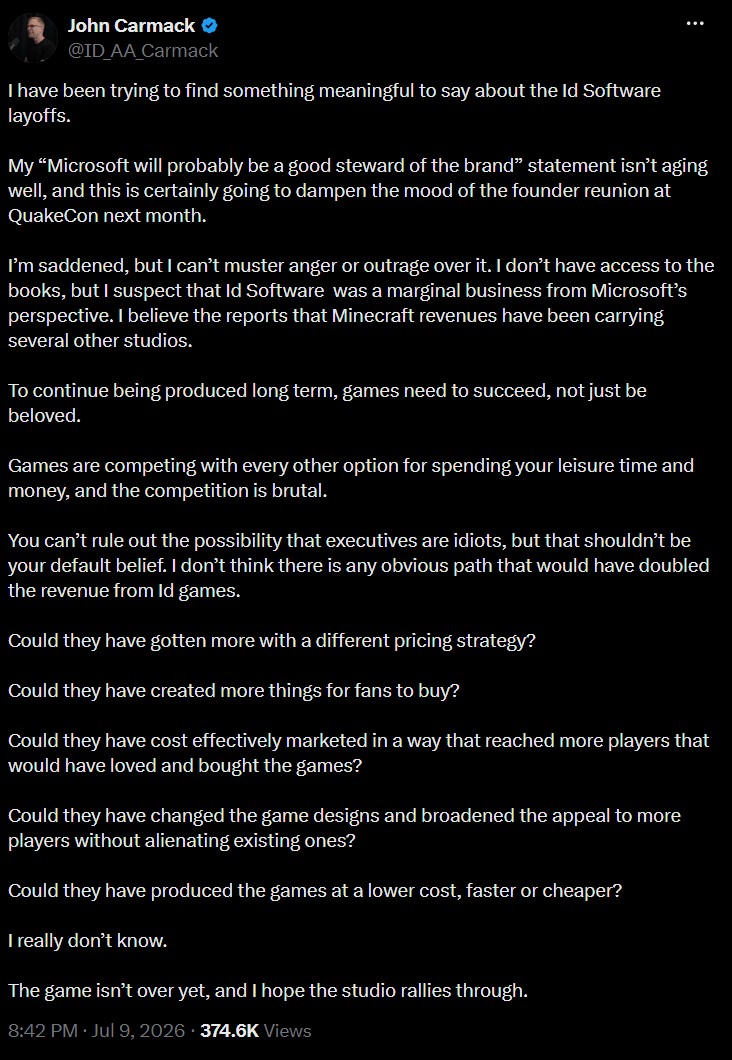
I think everyone wanted to see his reaction. It's quite down to earth I would say. No tables were flipped.


Those games would cost considerably less to develop.I'm going to disagree with Carmack on this one. My counterpoint? let's look at how other gaming companies operate. Specifically, let's look at Nintendo, possibly the most fiscally responsible of all video game publishers, certainly the most conservative console platform holder.
Do you think Metroid Prime 4 will lead to studio closures? Did Metroid Other M kill the franchise? How about games like Sin & Punishment or F Zero GX or even franchises like Star Fox?
None of those are major sellers, and certainly Mario Kart and Animal Crossing pay some of the bills for those studios.
Yet Nintendo understands they can't rely exclusively on its big hitters.
As far as I'm concerned, Nintendo's continued success is proof that there's nothing inherently wrong with Minecraft occasionally paying the bills for Doom.
All this proves is Microsoft are bad at running a software business in a highly competitive environment.Those games would cost considerably less to develop.
I think that's part of what is happening right now. MS are looking at ways to cut costs of development and consolidate IPs.
Sucks because it means less variety, and people losing their jobs but the alterbnative is for them to keep shovelling money into the pit.
I think they did a number of things wrong. Most of all giving the developers they control too much creative freedom at a time where it seems the 'creatives' are so far out of touch with the target audience (or what should be the target audience).All this proves is Microsoft are bad at running a software business in a highly competitive environment.
It's the sad truth, but they only know how to succeed when they operate in areas of business that allow them to offer essential (or nearly essential) services. They're closer to a utilities company.
MS have no clue what makes a good game. Their entire strategy is built around providing a framework and hoping the rest will follow. Hence the utility comparison. The framework is Xbox Live, Game Pass, etc.I think they did a number of things wrong. Most of all giving the developers they control too much creative freedom at a time where it seems the 'creatives' are so far out of touch with the target audience (or what should be the target audience).
In the case of ID, I think people probably overestimate the broad appeal of Doom. Doom 2016 was like a triumphant return, but I just don't think it has the legs to warrant a new release every few years.
Which is probably in part why they left it to the developers… turns out most of them didn't know either.MS have no clue what makes a good game. Their entire strategy is built around providing a framework a hoping the rest will follow. Hence the utility comparison.


Don't worry. MS applied for 5K H1B visas. I am sure that's going to fix everything.Microsoft is a multi-trillion dollar company that supports a failing business, i.e., Xbox.
ID software getting gutted is just business as usual for that company.
The developers know how to build good games within their area of expertise. That's not the same as running a successful publishing business.Which is probably in part why they left it to the developers… turns out most of them didn't know either.
What's the explanation for PlayStations GaaS chasing and gender swapping obsession?The developers know how to build good games within their area of expertise. That's not the same as running a successful publishing business.
There needs to be a layer of middle management that understands how games are made but also sees the bigger picture: the entire software lineup, the cultural impact of a coherent artistic vision, the social aspects of the broader message behind the content. Nintendo has this in their dozens of veteran producers because they were always an entertainment company and even when they were making playing cards they were in the business of competing for the customer's free time.
Microsoft doesn't understand this fundamental concept because it comes from a history of being an operating system monopoly.
I think Sony initially entered gaming with the mindset of an entertainment publisher which they inherited from their experience running a successful music label. A lot has been written about their approach to acquiring and managing talent in the days of PS1 and PS2, and that's where this idea is often mentioned.What's the explanation for PlayStations GaaS chasing and gender swapping obsession?

They definitely needed to diversify. Perhaps they were afraid of trying something new after Rage and Doom 3. It's a shame because I actually liked those franchises (I consider Doom 3 a different beast from the rest of the series, closer to an original IP).Would have liked to have seen them do a Perfect Dark after Doom (2016). It's a shame they wallowed on that franchise for so long. A studio trapped in Doom purgatory for 15 straight years, my God...


I think Sony initially entered gaming with the mindset of an entertainment publisher which they inherited from their experience running a successful music label. A lot has been written about their approach to acquiring and managing talent in the days of PS1 and PS2, and that's where this idea is often mentioned.
Starting with the PS3 generation they gradually became more and more like a Western publisher chasing trends rather than setting them. Chasing graphics which lead to rising costs also played a part in this. And they probably didn't see any other choice but to follow MS into online subscriptions which lead to gaming as a service.


