• Hey Guest. Check out your NeoGAF Wrapped 2025 results here!

[DF] Pragmata - PS5/PS5 Pro/Xbox Series X|S Tech Review - Another Big PS5 Pro Success

PSSR2 primarily uses INT8 inference, but unlike a PC-side INT8 implementation of something like FSR4.0, it does not inherently result in lower image quality compared to FSR4.1. In fact, INT8 inference is a well-suited and efficient choice for real-time game upscaling workloads.

For stages that require higher numerical precision, FP8 can be advantageous, but on PS5 Pro this role is likely handled with FP16 instead. The underlying algorithmic structure is essentially the same; only the precision format used in certain layers differs.

Don't bother, the next crusade of Sony haters is that FP8 is so much better that INT8, even if nobody could ever tell even the tiniest difference... :messenger_tears_of_joy: :messenger_tears_of_joy:

PSSR 2 made a lot of people salty or bitter, you know....
 
Last edited:
That graph is bugged, you can see 16GB version of 5060ti losing to 8GB version and regular 5060.

What's wrong with quality DLSS at 1080p? It is with Ray Reconstruction as well.
Because anything that doesn't use at minimum 1080p as the input resolution for Dlss looks bad to me. The texture detail degrades, the image just looks poor to me. I'm sure others have their own tolerance levels.
 
Because anything that doesn't use at minimum 1080p as the input resolution for Dlss looks bad to me. The texture detail degrades, the image just looks poor to me. I'm sure others have their own tolerance levels.

Dlss4 and 4.5 are absolutely fine with lower resolutions.

Same way that pro in this game has 864p internal res and still destroys base version using 1080p. I'm also using 40% scaling in PC version (to be able to play with PT and 60fps) and it's fine.

I think barrier is more psychological here (low number), current upscalers can do some incredible things with not that many pixels.
 
Dlss4 and 4.5 are absolutely fine with lower resolutions.
I disagree.
Same way that pro in this game has 864p internal res and still destroys base version using 1080p. I'm also using 40% scaling in PC version (to be able to play with PT and 60fps) and it's fine.
The pro version with 864p internal res does not look that good. Yes it looks better than the base ps5 but that has bad aa and no viable ml upscaler.
I think barrier is more psychological here (low number), current upscalers can do some incredible things with not that many pixels.
Again, I disagree. They do a better job than analytical AA. Better does not mean good. The lower the input resolution, the more the artifacts. People are judging image quality on just the AA. So if things look sharp, it looks "good" which is false. There are other aspects to image quality other than AA.
 
Last edited:
I mean fundamentally you just don't understand how neural upscalers work if you think there's a disadvantage to running the weights at INT8 vs FP8.

People need to stop talking so much and go educate themselves.
 
I disagree.

The pro version with 864p internal res does not look that good. Yes it looks better than the base ps5 but that has bad aa and no viable ml upscaler.

Again, I disagree. They do a better job than analytical AA. Better does not mean good. The lower the input resolution, the more the artifacts. People are judging image quality on just the AA. So if things look sharp, it looks "good" which is false. There are other aspects to image quality other than AA.
I can't tell if serious...
 
Sony never talked of unbelievable tech innovation when presented the PSSR
Yes, they did, back at Pro's unveil.

and they just dare to say pssr and fsr4 are 2 different algorithm with the same neural network
The "algorithm" there is the exact same since both take the exact same inputs and output the exact same output. See "Sony's lies" for further understanding.

I missed the part where you said Amethyst project is basically a paid exclusive for FSR4 tech. You have reached a new high here. Fuck.
Where's FSR4 INT8 version on PC? The code was in a working condition back when it leaked three months ago.

PSSR2 primarily uses INT8 inference, but unlike a PC-side INT8 implementation of something like FSR4.0, it does not inherently result in lower image quality compared to FSR4.1. In fact, INT8 inference is a well-suited and efficient choice for real-time game upscaling workloads.
It does and there are quality differences to FSR 4.1 running on RDNA4. Whether someone sitting 10ft from the TV would notice them is a different question.

For stages that require higher numerical precision, FP8 can be advantageous, but on PS5 Pro this role is likely handled with FP16 instead.
FP8 is not really higher precision than INT8 but it's better suited for handing graphics which is mostly FP math up until the frame buffer.
FP16 on PS5Pro is 8 times slower than INT8 IIRC.
 
Last edited:
Yes, they did, back at Pro's unveil.


The "algorithm" there is the exact same since both take the exact same inputs and output the exact same output. See "Sony's lies" for further understanding.


Where's FSR4 INT8 version on PC? The code was in a working condition back when it leaked three months ago.


It does and there are quality differences to FSR 4.1 running on RDNA4. Whether someone sitting 10ft from the TV would notice them is a different question.


FP8 is not really higher precision than INT8 but it's better suited for handing graphics which is mostly FP math up until the frame buffer.
FP16 on PS5Pro is 8 times slower than INT8 IIRC.
Can you show me an exact quote where sony said PSSR is an unprecedent upscaler in the market which will innovate the whole industry? .
Also you continue to give a lot of tech explanation but you omit smartly a lot of other stuff just to fit your narrative.
For example can you provide a real concrete data where FS4 and PSSR are showed to be same entity (better from a developer) or whatever outside your academic tech conjecture? Why sony should wasting time and money to just rebrand an upscaler when they can just leave to AMD the whole stuff and update their kit with the "normal" FSR4? (asked millions of times)
It's so weird see someone so invested so much to built a narrative around sony and PSSR marketing spin meanwhile for the Nvidia bullshits about the later DLSS5 showcase not show any sign of tha same despise or outrage.
 
Last edited:
To state that PSSR2/FSR 4.1 is an AMD development only isn't true. To state that PSSR2/FSR 4.1 is a Sony development only isn't true either.

It's not black and white, the truth lies somewhere in between.
 
I was going to leave a comment that had the potential to change the course of history, but the dogs just farted and I've forgotten what I was going to say.
 
FP8 is not really higher precision than INT8 but it's better suited for handing graphics which is mostly FP math up until the frame buffer.

That is true, for precision.
But FP8 has much greater dynamic range than Int8, which for a temporal upscaler, can result in slightly less ghosting, better history accumulation, better fine detail reconstruction in noisy regions, and slightly less banding.
It's not a huge difference, but it does exist.
 
I disagree.

The pro version with 864p internal res does not look that good. Yes it looks better than the base ps5 but that has bad aa and no viable ml upscaler.

Again, I disagree. They do a better job than analytical AA. Better does not mean good. The lower the input resolution, the more the artifacts. People are judging image quality on just the AA. So if things look sharp, it looks "good" which is false. There are other aspects to image quality other than AA.

Yeah, image quality is not just sharpness and AA. But Pragmata even with 864p internal resolution looks very clean with 4k output.


Even thin geometry is properly anti aliased.
 
Yeah, image quality is not just sharpness and AA. But Pragmata even with 864p internal resolution looks very clean with 4k output.


Even thin geometry is properly anti aliased.

With DoF disabled it looks ok. Capcom games are just static brick geometry so it's weird these games aren't 120fps on base ps5.
 
Yeah, image quality is not just sharpness and AA. But Pragmata even with 864p internal resolution looks very clean with 4k output.


Even thin geometry is properly anti aliased.

While you're on nvidia pc, can you check how that tram looks with dlss?
zZAP97O.jpeg

it's chapter 4 first fast travel. it's super blurry on fsr but smooth on native(native looks like ass).
 
Last edited:
While you're on nvidia pc, can you check how that tram looks with dlss?
zZAP97O.jpeg

it's chapter 4 first fast travel. it's super blurry on fsr but smooth on native(native looks like ass).

Interesting, I will check it out later.

Edit: It's blurry as fuck, looks like it lacks motion vectors.
 
Last edited:
FP8 is not really higher precision than INT8 but it's better suited for handing graphics which is mostly FP math up until the frame buffer.
FP16 on PS5Pro is 8 times slower than INT8 IIRC.
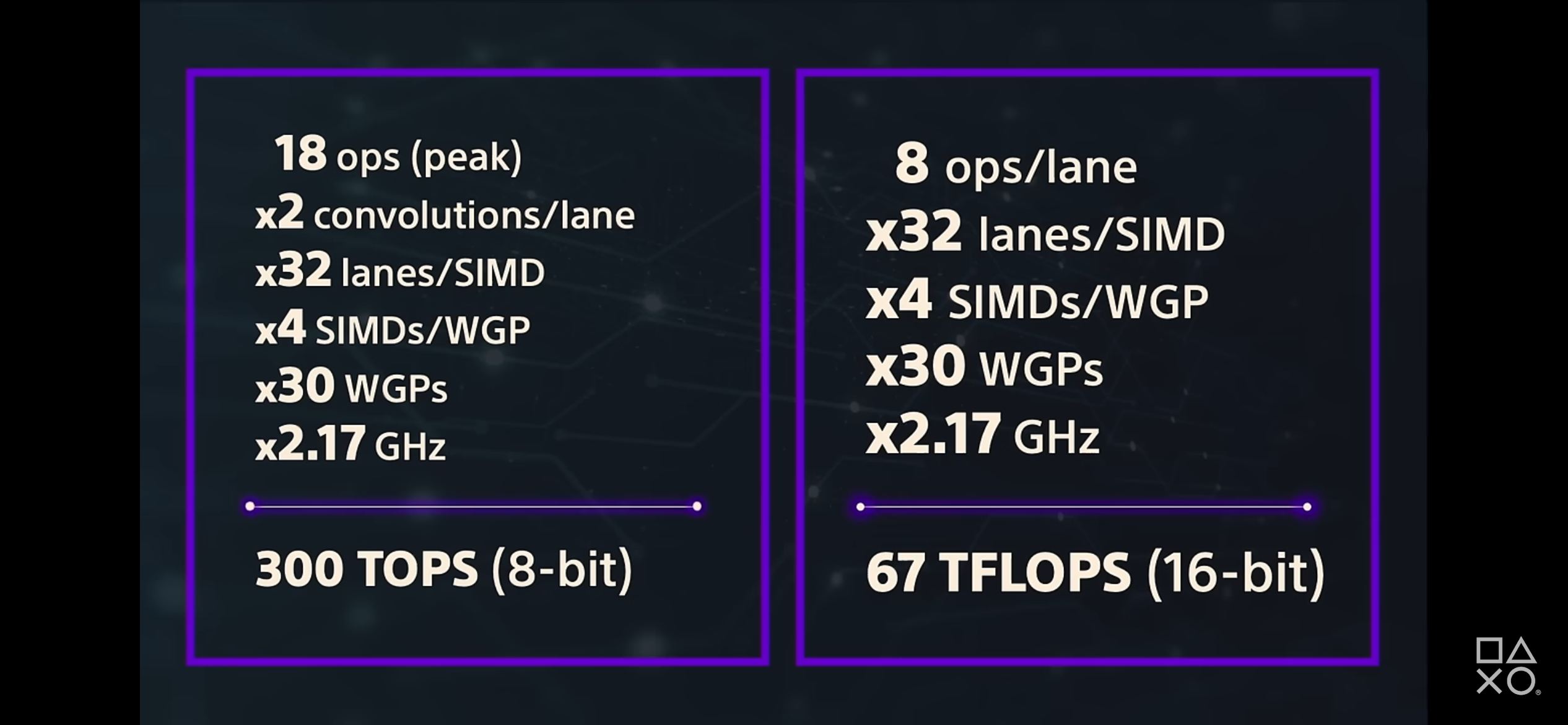
The PS5 Pro specs are often cited as around 300 TOPS for INT8 and about 66.7 TFLOPS for FP16 (with dual issue).

Given those numbers, how are you arriving at the "8x slower" figure for FP16?
I'm curious what assumptions or calculation you're using here, since it doesn't seem to line up directly with the raw throughput ratios.
 
The boiling, blotchy ray tracing is ugly to look at on the Pro sometimes

They really need to change that fucking denoiser. Ray Reconstruction (preset E) saves the day on PC (but for some reason it's not available for normal RT).
 
The boiling, blotchy ray tracing is ugly to look at on the Pro sometimes
Agreed, there should be an option to turn off RT on the Pro.
RE9 can also look very bad on the PRO.

RE2 remake (and RE3) had the best RT implementation on console in my opinion.
 
The PS5 Pro specs are often cited as around 300 TOPS for INT8 and about 66.7 TFLOPS for FP16 (with dual issue).

Given those numbers, how are you arriving at the "8x slower" figure for FP16?
I'm curious what assumptions or calculation you're using here, since it doesn't seem to line up directly with the raw throughput ratios.

The Pro does not have VOPD.
 
The link you posted says Cerny confirmed the PS5 Pro has 16.7 TFLOPs in FP32.
FP32 on PS5 Pro is about 16.7 TFLOPS, and it doesn't seem to benefit from dual-issue in practice.
FP16 is more nuanced — but based on Cerny's explanation, it can reach around 67 TFLOPS under certain conditions, likely due to packed FP16 and more favorable execution characteristics.
INT8 is a different path entirely, with around 300 TOPS on dedicated hardware.
So I'm still not seeing how that translates into FP16 being "8x slower."
 
FP32 on PS5 Pro is about 16.7 TFLOPS, and it doesn't seem to benefit from dual-issue in practice.
FP16 is more nuanced — but based on Cerny's explanation, it can reach around 67 TFLOPS under certain conditions, likely due to packed FP16 and more favorable execution characteristics.
INT8 is a different path entirely, with around 300 TOPS on dedicated hardware.
So I'm still not seeing how that translates into FP16 being "8x slower."
FP16 on the Pro is 2x FP32 (with RPM which is its own can of issues when you need to run a NN on that).
33TF is about 1/9th of 300TOPS so you're right I wasn't remembering correctly - it's actually 9 times slower than INT8.
 
FP32 on PS5 Pro is about 16.7 TFLOPS, and it doesn't seem to benefit from dual-issue in practice.
FP16 is more nuanced — but based on Cerny's explanation, it can reach around 67 TFLOPS under certain conditions, likely due to packed FP16 and more favorable execution characteristics.
INT8 is a different path entirely, with around 300 TOPS on dedicated hardware.
So I'm still not seeing how that translates into FP16 being "8x slower."

From what Cerny said, it seems those 67TFLOPs are only achieved while doing Matrix operations. He does say that they added 44 new instructions.
So it's not part of the usual 32bit shader path. But some specific Matrix operation that can execute 1 FP16 op, in place of 2 Int8 op.
But it's only while doing Matrix operations, and only in very specific situations that can use some of those new Matrix instructions.

The shader path continues to be 32bits, that can also do 2x 16bit ops.
Though RDNA2 is a dual issue architecture, that can issue one scaler and one vector instruction per clock cycle.
 
FP16 on the Pro is 2x FP32 (with RPM which is its own can of issues when you need to run a NN on that).
33TF is about 1/9th of 300TOPS so you're right I wasn't remembering correctly - it's actually 9 times slower than INT8.
Isn't the FP16 peak closer to ~67 TFLOPS?
If so, comparing 33 TFLOPS to 300 TOPS seems to mix different assumptions, so the "9x difference" might be misleading — especially since ~67 TFLOPS is the theoretical maximum under the conditions used for PSSR.
 
Isn't the FP16 peak closer to ~67 TFLOPS?
If so, comparing 33 TFLOPS to 300 TOPS seems to mix different assumptions, so the "9x difference" might be misleading — especially since ~67 TFLOPS is the theoretical maximum under the conditions used for PSSR.
Nope. 67 TFLOPs is only theoretically possible (even if currently useless in practice) with FP16 IF there is dual issue. But pro does not support dual issue, so it's not even relevant.
 
Nope. 67 TFLOPs is only theoretically possible (even if currently useless in practice) with FP16 IF there is dual issue. But pro does not support dual issue, so it's not even relevant.
Cerny himself stated ~16.7 TFLOPS (FP32), ~67 TFLOPS (FP16), and ~300 TOPS (INT8), so those are the theoretical peak figures for the Pro.
The exact implementation (VOPD, packed FP16, or specific instructions) doesn't change that. If we're discussing peak throughput, the comparison should be ~67 TFLOPS vs ~300 TOPS — using 33 TFLOPS mixes different assumptions.

https://www.tomshardware.com/video-...n-debunked-by-ps5-system-architect-mark-cerny
 
PS5 Pro isn't actually running at 300 TOPS or 67 TFLOPS all the time.
PSSR is more like short burst processing within a frame, so real usage is much lower than peak. That's why comparing peak numbers directly can be misleading.
In practice, INT8 and FP16 have plenty of headroom, so they're very unlikely to become a bottleneck during gameplay.
 
Cerny himself stated ~16.7 TFLOPS (FP32), ~67 TFLOPS (FP16), and ~300 TOPS (INT8), so those are the theoretical peak figures for the Pro.
The exact implementation (VOPD, packed FP16, or specific instructions) doesn't change that. If we're discussing peak throughput, the comparison should be ~67 TFLOPS vs ~300 TOPS — using 33 TFLOPS mixes different assumptions.

https://www.tomshardware.com/video-...n-debunked-by-ps5-system-architect-mark-cerny
I stand corrected. Was not aware that they made specific custom upgrades for FP16 performance on the pro to support CNNs. Learnt something new today!

t0TrNtbTUctBYUR6.png
 
Cerny himself stated ~16.7 TFLOPS (FP32), ~67 TFLOPS (FP16), and ~300 TOPS (INT8), so those are the theoretical peak figures for the Pro.
The exact implementation (VOPD, packed FP16, or specific instructions) doesn't change that. If we're discussing peak throughput, the comparison should be ~67 TFLOPS vs ~300 TOPS — using 33 TFLOPS mixes different assumptions.

https://www.tomshardware.com/video-...n-debunked-by-ps5-system-architect-mark-cerny

Notice that Cerny talked about those 67TFLOPs, specifically for the AI capabilities and how it would work on the CNN upscaler.
This is not a value for the normal shader throughput, it's very specific for Matrix operations.
 
Isn't the FP16 peak closer to ~67 TFLOPS?
If so, comparing 33 TFLOPS to 300 TOPS seems to mix different assumptions, so the "9x difference" might be misleading — especially since ~67 TFLOPS is the theoretical maximum under the conditions used for PSSR.
Yeah, seems so. It's still not a lot in comparison to other h/w and is 4.5 times slower than INT8.
 
Patch 1.21 has upgraded the Pro's internal resolution to 1080p:

Article:
Pragmata's PS5 Pro release was something of a strange one, as it offered the best way to play the game on console, yet it actually used a lower internal resolution than the base PS5 code in its 60fps mode. With patch 1.21, that's now been rectified, with the game moving from an 864p internal resolution to 1080p, the same as the vanilla PS5.

Previously, the lower internal resolution was mostly made up for by the use of Pro-exclusive PSSR upscaling versus FSR on the base console, but RT reflections on PS5 Pro actually looked lower resolution than the base console - because they were. Now, that issue has been rectified, and there's a nice bump to image quality too.

The change was first surfaced in a video by Brazil Pixel which tested version 1.21 and found the higher-than-expected internal resolution using the creator's own bespoke tools. Our earlier testing was on the 1.20 release, which gives us a nice chance to see exactly how the game has changed.

We've since popped back in to Pragmata on PS5 Pro to confirm the finding and capture some screenshots (above), and there's a clear difference in image quality between the two versions - especially on geometry and effects with long straight lines or edges, as you can see with the holographic lines or metal components we've highlighted here.

Thus far, performance here doesn't seem noticeably worse, but there is the potential for the most challenging areas to run at slightly lower frame-rates. We generally saw these in cutscenes where Diana's computationally expensive hair took up more of the screen than usual, though some battles also resulted in performance dips. The PS5 Pro was generally the most likely console to lock to 60fps, so hopefully any drops will remain well within the 48-60Hz VRR window.

For more resolution hijinks, why not read about how to engage a 1440p quality mode on base PS5? It's pretty amusing that it works, even if performance isn't great.

 
Last edited:
Patch 1.21 has upgraded the Pro's internal resolution to 1080p:

The 1440p mode on PS4 showed that the console had a lot of headroom at that resolution, it's not a surprise it's the same on Pro.

Also after Cyberpunk and those pristine RT reflections I wouldn't call that PS5 Pro port a success. Those reflections are real shame on Pro.

Finally Brazil pixels is the best out there and is now the source of DF!
 
Last edited:
The 1440p mode on PS4 showed that the console had a lot of headroom at that resolution, it's not a surprise it's the same on Pro.

Also after Cyberpunk and those pristine RT reflections I wouldn't call that PS5 Pro port a success. Those reflections are real shame on Pro.

Finally Brazil pixels is the best out there and is now the source of DF!

Why it's not literally perfect, it is a good PS5 Pro porting success.
 
The 1440p mode on PS4 showed that the console had a lot of headroom at that resolution, it's not a surprise it's the same on Pro.

Also after Cyberpunk and those pristine RT reflections I wouldn't call that PS5 Pro port a success. Those reflections are real shame on Pro.

Finally Brazil pixels is the best out there and is now the source of DF!
I think the problem is more Capcom and his incompetence to handle raytracing tech than a real bad port.
 
Last edited:
Why it's not literally perfect, it is a good PS5 Pro porting success.
They just added PSSR2 (which is not a big job when you already use TAA). Compared to Cyberpunk it's a failure of a port and just rely on the beefier GPU for better performance.

A success would be to use Pro specific BVH8 instructions to allow much better RT reflections than it is.
 
They just added PSSR2 (which is not a big job when you already use TAA). Compared to Cyberpunk it's a failure of a port and just rely on the beefier GPU for better performance.

A success would be to use Pro specific BVH8 instructions to allow much better RT reflections than it is.

I don't tend to compare things to "The Best in the Industry" to judge if something is "Good" or not. Why do we have to compare everything to CP2077?
 
Top Bottom