
-
Hey Guest. Check out your NeoGAF Wrapped 2025 results here!
You are using an out of date browser. It may not display this or other websites correctly.
You should upgrade or use an alternative browser.
You should upgrade or use an alternative browser.
Manga News/Discussion |OTY| Creatively Bankrupt
- Thread starter dramatis
- Start date
- Status
- Not open for further replies.
AquaWateria
Member
My assessment of Tokyo Ghoul has always been, "Not particularly bad, but also not particularly good". In other words, it's readable, but nothing to write home about. It's in the same place I slot Nogami Neuro.
You can keep going on and on showing tarot card hints and 'foreshadowing' and all that jazz, but it just reminds me of the people who harp on and on about symbolism in Evangelion. Which is to say you're like a guy who thinks a lady who asks him to buy a mattress for her wants to have sex with him; you're reading too much into it. The so-called careful development and 'symbolism' and 'hints' are largely irrelevant to the actual storytelling: Kaneki is a human who became a half ghoul through sheer bad luck, and his existence as half and half is supposed to question humanity's coexistence with other species, particularly one that is higher on the food chain. Problem: those questions are tossed aside once he powers up through a torture sequence and the plot becomes less about human-ghoul relations and more about SEKRIT ORGANIZATION MAKING GHOULS ETC. I want us to understand each other, so let's have a power level fight! Mental instability increased because of plot details, time to have another fight! And so on. Unquestionably straightforward shounen fight-to-fight storytelling, predictably boring.
My comparison to Kira Yamato stems largely from one incident I found somewhat similar to Kaneki's progression. Kira gets blown up by his friend and wakes up with his friend's fiancee, and abruptly gets an enormous powerup in his convictions and fighting abilities. The torture sequence for Kaneki does the same; perhaps you can say the reflections on his mother and all the time spent psychologically running around during the torture is part of his development into a powerful ghoul, except that it doesn't make sense. He became a madman to escape; minutes after that he returned to 'normal' mental state except now with significantly more power. Ha. What did I miss? I missed the part where he slid back into sanity so suddenly he's a functional, plotting human being the same night he lost his mind. Why did I miss this part? Because it never existed. He just walked out of there and he was powerful.
Perhaps then it was 'setup' for the second half. The so-called psychological themes you speak of is in every other good manga, it's called drama. For Tokyo Ghoul, Kaneki's internal conflicts lasted far too long. There's only so much to take of one person struggling to stay sane with no progression. He always feels like he's hit by a truck with every plot revelation and there's endless angst without character development. Reading about the opposition was a breath of air and their inclusion into the story with chapters of their own was probably necessary because Kaneki was such a drag. It's like watching a South Korean soap opera: there's way too much garbage happening in the middle of the romance because the show needs to be X episodes long, so it stretches until the romance is a bore.
If you can tell me what insightful thing the second part of Tokyo Ghoul had to say about being human, being ghoul, relation between humans and ghouls, and society or generally just anything it introduced as themes in the first part, you're welcome to try. What the second part is concerned with is the personal drama of Kaneki, and of the ghoul investigators. But those personal dramas don't tie to statements about humans/ghouls. It's just standard character drama. I barely remember anything about those stories other than Amon trying to get with the daughter of his former partner (I don't even remember her name or his boss's name) and something about why the girly boy remains girly due to his balls getting cut off.
It's no good if your characters are getting development subtly through numbers drawn in the pictures. Did FF13 have good character development because you could read all of the characters' thoughts and feelings in the menu? No. If I have to look up with the Death Tarot card means in order to better understand a character, what good is the writing? See my statement above about Evangelion. The number of crosses in the scenery do not translate to how deep the characters or story are. Many Tokyo Ghoul characters are actually quite one-dimensional despite your assignation of 'tarot cards' ('concocted depth') to their characters. The bulk of character development is invested in Kaneki. Touka, despite her so-called position as heroine, receives very little development and the 'Prietess' arcana SAYS NOTHING about how her perspectives or resolve changes. She plays practically no role in the second half of Tokyo Ghoul. Suzuya? Likes killing. Is in perpetual 'learning to be human' stereotype until the very end where he finally receives development through the death of another character who plays teacher stereotype. The characters are not well written; they're hardly written.
I don't remember who the villains are. Some well-developed villains they are. Lol.
My assessment of Attack on Titan, currently, is "This is still going in a direction I didn't expect it to". I'm not under any delusion that AoT is the best shounen ever or that it is a super deep amazing story with amazing characters. What I can respect is that the author took an unusual direction that practically nobody who likes shounen liked. That he could have continued down the human suffering and futile fight against Titans route but he didn't (the route that Tokyo Ghoul took!). Which ironically leads to AoT being oddly more seinen feeling than Tokyo Ghoul.
If I am to evaluate AoT's characters, I would say my opinion of them is about the same as my opinion of Tokyo Ghoul characters: they're not well written, they're hardly written. The upside to AoT's cast is that for all of the clamoring about Levi, he's less of a Jesus than Arima.
Your evaluation of Mikasa shows that you like girls who are pretty for scenery (Touka) and not girls who have some past development and the potential to grow more (Mikasa). I dislike the aspect of Mikasa that is fixated on Eren; however, she is not depicted jobbing to other characters after having some portrayal of how strong she is, unlike Touka. AoT rightfully tempers Mikasa's strength due to her limited combat experience; I feel like she doesn't play second fiddle to Levi because he's just more powerful, but rather with more combat experience and a thirst for blood Mikasa could outstrip those who are currently better fighters than her. Touka is floored when her brother arrives on the scene, despite having in just a past arc defeating a supposedly powerful ghoul. And then she virtually disappears from the plot. Mikasa on the other hand operates with Armin and the other rookies when the Titans gain entry to Trost; despite the absence of Eren she works with Levi and performs as a focused soldier equal to the position of 'first' that she was attributed with during their training days. Mikasa doesn't get shafted like Touka. But obviously, you're more into hunting for 'symbolic' numbers in artwork than in properly evaluating characters that are not in your favorite manga.
Currently I consider AoT better than Tokyo Ghoul purely due to the progression being more interesting than what happened in Tokyo Ghoul.
I wonder if my writing is just that poor that the comparison between AoT, Tokyo Ghoul, Terra Formars, and Parasyte for this, "The Japanese market for the past two, three years hungered for man vs. monster stories that portray men as something darker than your usual righteous justice against evil powers." is taken as a direct comparison of anything between all of the mentioned stories. Or is it poor reading comprehension clouded by bias that cannot bear a superficial comparison to an unpleasant manga to illustrate a point about the audience in Japan?
Because a guy using a female's power to win a fight is the same as a female character winning a fight. Right.
I guess different strokes for different folks, because there are many things that I would argue are incorrect especially about the characters.
So to keep it short I respect your opinion on why you believe Tokyo Ghoul is average and not better than AOT. If I went on to further argue I believe your opinion wouldn't change so I think we should leave it at that. Plus I really don't have time to write a long ass essay explaining why Tokyo Ghoul is better than AOT and is not average.
Dedication Through Light
Member
I was Haikyuu!! and Gakkyu Hotei could generated such comprehensive discussion as Tokyo Ghoul and Shingeki 
Wut.
Ctrl+T?
You lost me there... I'll go back and find the name myself lol
I think he means Ciguatera guys.

Bokura wa Minna Kawaisou 41
She must be an A Song of Ice and Fire reader.
Bokura wa Minna Kawaisou 42
lmao. If she were my mom, I'd disown her.

She must be an A Song of Ice and Fire reader.
Bokura wa Minna Kawaisou 42

lmao. If she were my mom, I'd disown her.
MetroidPrimeRib
Banned
My assessment of Tokyo Ghoul has always been, "Not particularly bad, but also not particularly good". In other words, it's readable, but nothing to write home about. It's in the same place I slot Nogami Neuro.
Goddamn that's pretty scathing but I can't really say you're wrong on any of it.
Your criticisms on both TG and Titan are sound but I still find myself liking those series, although I'm not as interested in Titan as I was when I picked it up (around the end of Utgarde Keep) and when I picked up Tokyo Ghoul I found it mostly average and kinda sluggish to read at parts, but after I finished it and sat on it for a while I looked back on it more fondly.
Maybe I'm just a sucker for mysteries?
AquaWateria
Member
I was Haikyuu!! and Gakkyu Hotei could generated such comprehensive discussion as Tokyo Ghoul and Shingeki
Isn't Gakkyu Hotei drawn by Obata and seems like something out of Phoenix Wright, if so I might read.
I was Haikyuu!! and Gakkyu Hotei could generated such comprehensive discussion as Tokyo Ghoul and Shingeki
Well, you know Haikyuu!! is one my favorite manga ever but there's not much to say about it haha
You lost me there... I'll go back and find the name myself lol
CTRL+T is an artbook/sort of epilogue to Solanin, so if you haven't read it yet I suggest you check it out.
Coriolanus
Banned
Because a guy using a female's power to win a fight is the same as a female character winning a fight. Right.
Because clearly stating that the only reason he can do anything is because he stole that power from someone far superior = a guy using a female's power to win a fight is the same as a female character winning a fight.
But hey.
You lost me there... I'll go back and find the name myself lol
Yeah, Minoru Furuya is a damn good artist, go read his stuff now
(basically it's just Himizu and Ciguatera, his other works are lost in scans limbo as far as I know)
CTRL+T is an artbook/sort of epilogue to Solanin, so if you haven't read it yet I suggest you check it out.
Such an odd name, I actually clicked ctrl + T on my keyboard lol
Yeah, Minoru Furuya is a damn good artist, go read his stuff now.(basically it's just Himizu and Ciguatera, his other works are lost in scans limbo as far as I know)
YES SIR!
Dedication Through Light
Member

Freezing 175
So much lol.
Is Kazuya still useless?
ThatChairMan
Member
Himouto! Umaru-chan 90
So many levels of rage right now.
So many levels of rage right now.
TheRealTalker
Banned
Nanatsu no Taizai 112.5
Nice to see the old Great Holy Knight in action before his assaniation.... We also saw a gliumpse of Escanor who currently looks weak during the day
but don't worry for those who wanted the old bearded dude since
Spoilers:
Nice to see the old Great Holy Knight in action before his assaniation.... We also saw a gliumpse of Escanor who currently looks weak during the day
but don't worry for those who wanted the old bearded dude since
Spoilers:
apparently that isn't his true for which he changes into during the day
8 X 11 Printer Paper
Member
Himouto! Umaru-chan 90
The author is being a dick.
The author is being a dick.
Is Kazuya still useless?
yep
but now everyone is basically useless.
so it evens out!
Save 'N Quit
Banned

This match sort of reminded of that early one in Kuroko with the tall guy as well.
Even had the team concept of concentrating around solely him.
I missed DTL. A bit.Boring is not what I would use to describe Yamada. Only wholly good romcom that I have read.
A bit.
yep
but now everyone is basically useless.
so it evens out!
Thanks, Dall-Young.
Mill 17
Thank you Mill for reminding me that that I have a class reunion in 3 months.
Thank you Mill for reminding me that that I have a class reunion in 3 months.

Mill 17
Thank you Mill for reminding me that that I have a class reunion in 3 months.
Does this have romancu?
Don't hate me for liking spice in my manga.
Doesn't right now but it's... gunnaaaaah maaaaaaybe? Aki just met up with his ex and they're reminiscing about the past while the bakeneko who the manga is named after is jealous and sulking in her cat form.Does this have romancu?Don't hate me for liking spice in my manga.
It has way less romance than your average "cat turned human" story.

MetroidPrimeRib
Banned
Terra Formars 108-110
Guess there's a new group scanning this? Maybe it will be a better read by chapter rather then by volume.
Frankly it's pretty amazing how little happens in this series in 3 chapters. Maybe it's because half the panels are filled up with scientific explanations that are probably all bullshit.

lolwut
Guess there's a new group scanning this? Maybe it will be a better read by chapter rather then by volume.
Frankly it's pretty amazing how little happens in this series in 3 chapters. Maybe it's because half the panels are filled up with scientific explanations that are probably all bullshit.
Hero Prinny
Member
yooo tokyo ghoul re tho! I'm upset it ended just when it was starting to get interesting. also fuck(Villain spoilers for Tokyo Ghoul)
with a bag of dicks, rat face sacks of shit. >_<
Uta & Roma
AquaWateria
Member
Terra Formars 108-110
Guess there's a new group scanning this? Maybe it will be a better read by chapter rather then by volume.
Frankly it's pretty amazing how little happens in this series in 3 chapters. Maybe it's because half the panels are filled up with scientific explanations that are probably all bullshit.
I haven't caught up with Terra Formars yet, but these fuckers are wearing robes now lol.
MetroidPrimeRib
Banned
I haven't caught up with Terra Formars yet, but these fuckers are wearing robes now lol.
They evolve very fast, every 5-10 chapters there is a new variation and they make their own tools like slings and knives now instead of just stealing guns.
I'm still waiting for one to start speaking human languages.
Save 'N Quit
Banned


The best thing about this whole scenerio is that I'm almost certain the little bro is trying his hardest to not let out that he's actually a siscon.
Doesn't right now but it's... gunnaaaaah maaaaaaybe? Aki just met up with his ex and they're reminiscing about the past while the bakeneko who the manga is named after is jealous and sulking in her cat form.
It has way less romance than your average "cat turned human" story.
I'll give it a try then. Got a nice backlog filled with romance and action!
The best thing about this whole scenerio is that I'm almost certain the little bro is trying his hardest to not let out that he's actually a siscon.
An author that can draw proportions... Its a great sight to see.
The best thing about this whole scenerio is that I'm almost certain the little bro is trying his hardest to not let out that he's actually a siscon.
Every single character introduced in this manga is batshit insane.
Convenience store chick for final boss.
The Silver
Member
so does the terra formers manga explain why fucking cockroaches evolved to have humanoid bodies?

feelsbadman
Shoot me a PM, I might have something for you.
Just sent a PM to you!
dakkumauji
Member

Dedication Through Light
Member
Haikyuu!! 145
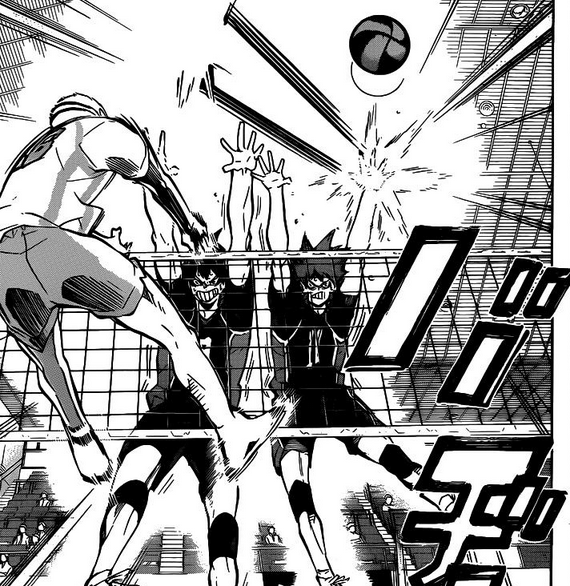
Laughed at Kageyamas face here, great block. Tsukkis reaction to Hinata blocking was incredible. All the blockers in this series are great.
No matter who wins next week it will be both an exciting and sad chapter.
Laughed at Kageyamas face here, great block. Tsukkis reaction to Hinata blocking was incredible. All the blockers in this series are great.
No matter who wins next week it will be both an exciting and sad chapter.
Himouto! Umaru-chan 90
The author is being a dick.
I agree, but at the same time, Umaru has a point...why would he give money to Ebina? Which leads one to believe that something did happen, we're just not privy to it yet.
I kind of suspect the author's going to let Ebina and Taihei go out and not make a big deal out of it. Just little things here and there like Taihei giving Ebina money for New Years and, probably more notably, Ebina visiting and not saying a word to Umaru.
My assessment of Tokyo Ghoul has always been, "Not particularly bad, but also not particularly good". In other words, it's readable, but nothing to write home about. It's in the same place I slot Nogami Neuro.
[...]
I'm not that far into Tokyo Ghoul manga, while I'm more or less current on Tokyo Ghoul anime and even though there are differences between the two (obviously) I gotta say that yours feel like a pretty spot on perspective about the work from the knowledge I have of it.
I'm enjoying reading the manga exactly because of those initial themes it seems to posses, but from reading certain opinions and from looking at the anime, it also seem like those themes went nowhere which make it a disappointing work. The characters feel a bit too much like caricatures at times too.
Anyways, it was an interesting opinion to read.
Dedication Through Light
Member
Heromask 5
The hero manga that Ive always wanted. Two assembled!
The hero manga that Ive always wanted. Two assembled!
Fujiyama-san wa Shishunki 1
We'll this advanced more in 1 chapter than Nisekoi will until the end of the series.
I never asked Dani but where is your avy from?
Please don't say Nisekoi...
I never asked Dani but where is your avy from?Please don't say Nisekoi...
Nisekoi's Haru Onodera. AKA the one bright light in that desert of nothing ever happening.
- Status
- Not open for further replies.