
• Hey Guest. Check out your NeoGAF Wrapped 2025 results here!

First Herculaneum scroll read in full through machine learning after 2000 years

EviLore

Expansive Ellipses
Staff Member

QAbBa06YgGGSeQCY.jpeg


Article:
PHerc. 1667, sealed since the eruption of Vesuvius in 79 AD, has been virtually unwrapped and read from beginning to end.
June 25th, 2026
Read the preprint: Complete virtual unwrapping and reading of a rolled Herculaneum papyrus (PDF). The data is openly available at scrollprize.org/data, and the code on GitHub.

For almost 2,000 years, the carbonized library of Herculaneum has kept a cruel bargain: its scrolls survived the eruption of Mount Vesuvius, but only by becoming too fragile to open. To read one was to destroy it. Hundreds of rolls have therefore remained sealed, their contents preserved yet unreachable.

Today that changes. We have completely virtually unwrapped and read PHerc. 1667 — the scroll the Vesuvius Challenge community knows as Scroll 4 — without ever touching its pages. It is the first Herculaneum papyrus to be digitally unrolled and read in full, end to end, and made available for sustained scholarly study.

From a sealed lump to a readable book

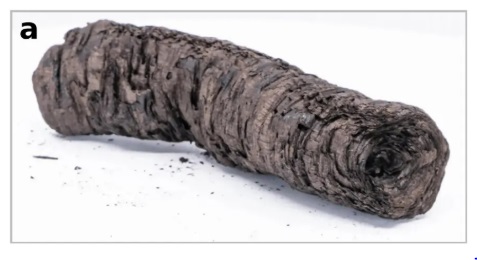
PHerc. 1667 began as a blackened, rolled mass of carbonized papyrus. To read it, we never unrolled it physically. Instead, we scanned it with high-resolution X-rays, reconstructed the wound sheet inside the volume, flattened it into a readable surface, and used machine learning to bring out the faint traces of ancient ink.

Three sealed scrolls, three milestones

The work reaches beyond a single scroll. Alongside the complete reading of PHerc. 1667, the research establishes a method that holds up under independent checks and scales to other rolls.

PHerc. 1667 — read in full

PHerc. 1667 is what survives of a larger roll: earlier attempts to open it by hand — in the nineteenth century, and again in 1969 and the 1980s — destroyed its outer layers and left only the compact inner core, about 8 cm of an original height of 19–24 cm. From that surviving portion we have now recovered and read the text in full— the lower parts of some twenty-two columns, transcribed and reviewed by papyrologists. It is the first time the preserved text of a rolled Herculaneum scroll has been read continuously, end to end, rather than in isolated words or patches.

The recovered text is a philosophical treatise on ethics, and the evidence points to a Stoic work: it turns on human nature, impulse, and the moral progress of human beings, and its final preserved column names Aristocreon — nephew and disciple of the great Stoic Chrysippus — which, together with the language and themes of the text, places it in a Stoic context and dates it to the 2nd century BC.

Because the papyrus is damaged, the readings are fragmentary, with gaps where the surface is lost. Even so, several passages can be read clearly for the first time in two thousand years:

"…we will inquire into something, but we will not grasp it, if in some way we depart from ourselves and from our own nature…"
"Having…strained ourselves to the utmost through research and learning…possessing the same practical wisdom…"
"…such being the goods for us, even from the opposite evils there will be neither anything good — let alone beautiful — nor anything bad — let alone ugly — nor happiness…"
Translated from the Greek; the full column-by-column transcription is in the preprint.

PHerc. Paris 4 — ink made visible by higher resolution

In a second scroll — PHerc. Paris 4, the scroll the Vesuvius Challenge community knows as Scroll 1 — a higher-resolution imaging technique makes the ink directly visible inside the scroll itself, in the three-dimensional X-ray data, for the first time. Segmented in 3D and projected back onto the unwrapped page, that ink matches the text read in the 2023 Grand Prize one-to-one — an independent confirmation, from better data, that the reading is real.

PHerc. 139 — a title, and an author

In a third scroll, PHerc. 139, we recover the scroll's title and author attribution: the work is identified as Philodemus, On Gods, Book 8 — a treatise by the Epicurean philosopher whose works fill so much of this library. Reading the title of a closed scroll tells scholars what a roll contains before a single column of its body is studied.

How it was done

The scans were acquired with high-resolution phase-contrast X-ray microtomography on the BM18 beamline at the European Synchrotron Radiation Facility (ESRF) in Grenoble — an instrument able to resolve the wafer-thin, densely packed layers of a Herculaneum roll. The work was carried out in collaboration with the National Library of Naples "Vittorio Emanuele III", which safeguards the Herculaneum papyri. From those volumes, the team reconstructed the scroll's geometry, traced and flattened its surface into a readable sheet, and trained machine-learning models to detect ink that is almost indistinguishable from the carbonized papyrus beneath it. Each reading was then examined and transcribed by papyrologists.

What's next

PHerc. 1667 is one scroll. Hundreds more remain sealed — an entire library of philosophy, poetry and prose waiting to be read for the first time since antiquity. The method shown here is built to scale, and everything needed to apply it is open.

If you want to help read the rest of the library:

The thoughts of the ancient world, sealed in darkness for two millennia, are coming back into the light — a whole scroll at a time.


Very exciting times. Now that they have the imaging methods and machine learning model figured out they can spend the resources necessary to scan all of the scrolls. We will hopefully uncover some important lost works from antiquity.

nWxQjkl4BacxGHdm.jpeg
 
I saw something about this earlier, but the article was focusing on the use of AI, not about all the other steps to even get there.

Truly fascinating and intricate work by the historians here!
 
That's so awesome! While the Vesuvius eruption was certainly a horrible tragedy, at least the eruption helped preserve so much history for us to learn from.
 
Exciting times. I would imagine there are many Qumran-like caves in particular out there filled with ancient scrolls. Exciting to know that we now may have the ability to A) narrow down search possibilities with the help of AI and B) read any that we find without damaging them.
 
Last edited:
There are supposedly many more scrolls yet undiscovered in the building where these scrolls were found.

Article:
The papyri appeared in the dwelling that bears this name, the Villa of the Papyri. A luxurious building that extended along 250 m on the Herculaneum coastline. To give us an idea of its magnitude, the peristyle garden measured 100 m and the fountain 66 m.

We don't know who built it, but we do know that one of its owners was Lucius Piso, an important Roman politician and military man, father-in-law of Julius Caesar. The "Historia Augusta" tells us about a cultured man who surrounded himself with philosophers and literati like Philodemus of Gadara.

Lucio displayed his power and culture in the decoration of the villa. In the peristyle he placed more than 80 statues and busts, among them Greek politicians and philosophers, and Roman military men such as Scipio Africanus. Also his own. And in the center Athena, goddess of war and wisdom.

But the villa, besides a rich collection of statuary in bronze or marble, beautiful frescoes, or ivory furniture, hid another secret that would end up giving it its name. In 1738, the Spanish engineers Roque Joaquín de Alcubierre and Pedro La Vega began the excavation of Herculaneum.

In 1750, Swiss engineer Karl Weber joined, who through tunnels accessed the villa and drew up its first plan. The excavation ended in 1765 due to sulfur emissions. In a small room with shelves and boxes, hundreds of carbonized parchment scrolls were discovered.

In the 1990s, excavation of the villa resumed. The atrium, baths, 16 rooms, 3 triclinia, and the villa's core structure were discovered. It was thus determined that the villa has 4 construction levels. It is dated between 60 and 40 B.C. However, it was decided to preserve what had been excavated, and work was not continued.

This sensational discovery has led the entire complex to be renamed the Villa of the Papyri. We are faced with a great library of Greek texts and, to a lesser extent, Latin ones, buried by lava and ash. Today, nearly two thousand are preserved in the National Library of Naples.

And there are two levels left to excavate. It's believed to be nearly 3000 m². Surely with many more scrolls buried, in fact the villa's main library hasn't been found yet. The Latin scrolls must be there. A treasure to be discovered.


Last edited:
'We have completely virtually unwrapped and read PHerc. 1667 — the scroll the Vesuvius Challenge community knows as Scroll 4 — without ever touching its pages.'

"…we will inquire into something, but we will not grasp it..."

Disbelief Wow GIF by TruRebels
 
Absolutely incredible stuff. I can't help but wonder how much our perception of the past shifts as more ancient scripts and scrolls are deciphered like this. Gotta be an exciting time to be an archaeologist.
 
I'm gonna laugh if this stuff is the equivalent of a bro message thread...

"Yo, your sister is fine! Can I ask her out?"

"Nay, friend, she is betrothed to a roman general, he's way richer than you, dog. 'Sides, I thought you liked them big booty african slave girls?"

"Shit, that's true, but they ain't marriage material, and to be honest they kinda scare me and I have to lock them up at night so they don't stab me in my sleep."

"Well, keep your pox ridden cock away from my sis, she's had it bad enough after her first three husbands all died within the first year of marriage."

"Some friend you are, guess I'll just take a quick trip over to Judea, I hear they are gonna crucify some people in a month. Hang on, I hear some rumbling, BRB AFK......."
 
Top Bottom