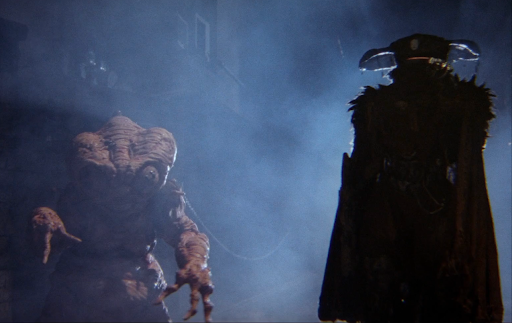
• Hey Guest. Check out your NeoGAF Wrapped 2025 results here!

ALTERNATE VIDEO GAME TIMELINE: The 5th Generation (Mega Thread)(Ongoing)

Your favorite home console of the 5th generation?


  • Total voters
    131
Okay, so the next part should be up on Saturday. It'll cover the 1993 period, but I'm not sure if I'll have the 1994 part up for Sunday. That's kind of also because, in addition to what I'll explain below, the year 1994 has a lot of things happening and I will probably even need to split it into smaller sub-parts (i.e one for the 1994 June Tokyo Toy Show).

I've been trying to get renders for some of the systems and it was a challenge to do that for the 1993 part. In part because I was being cheap and kept jumping between Gemini, ChatGPT, Copilot, Grok and some random AI image modifiers to try generating the look needed for some of the new devices. But due to all the limits I coughed up for a ChatGPT trail.

And well, out of those AI, ChatGPT is easily the best at following prompt constraints & directions accurately for image generation from what I've noticed, which was kind of surprising for me. Also the best at retaining original image quality (no artifact or blurring issues, etc.). Copilot is laughably bad no matter how much you simplify constraints, Grok never actually generated anything without hitting me with a message to subscribe, and Gemini was only "decent" at best. It would regularly degrade images over time when doing multiple modifications, and had issues with constraints that were directional in specific ways.

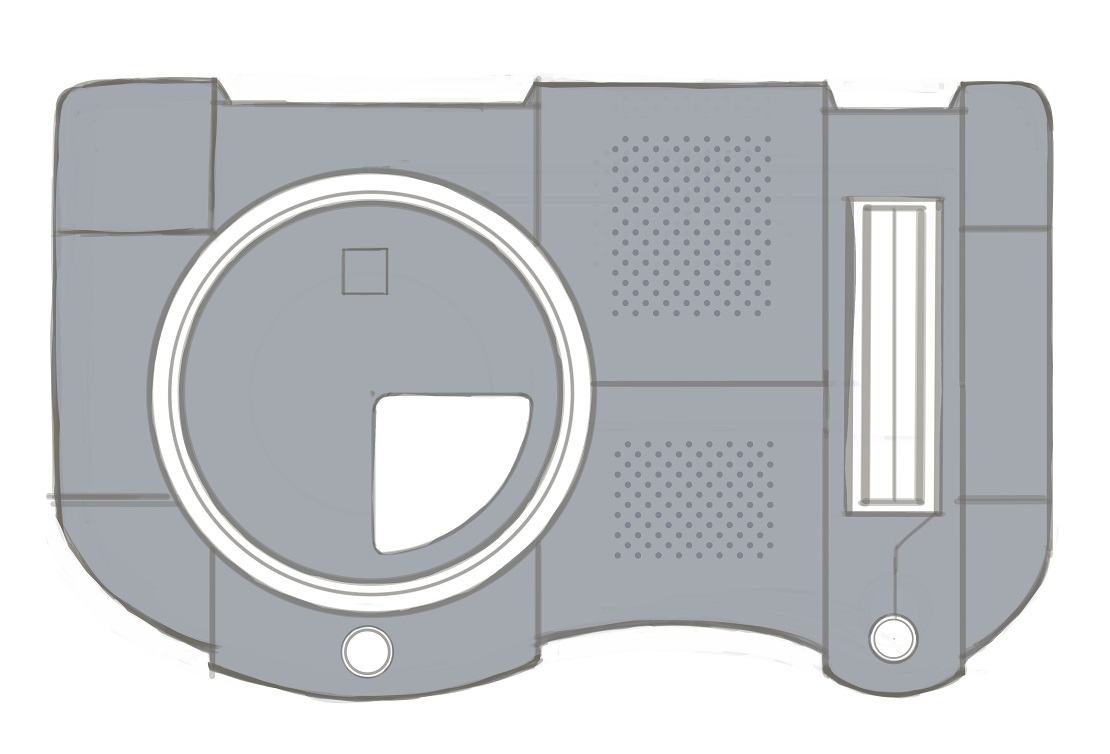
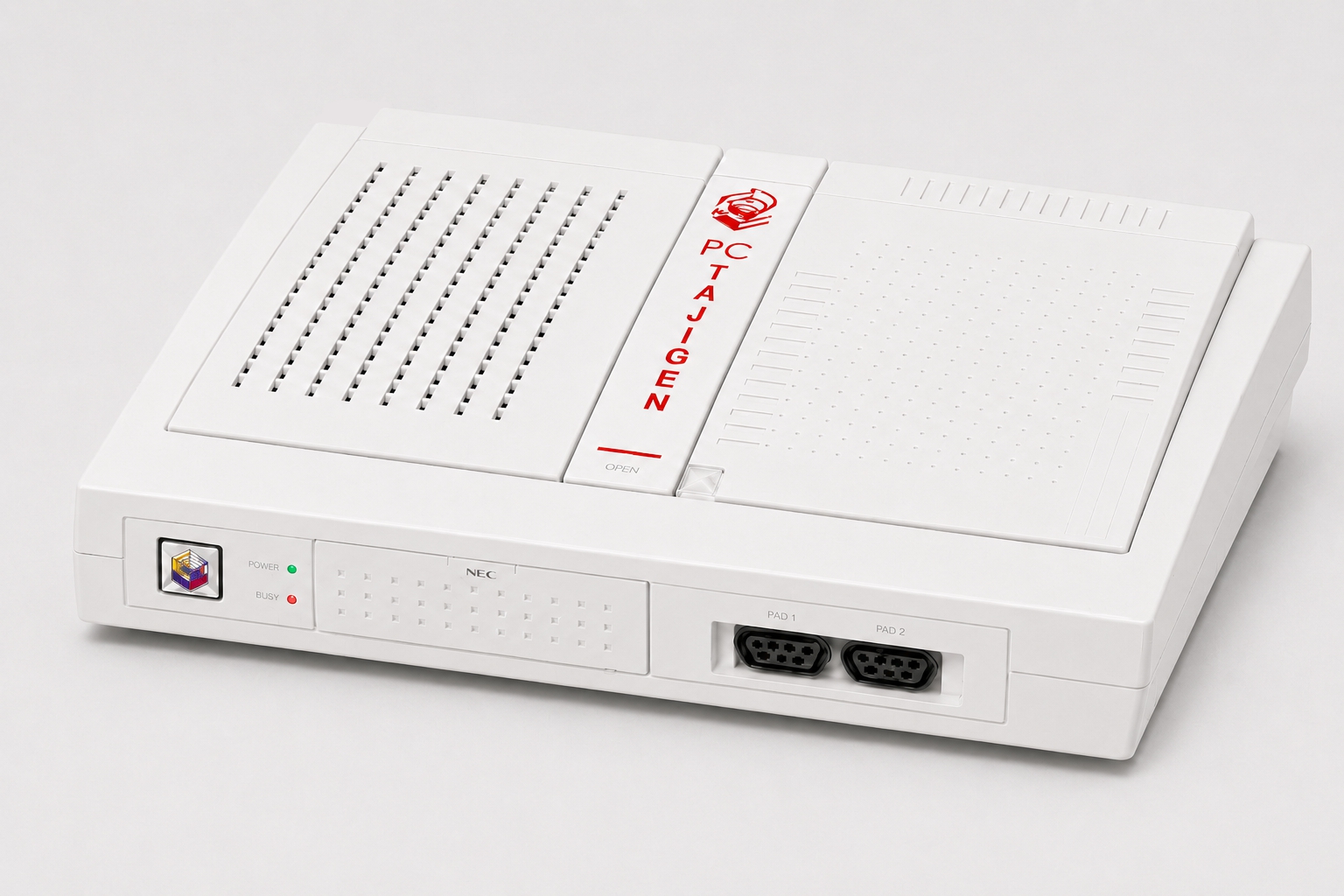
So uh yeah, brief update on that. For Project Tetsujin E (the NEC console), I actually have a rough sketch drawn up and hope to generate a proper real-life render from the sketch. You can see it below (top view), and I'll keep refining it and getting other angles drawn before trying to render it. But it won't actually show up until the timeline moves on to 1994 😜

H3dRsIwtPmK66ogE.jpg
 
Link to Part 2 (2 of 2)

[AVGT: 5TH GEN (PART 3)]

==================================================================


[1993]

[JANUARY]

SH2.jpg
SH2-01.gif

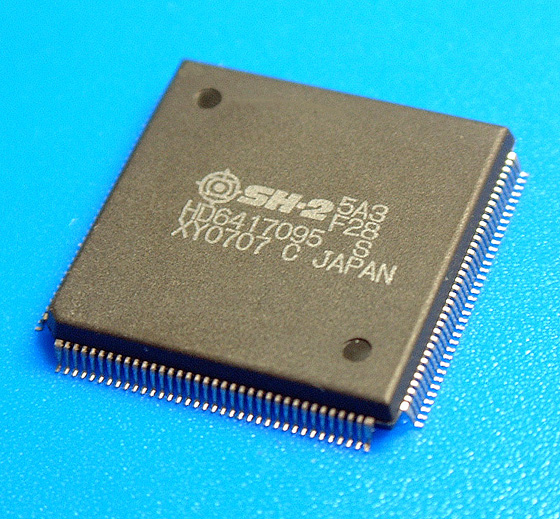
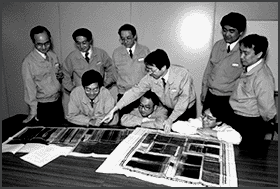
Hitachi's SH design team lead by Shunpei Kawasaki pull off a last-minute deal to provide the brain for SEGA's 32-bit wonder

>Full-scale development of Hitachi's SH2 processor begins in January 1993. Back in November 1992, SEGA of Japan had ultimately decided to go with Hitach's SH2 rather than NEC's V60 or V810 processors, which they had also been considering for GigaDrive going back to Early 1992. The V60, in particular, was already a well-understood CPU from SEGA's arcade group due to its use in the Model 1 arcade system.

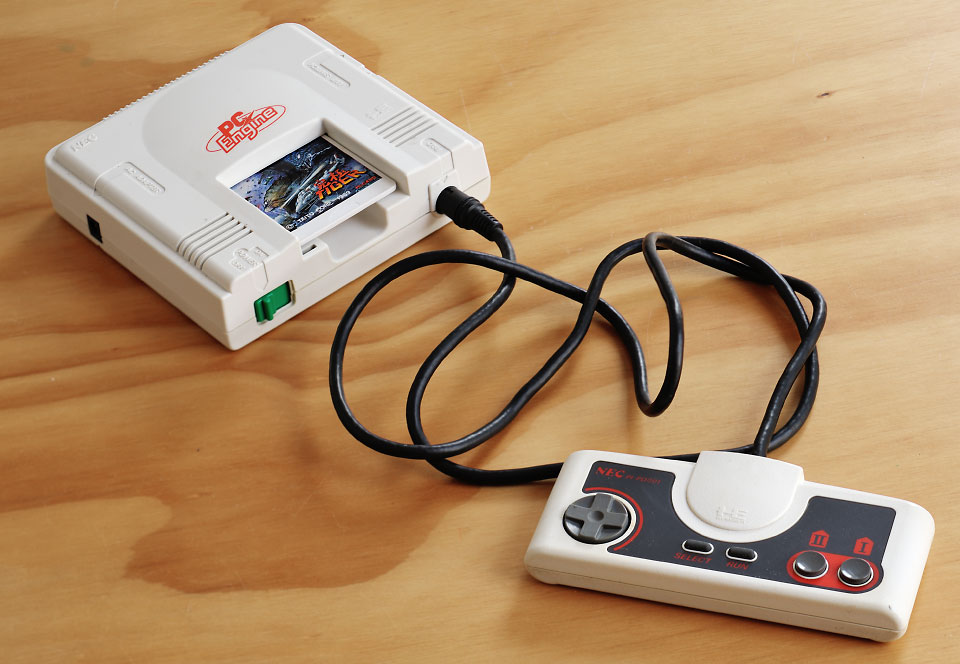
At the end of the day, however, Hitachi's SH2 provided more of what SEGA of Japan were looking for, and at an affordable price, hence its choosing over the V810. NEC Corporation were now in need of a new mass-market product to helm their in-house RISC processor design at high volume, and the most likely candidate was looking to be the Project Tetsujin E, PC-Engine's 32-bit successor.

Headquarters_of_Kubota.jpg
images

Kubota Corporation's graphics arm, Kubota Pacific, seeks to provide the visual punch for NEC's RISCstation project

>Members of Kubota Pacific meet with NEC America/NEC Technologies to discuss the potential of utilizing Denali graphics in a workstation product under active development called the RISCstation 2000. Initial contact between members of both sides occurred in December 1992, with a BTS meeting at Winter CES for January 1993. At the time, NEC Technologies were also considering usage of S3 Vision or 3DLabs, but Kubota Pacific saw an opportunity to leverage NEC for increasing market penetration against rival Silicon Graphics.

To this end, they seek to display the scalability of their graphics technology in both the impending RISCstation 2000 for the American side, and a design configuration for the Japanese SX computer group. The latter is an angle Kubota Pacific use in order to perhaps entice NEC Corporation to support the venture between Kubota Pacific and NEC Technologies on the American side. This later becomes a point of focus when a pair of acquaintances between NEC Corporation and Kubota Corporation (parent company of Kubota Pacific) discuss the desire for an alternative graphics package to test with an SX configuration, but at a pricing cheaper than what Silicon Graphics (whom NEC were already involved with for MIPs-based RISC processors) were offering, as well as one more flexible to be customized for their SX supercomputer offerings.

Details on both fronts are soon established, with developments throughout 1993 and into 1994 (tho NEC Technologies still offer RISCstation 2000 setups with S3 Vision & 3DLabs cards toward the lower end), with Kubota Pacific providing solutions to both parties near the end of 1994. Bear in mind, at this time NEC Corporation have their own custom workstation graphics solutions in the form of the GZ-700 (high-end) for the EWS8400/220 and EWS 8400/260 workstation systems. However, Kubota's solution promises to be more scalable, so a design is targeted at one of their SX setups (the workstation & server group saw no need for Kubota solutions at the time) as a test to viability, and to explore potential iteration on the design for larger-scale adoption. Meanwhile, for the RISCstation 2000, Kubota Pacific promises to deliver better visual performance & programming compatibility at a competitive & scalable price.

[FEBRUARY]

TTi_logo.png
92c6ba1d-d4f5-4872-b3a3-ca1a56bda07e.jpg

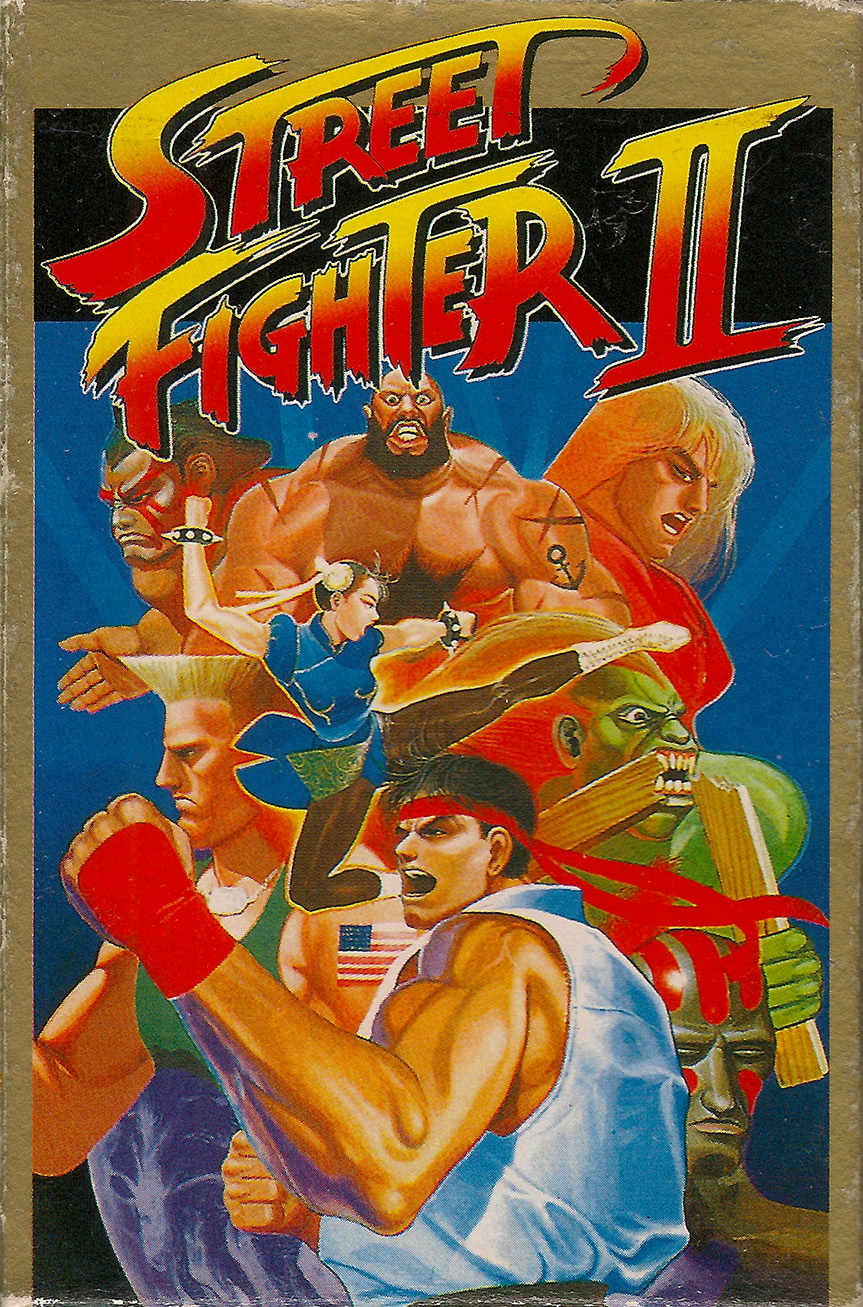
TTI gears up for a special Turbo Duo version of Street Fighter 2 for the holiday season

>A few big developments take place take place with Turbo Technologies. First of these is that Capcom agree to bring an enhanced version of the currently in-development Street
Fighter 2: Champion Edition, to the PC-Engine Duo and Turbo Duo platforms. This version will be known as Street Fighter 2: Super Champion Edition, and is based on the Street Fighter II' arcade version from back in March 1992. Like the HuCard edition, Capcom are at least handling part of the PC-Engine Duo/Turbo Duo version internally.

However, in order to expediate the Turbo Duo version of the release to market for 1993, TTI's Steve Garwood turns to a former colleague of his from the Universal days, and who currently owns a 45 RPM records & small media distribution (CDs, videotape) company called American Pie, to help offload a substantive portion of disc box SKU packaging, assembly, and distribution logistics on behalf of Capcom USA.

With the Turbo Duo's American launch back in Late 1992, TTI mainly found themselves relying on Hudson Soft USA and a mid-sized packaging assembly warehouse (co-owned by Garwood's previous employer before going to TTI). However, the Hudson Soft USA office wasn't that experienced with disc-based games, and was split between HuCard support AND cartridge support (NES, SNES). Meanwhile, the mid-sized packaging assembly warehouse was quickly running out of required capacity. These are the reasons why American Pie was brought on to act as another packaging & assembly warehouse for game disc boxes and Turbo Duo SKU packages back in Early 1993.

That said, business with American Pie will steadily evolve over the following year, with TTI acquiring the business outright in 1994. The other big development with TTI is that a swell of several Western microcomputer & PC developers are showing interest in bringing titles to the Turbo Duo. Many of these are also doing similar for SEGA's recently released SEGA CD, but over time some will show themselves as preferring the NEC option for sake of convenience (the Turbo Duo is technically an integrated TG-16 & CD-ROM drive, for example) and the fact that install base splintering is less severe than what develops for the SEGA alternative.

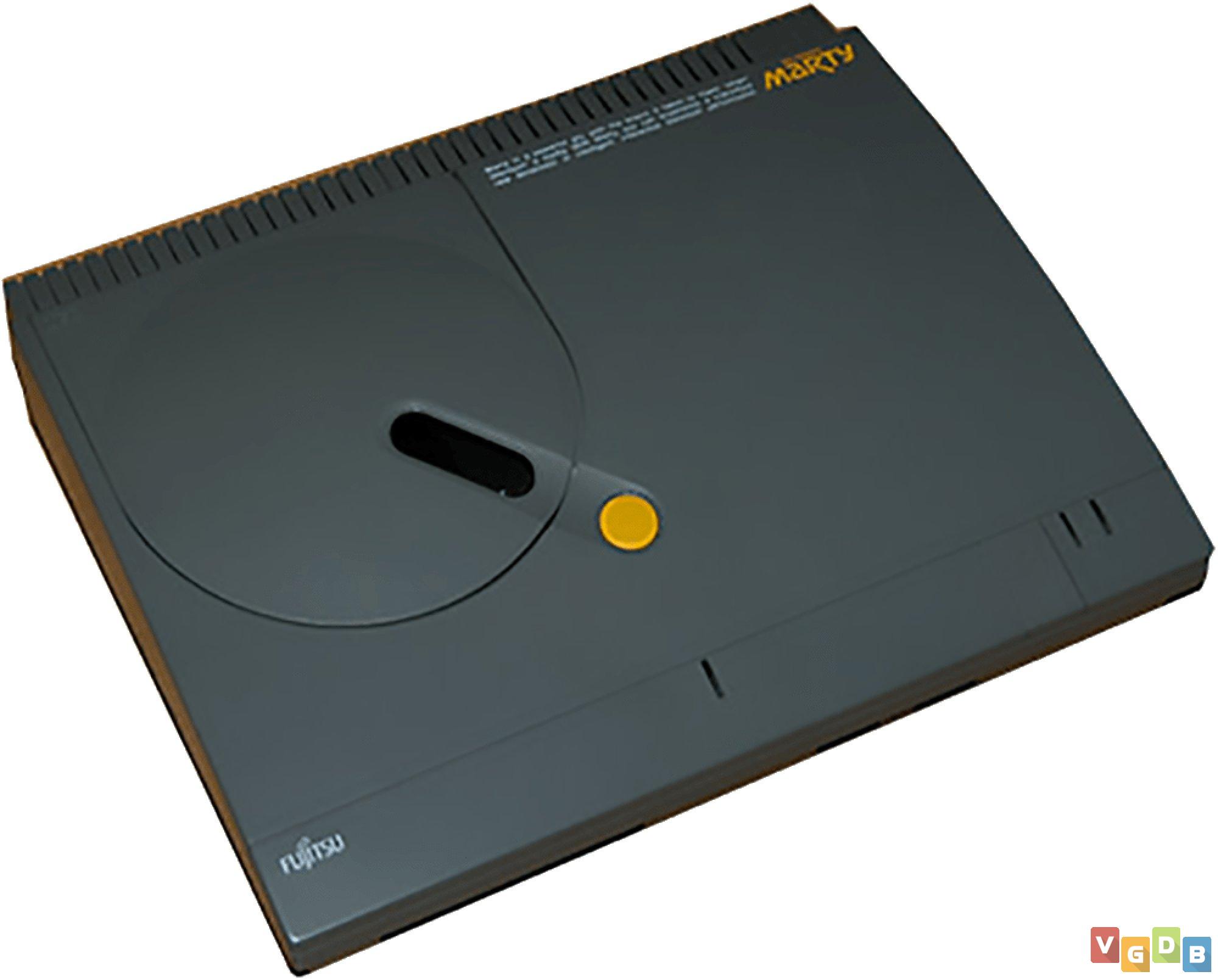
1920px-FM-Towns-Marty-Console-Set.jpg

Fujitsu's entry into the 32-bit console battle

>Fujitsu release their consolized FM Towns, the FM Towns Marty, in February exclusively to the Japanese markets. It features an AMD 386SX CPU clocked at 16 MHz, Fujitsu's own custom graphics solution, a Yamaha 2612 (FM synthesis), Ricoh RF5c68 (PCM sampling), 1-channel CD-DA, 1x-speed CD-ROM drive, 1x 3.5" FDD, 2 MB of system RAM (non-upgradable), and 1x PCMCIA expansion slot.

Priced at ¥98,000 (~ $710), it is Fujitsu's play to break into the living room and subvert the home computer dominance of entrenched top dog NEC through such a subversion, similar to Sharp's own X68000-CC from the year prior. It also beats NEC's own PC-98 Kantan to market by a month, and at less than half the price. However, while initial support will seem decent enough, the FM Towns Marty eventually becomes a victim of getting squeezed between an X68000-CC that steals a good chunk of early thunder, and megaplayer NEC's own response to both Sharp & Fujitsu having the backing of the PC-98 brand power behind it.

[MARCH]

aBwMyyngGWnKB4eA.png

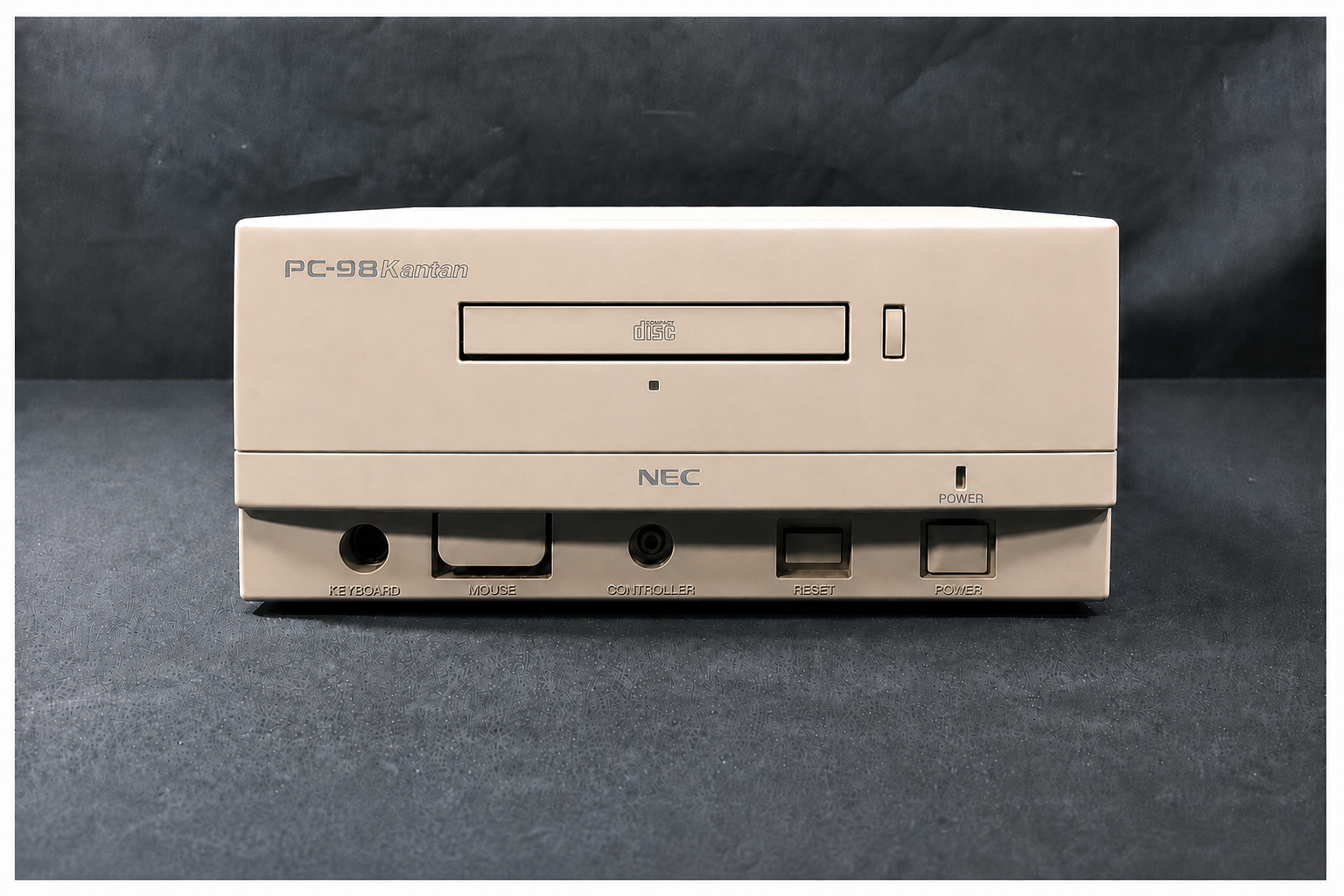
Front view of NEC's PC-98 Kantan

>NEC release the PC-98 Kantan (Easy) in Japan in late March 1993, for a price of ~ ¥166,685 (~ $1499). The Kantan gets good reviews for its MJPEG decoder, CD-ROM drive, and 2D sprite & tile background hardware, but draws criticism for its limited upgradable RAM capacity (only 4 MB) and high price, both in comparison to Sharp's X68000-CC which released back in Late 1992. Additionally, unlike Sharp's system, the new graphics & video chips in the PC-98 Kantan don't have a lot of applications to make use of them, so the primary driver of sales would appear to be limited PC-98 software productivity in a small office or living room environment. Its usage as a multimedia system for advanced MJPEG film playback or high-quality 2D sprite games won't really arrive until more programs make use of the MJPEG decoder & additional 2D hardware, neither likely to arrive until later in 1993.

Another thing worth mentioning, is that the final PC-98 Kantan is lacking some of the features of the Project Tetsujin K prototype shown back in May 1992. Specifically, it no longer has the floppy disk drive, and the amount of blitter VRAM has been halved from 512 KB to 256 KB, though to compensate for these changes, a 2x 3.5" FDD peripheral is provided for the Kantan at launch (existing FDDs can also be connected to the system. However, these are not form-fitting, and must use the sole expansion slot at the bottom which requires the Expansion Docket (the form-fitting FDD peripheral does not require the Expansion Docket as that functionality is built into the FDD peripheral itself). The system also allows additional graphics RAM to be installed to the system, tho the proprietary modules for doing this are not available at launch.

In spite of this, the PC-98 Kantan is also seen as a credible (if limited) effort to stave off growing aggression from American companies digging into the Japanese computer market with IBM-compatible DOS/V machines, without necessarily needing to cut the pricing severely on mainline PC-9821 systems.

[APRIL]

mitchell-hendriks-render-13.jpg
images

Conceptual renders of SNK's 'Neo Star' (courtesy Mitchell Hendricks)

>For SNK, as of April 1993 planning and design work on 'Neo Star' is not going well. The company has come to realize that their design is overly ambitious; even while scaling back non-essential features, they realize that the 3D capabilities they had been wanting to include (heavily influenced by arcade developments such as Namco's System 21 and SEGA's Model 1 boards) were not going to be achievable through purely internal routes. SNK & ADK's engineers lacked understanding of developing in-house 3D silicon; as Neo Star was also just as much a focus for the arcade market as it was the home one (and similar to Neo Geo, SNK wanting the arcade and home systems to be 1:1 similar in performance), this simply was not acceptable.

As a result, various aspects of the Neo Star roadmap had been in the process of beginning a shift. The company were considering NEC's V60 CPU and, more specifically, what they assumed to be a scaled-down version of it in the V810 revealed back in Early 1992 (the V810 is in fact based on a completely different instruction set architecture, V800, than the V60's x86-based ISA and CISC principles), and were drafting up plans of entering discussions with NEC Corporation's Semiconductor Solutions Division (SSD) to get things rolling. For graphics, SNK were weighing options; for example, perhaps entering a partnership with Lockheed Martin or Evans & Sutherland similar to what SEGA and Namco had done, though both options might've been too deeply involved with SNK's competitors to bother. SNK (thanks to the American side) were expanding their options to consider partners like Silicon Graphics, as well.

However, an answer comes approaching SNK's doors instead a bit later into the year, giving them an opportunity that would seem too good to pass up.

[JUNE]

Sharp-logo.png
jrPqMKyTm0Zrrqd2.png

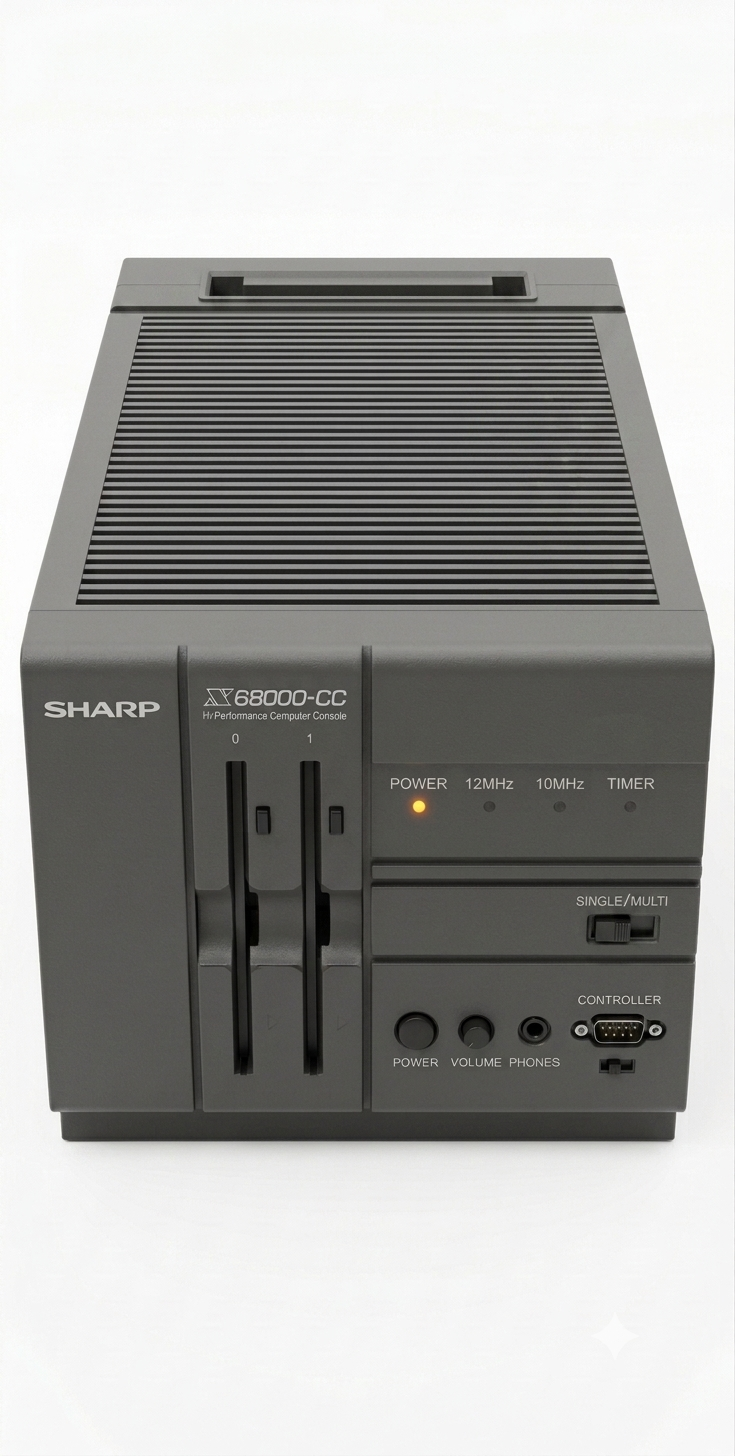
As many suspected, a console version of the X68000-CC is on the way

>Sharp make an announcement in June 1993, WRT the future of the X68000-CC, as well as a celebration of it having reached 274K in sales. The company has two new additions to the platform planned, both coming in 1994.

The first is an upgrade 68030 Master Cartridge for the current X68000-CC; it contains the same System BIOS ROM (with Human 68k OS and I/O Control System) as the current Master Cartridge along with the File Compression ASIC. However, it now also integrates a Motorola 68030 CPU upgrade with a clock rate planned for "at least 20 MHz", and 4 MB of onboard main RAM. The separate 2 MB Silicon Disk has been removed, but programs will be able to map out a partition of the 4 MB main RAM to act as a Silicon Disk instead. The Master Cartridge is projected to cost between equivalent $300 - $400 USD, and should provide a substantial upgrade to the current X68000-CC system.

The other announcement is a slimmed-down version of the X68000-CC, positioned to solely focus on playing games. It will remove the Master Cartridge port, Expansion Bay port, and floppy disk drive, but will have an upgraded CD-ROM drive to compensate. It will also replace the 68000 CPU with a more performant 68020 CPU, plus a redesigned Cynthia ASIC. The I/O ports for keyboard and mouse inputs is also removed, to be replaced with modified game controller ports.

This is basically Sharp's means of entering the lucrative video game space, but work is still under development on several components, hence why it is not set to release until sometime 1994. The upgraded Cynthia chip (later referred to as the Enhanced Cynthia) will also be provided as an add-on expansion card (via the Expansion port) for X68000 computers and the X68000-CC at around roughly the same time (slips into Mid/Late 1995).

To NEC, this is effectively Sharp making a direct challenge to them in the Japanese home console market AND undercutting them in the home computer space, utilizing the X68000 platform. It's also likely that Sharp will attempt courting additional software developer support for X68000 (this has actually already began somewhat BTS with them taking a deeper interest in Exact's Geograph Seal), with all of this happening around the time Windows-base DOS/V entry-level IBM PC-compatibles are starting to proliferate more strongly in Japan, thanks in heavy part to the 'Compaq Shock'.

As such, it makes prioritization and definition of the upcoming PC-Engine successor's features that much more urgent, while additional device peripherals are planned for the PC-98 Kantan, including a likely product refresh a couple of years out.

0*IeRP_KrIBepmhM1I.

Nintendo finally break their silence on their 5th-gen console...somewhat

>Nintendo and Silicon Graphics announce their technology partnership in June 1993. This partnership will see Silicon Graphics providing the processing core for Nintendo's Project Reality, which the company promises to be the "most powerful" of the upcoming 5th-generation games consoles.

While SNK had considered turning to SGI themselves, the truth is that the costs and effort that'd of been required to scale SGI's technology down into an affordable arcade unit (let alone a home console) would've been well beyond SNK's financial and production capabilities. SGI were seeking to work *with* a partner to scale their workstation graphics technology down into a viable home product; they hadn't actually designed such a product themselves yet. This also explains why Jim Clark (SGI CEO & founder) likely did not approach SNK the way he had SEGA and then Nintendo.

During their talks with The 3DO Company, SNK were actually told this as a likely reason why a deal with SGI would not have worked, and why it was better for SNK to work with 3DO. It would appear that SNK take this word heavily into account going forward.

[JULY]

709584e62f67caae7e8452db774e3e9d.jpg
images
409px-3DO_%281996%29.png

An unforeseen partnership between East and West (well, aside 3DO already partnering with Matsushita)

>As expected, in July 1993, SNK resume talks with The 3DO Company to see if both parties can come to terms and strike a deal. Part of the reason for this quick resumption is because of Nintendo announcing their technology partnership with Silicon Graphics in June. Silicon Graphics represented one of the last options for SNK in finding a 3D technology partner for Neo Star; with that out of the picture they are seemingly "forced" to rely on 3DO, though it is admittedly a great option to have nonetheless.

This reopened discussion would lead to a lot of points being brought forward by both SNK and The 3DO Company, with each side discussing their needs. SNK are willing to become partner, but they are interested in merging aspects of the 3DO technology with their Neo Geo technology, as the company wants a wholesale successor to the Neo Geo platform and feel the 3DO's 2D capabilities are not sufficient enough to rely on it for that area of graphics performance. SNK also want some flexibility in customizing the 3DO's OS and API packages for this technological hybrid.

The 3DO Company, meanwhile, would still require SNK to adhere to ensuring whatever they conjure is compatible with the 3DO architecture as it currently exists, and therefore able to run current & upcoming 3DO games without modifications. They are also interested in seeing if SNK could develop an add-on to establish parity between other 3DO systems and SNK's own; this isn't necessarily a "requirement" on 3DO's part, rather just something they are curious in if SNK would want to do.

The nature of these requirements from both sides means a deal isn't exactly set in place quite yet; however, given both the impending release of the 3DO (October 1993) and SNK's plans of turning to Silicon Graphics for a 3D graphics solution up in smoke thanks to Nintendo beating them to a development partnership deal (with the June 1993 partnership announcement), SNK needed *something* to bring to both the arcade and home markets, as they knew the Neo Geo MVS could likely get squeezed out in the arcade space (& AES similarly squeezed out in the home console market) if something drastic wasn't done, quickly. Simply cost-reducing the AES was not seen as enough given what areas it was lacking in (and SNK not having robust CD-ROM experience, while cartridges would've still proven too expensive for home consumers in the face of CD-based 5th-gen machines).

logo-nec-corporation-of-america-brand-image-png-favpng-iimJ6M1yBHBAbQmBrSeTE7qn0.jpg
system.jpg

The sails are shifting for NEC's PC-Engine follow-up

>Given the announcements from Sharp, and rumors swirling around an upgrade for the FM Towns Marty, not to mention rumored developments around the SEGA GigaDrive (in which NEC's CPU was turned down in favor of Hitachi's newer SH2 back in Late 1992), higher-ups at the Home Electronics division and NEC Japan as a whole want to ensure the PC-Engine successor is more capable than what Sharp have planned for the consoleized X68K which, to NEC, would involve a 68030 CPU and the Enhanced Cynthia chip improved upon the version present in the CC.

The current Project Tetsujin E design generally matches or beats the 68030 in synthetic integer math tasks and even floating point thanks to switching out the HuC62320 CPU with the NEC V810 (a decision mandated by NEC Japan senior executives back in February 1993 due to SEGA passing the V810 for a Hitachi CPU in GigaDrive instead, and SNK generally abandoning the Neo Star design throughout 1993). However, NEC are aware that the V810 is potentially generally weaker than Hitachi's SH1 and their in-development SH2, the latter of which being SEGA's CPU of choice for GigaDrive.

Like SEGA, NEC are under the belief that 2D will still be a focus for the upcoming generation, with 3D serving as more of a novelty. The affine transformation functionality of the Project Tetsujin E's King ASIC (a feature not present in the King ASIC for the PC-98 Kantan-I and PC-98 Kantan, though otherwise they are functionally similar in their design) makes it very suitable for large scaling operations of sprites and tiled macroblock data from the MJPEG decoder, but between adding in a PEGC blitter (derived from the PC-98 line, and only gaining the cooperation of the HCG if the HCDDG would in turn help develop some modifications for an enhanced PEGC blitter for use in upcoming PC-98 computer products) and the King having four background layers of support as-is, the design is potentially becoming too expensive.

Finance & marketing members of the Home Electronics division in Japan advise that the HCDDG find areas to cut back on the design for cost reasons. Simultaneously, some members of the HCDDG have been pondering about adding PC-Engine compatibility support, though senior executives within the Home Electronics division have reservations (again pertaining to costs, as well as cutting into PC-Engine Duo sales). PC-Engine compatibility (in the form of TG-16 and TurboDuo) is also a request from Turbo Technologies around August-September 1993 after being notified the existence of the Project Tetsujin E (now going by the working name Project Tetsujin PCE), and is given some consideration due to improving sales of the system in the American market.

To ensure the PC-Engine successor can best what is suspected of the upcoming consolized X68000-CC and improved FM Towns Marty, as well as SEGA's GigaDrive, the HCDDG make the following design scope changes between June 1993 and October 1993:

>Remove the PEGC blitter's local VRAM; it will now fetch data from the King ASIC KRAM

>Increase the King ASIC KRAM from 512 KB to 1 MB

>Implement additional linear/affine scaling & rotation functions to the King ASIC in the Warp Transformation Engine block

>Add a JEIDA-compliant modification to the system bus design for the cartridge port

>Modify the cartridge port interface to utilize C-Bus (2x 16-bit connectors for 1x 32-bit connection; requires discussions and planning with the HCG over a period of months)​

*C-Bus is a proprietary bus interface developed by NEC's Home Computer Group (HCG) for the PC-98 (and I believe, some PC-88) computer systems prior to their shift to Wintel in the latter half of the '90s. You can find more information on it online.

>Use the modified cartridge port for potential high-performance peripherals, such as a PC-Engine compatibility unit (and enabling enhancement of PC-Engine & PC-Engine Duo games on the new system); this can enable PC-Engine playback for a marketing boost while offloading costs from the new system directly

>Increase the CD-ROM drive to 2x-speed vs 1x-speed, but remove the private CD-ROM buffer cache (a portion of the King ASIC's 1 MB RAM will now serve as a cache buffer)

>Improve performance of Soundbox (adding more PCM & FM channels, plus LFO & ADSR logic)

>Remove private audio RAM (now use a portion of King ASIC KRAM for audio data, and add 2 KB embedded audio cache to King ASIC as part of a ring buffer)

>Increase clock rate of V810 CPU slightly

>Increase HuC6270 VDC VRAM from 256 KB to 512

>Add a 2nd HuC6271 'Rainbow' MJPEG Decoder to the system design to operate in parallel (and have same functionality as the initial one, which already has modifications compared to the one in the PC-98 Kantan product line)​

>Remove the 4x background layers from the King ASIC chip (cost-saving measure; ultimately redundant in light of 2nd HuC6271 MJPEG decoder)

>Modify King ASIC to accommodate interfacing to 2nd MJPEG Decoder​

This results in the development of a new Project Tetsujin E specification by Late September/Early October 1993, but with development of the new hardware components continuing up
through March 1994, aiming for a Q4 1994 Japanese launch. However, the announcement of a "certain something" in October 1993 (and spec reveal in December 1993) throw a monkey wrench into NEC's plans.
 
Last edited:
(Link to Part 3 (1 of 2))

[AUGUST]

>In August, SNK and The 3DO Company are able to resolve outstanding differences, and formally enter a partnership agreement. SNK now have solid 3D capabilities for an arcade & home console follow-up to the Neo Geo platform, and The 3DO Company have a highly-respected Japanese arcade titan on their side to bolster 3DO's credibility both in the arcade and in the home.

The tight timing of this arrangement could not have been luckier, either, as a sleeping giant is almost ready to officially reveal their entry into the 5th-gen race, which will take practically all others by some measure of shock.

cover.jpg
page1-430px-DaytonaUSA_Model2_Flyer.pdf.jpg

Namco and SEGA get ready to duke it out with the next evolution of 3D graphics tech in the arcades

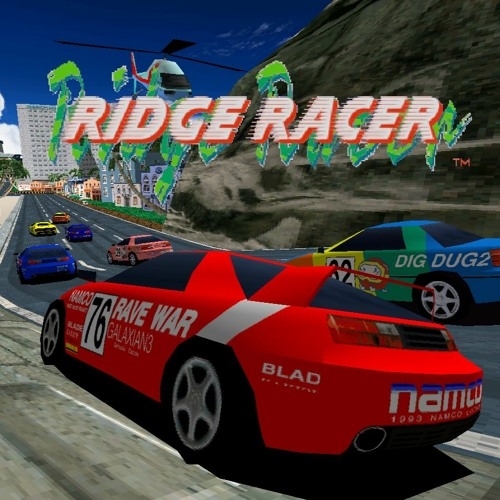
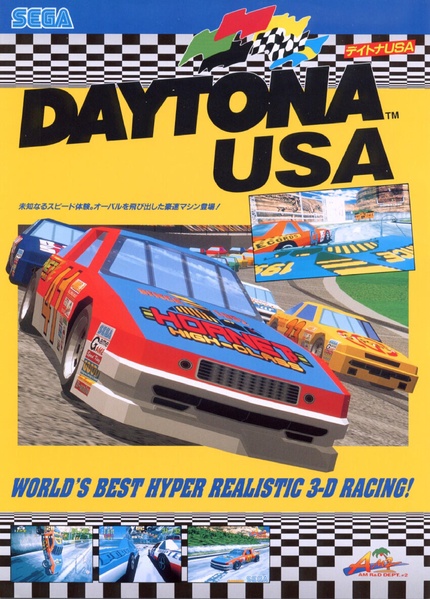
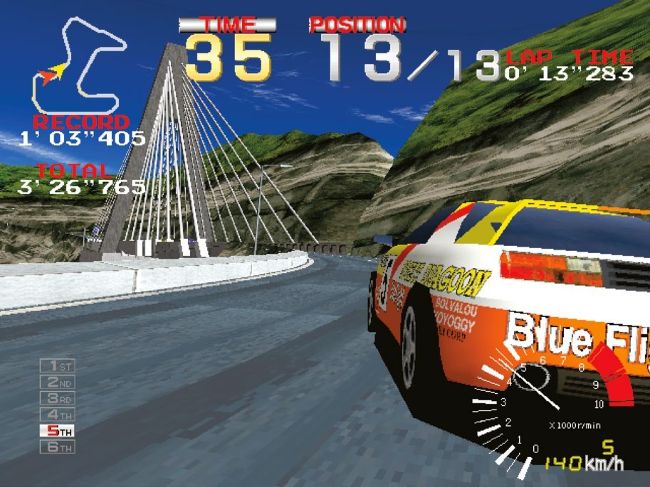
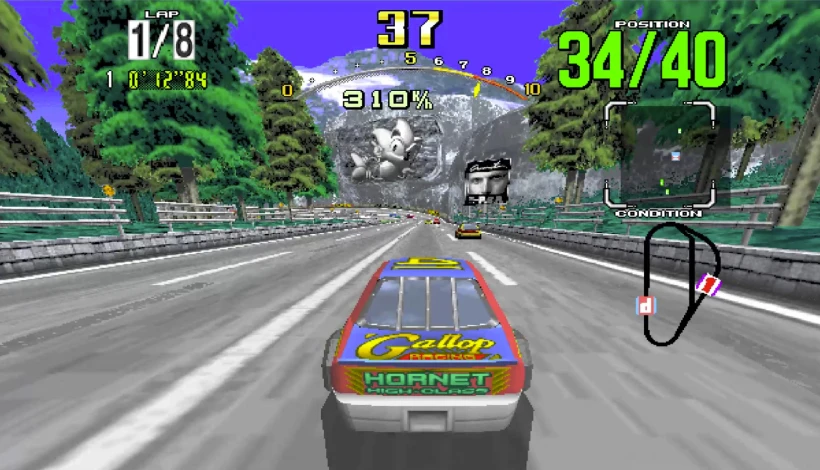
>SEGA and Namco each show off the future of 3D gaming with their respective Daytona USA (Model 1) and Ridge Racer (System 22) cabinets in August of 1993. Everyone who bears witness to these demonstrations are floored, as they provide fast, fluid 3D texture-mapped polygonal graphics unlike anything seen before or elsewhere, creating a fervor for 3D gaming worlds.

img_19-2.jpg
daytona-usa-sonic-in-mountain-featured.webp

Gameplay for Namco's Ridge Racer (left); SEGA's Daytona USA (right)

However, for the time being, companies like Sharp, NEC, and even SEGA are under the assumption that the home console market will go for a much more modest uptake of 3D graphics while primarily focused on 2D sprites and FMV. It isn't until a certain newcomer formally reveals their own entry into the 5th-gen race that these assumptions start to be seriously challenged, with each of the other players providing their respective responses.

[SEPTEMBER]

hq720.jpg

The Turbo Duo's version of SFII finally sees release, ahead of the PC-Engine Duo version, no less

>September 1993 brings about the release of Street Fighter 2 Super Champion Edition for the Turbo Duo. While it's a bit later than the SEGA Genesis version, the Turbo Duo edition of the game has extra content not present in the Genesis cart. It is also placed in hand with a wave of additional releases, especially ports from DOS, Amiga & Atari ST systems. These games, released between September and December 1993 for Turbo Duo, include:

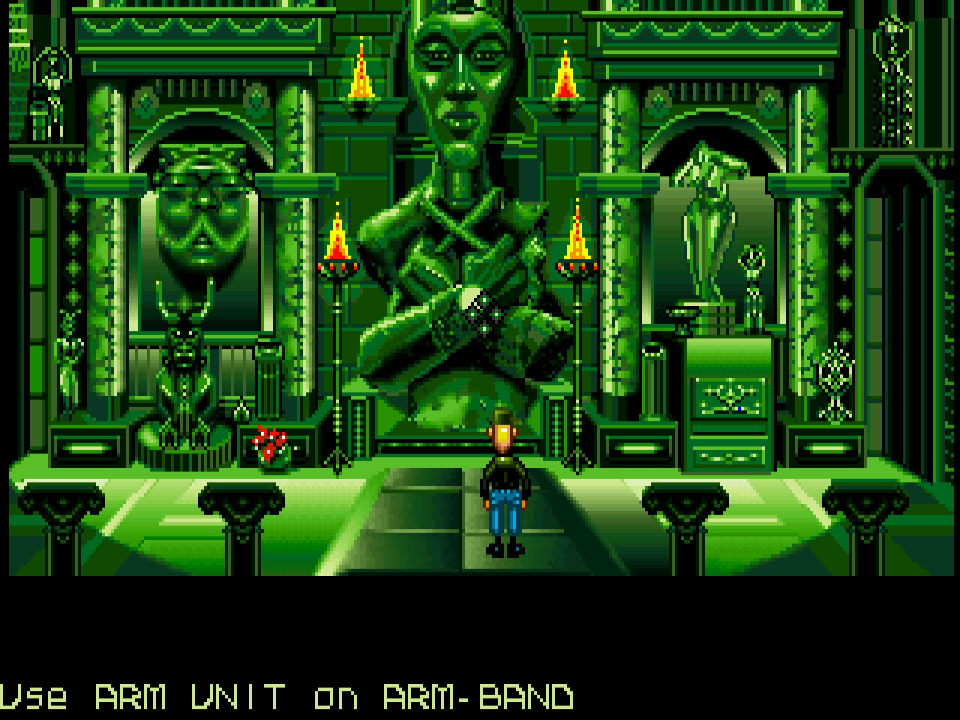
scummvm-bargon-00015.png

>Bargon Attack (D: Coktel Vision; P: Turbo Technologies)​

start_1029.png

>Buck Rogers: Matrix Cubed (D: Strategic Simulations Inc; P: Stategic Simulations Inc/Turbo Technologies)​

First-Samurai-022.jpg

>First Samurai (D: Vivid Image; P: Hudson Soft USA)
*This gets a release on both HuCard and CD format, with the HuCard version cutting some of the content and CD-quality audio & music

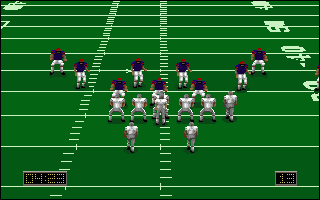
front-page-sports-football-pro_7.png

>Front Page Sports: Football (D: Dynamix Inc; P: Dynamix Inc)
*This gets a release on the SEGA CD in 1994, but that one is Football Pro)

maxresdefault.jpg

>Lamborghini: American Challenge (D: Titus France SA; P: Turbo Technologies)​

Psychic_Storm_02.gif

>Psychic Storm (D: AlfaSystem Co Ltd; P: Working Designs Inc.)
*Gets both a HuCard and CD release

[OCTOBER]

wmmdCaIVhW8ohBJA.png
8huONxoCdSZNqk7k.png

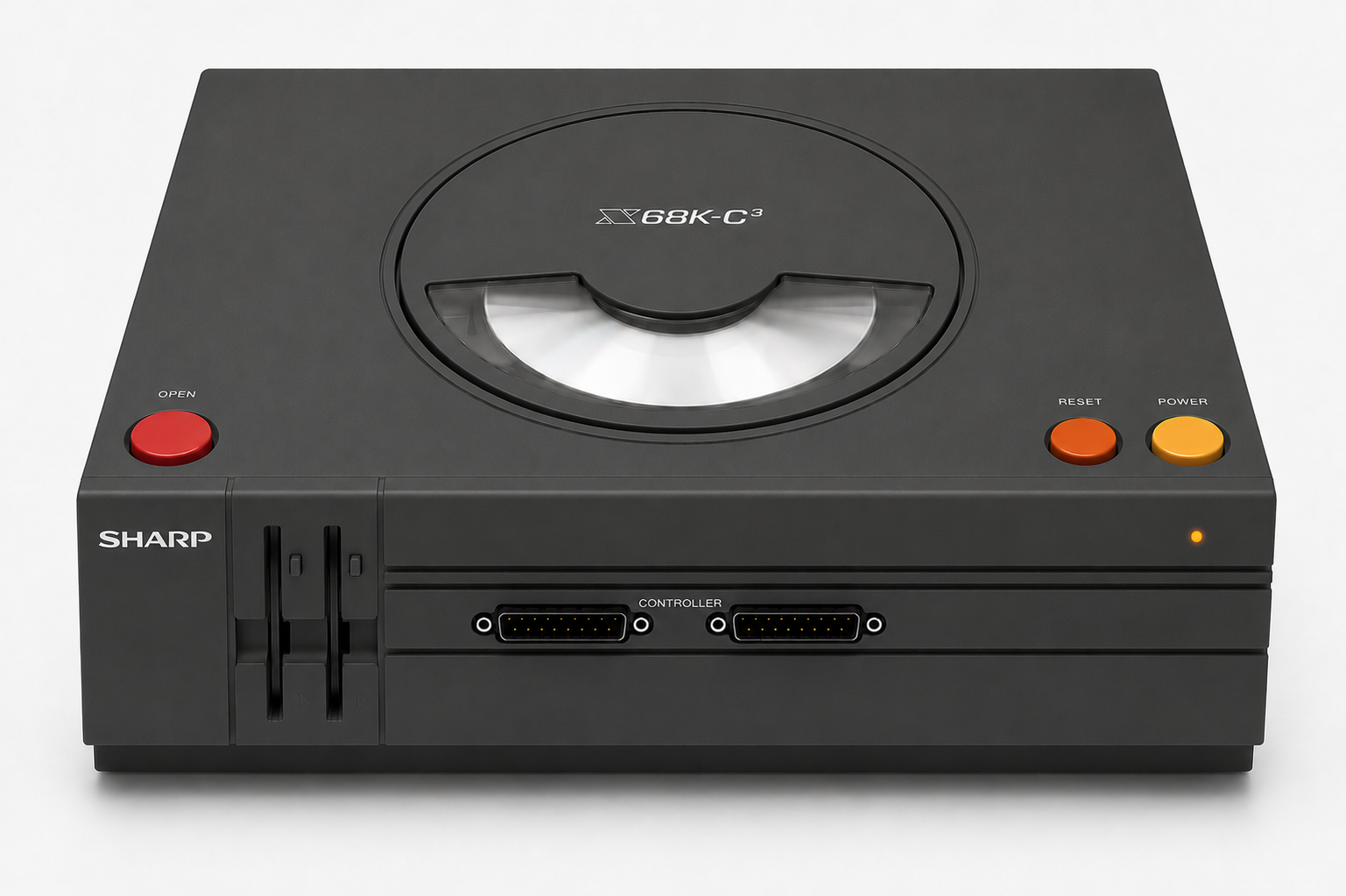
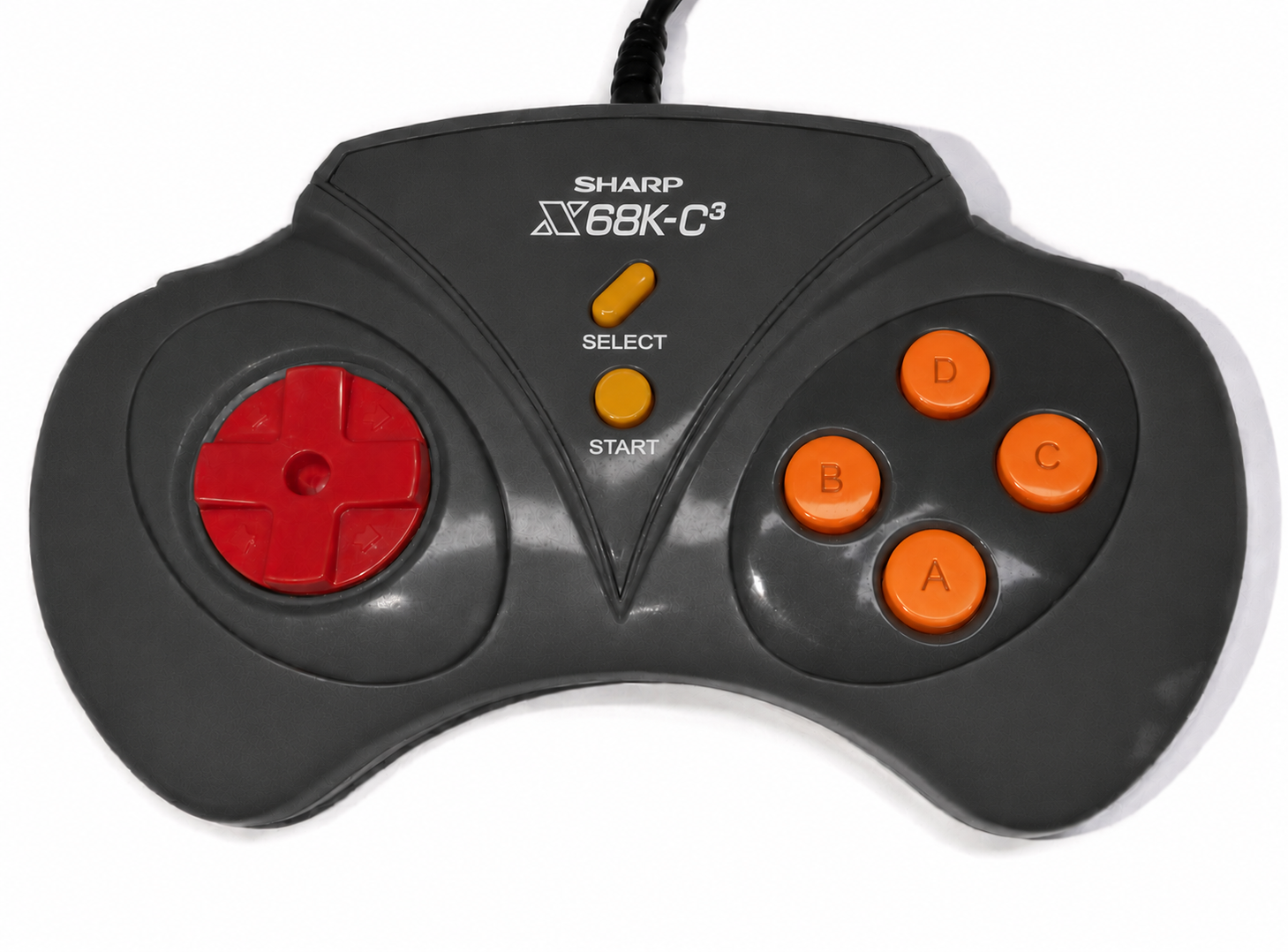
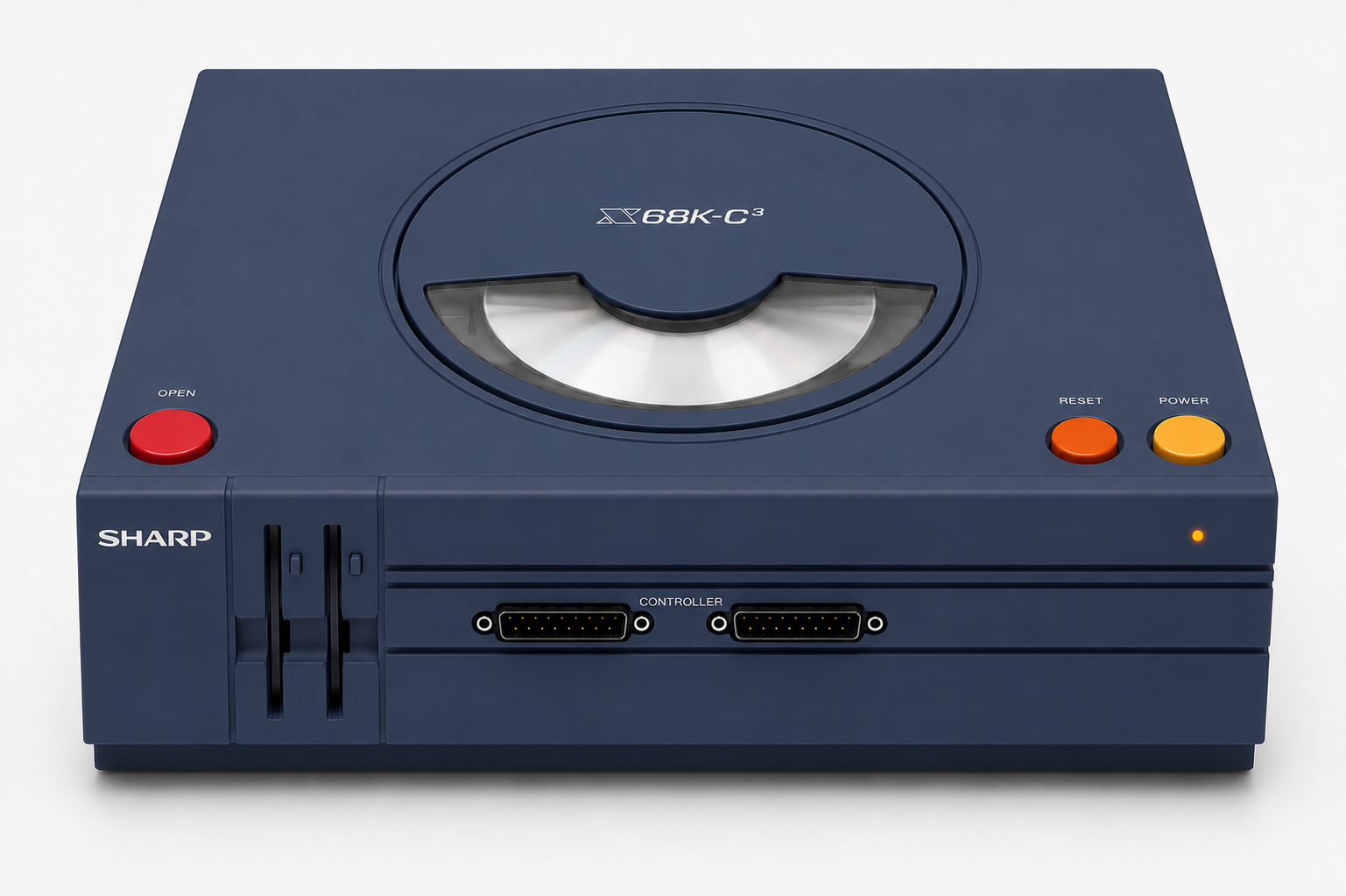
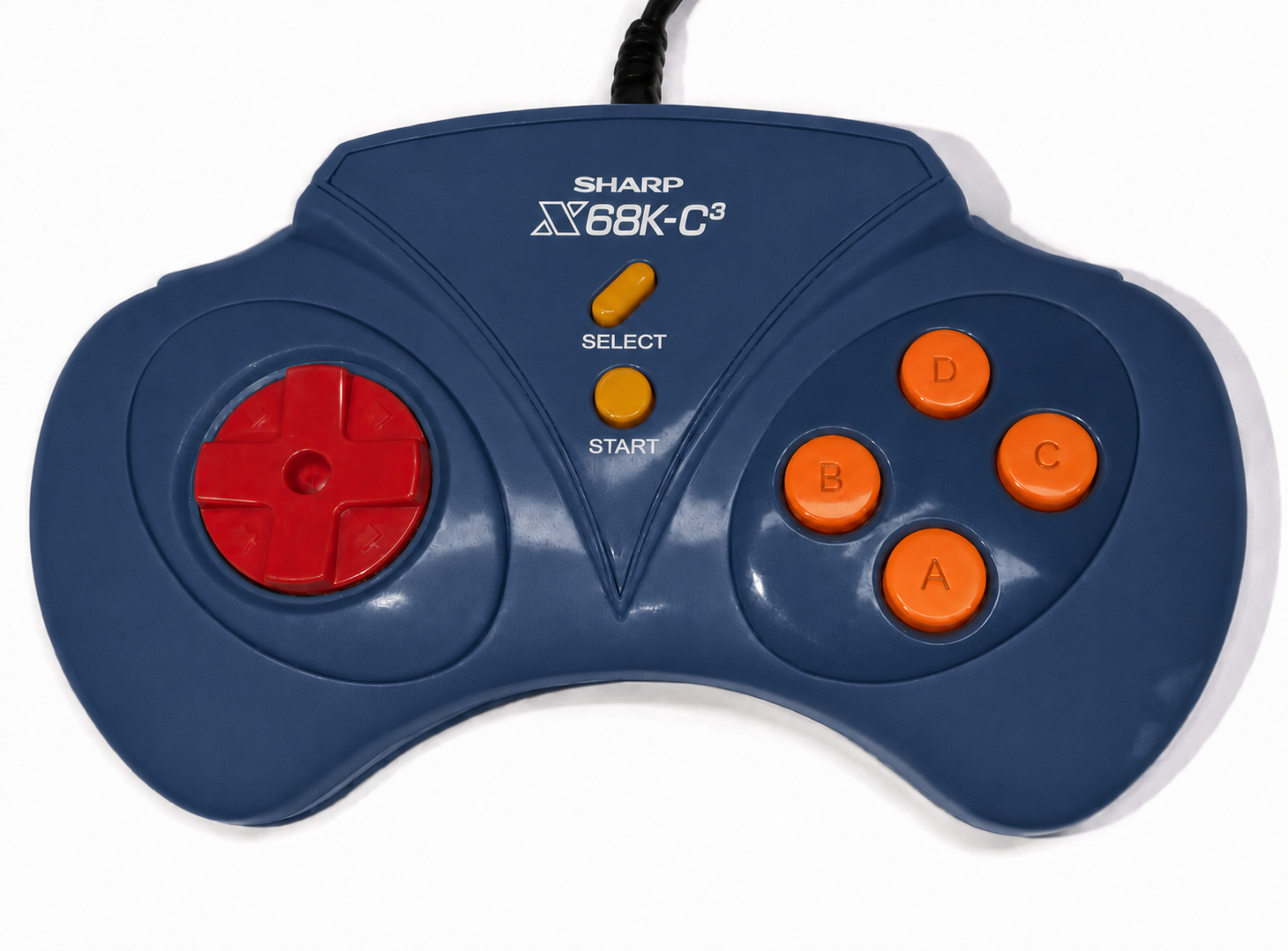
The Sharp X68K-C^3 console (black model, left); Sharp X68K-C^3 official game pad (black model; right)

>Sharp formally announce the consolized X68000-CC system, called the X68K-C^3 (Cubed), in a press release in October 1993. They also show off the system's design shell. The specifications provided are:

>Motorola 68EC020 CPU @ 25 MHz

>MBSU (Memory Bankswitch Unit) @ 25 MHz​

*Later renamed to BMA (Bank Mapping ASIC) in December 1993

>Enhanced Cynthia ASIC (Cynthia+) with texture mapping (Affine) + Gourard Shading support

>Zilog Z380 CPU (audio)

>1x CD-ROM drive with 64 KB buffer cache​

*Technically rated at 1x-speed, but highly optimized to function closer to a 4x-speed drive with the MBSU Delta Compression usage

>1 MB system main RAM​

*For cost-related reasons, this was reduced down from 2 MB to 1 MB

>1.5 MB Fast VSRAM (Video SRAM)
*For cost-related reasons, this was reduced from 1.5 MB to 1 MB

>64 KB audio SRAM (bank-switchable with virtual partition in main system RAM)

>32,768 color palette with up to 16,384 on-screen

>8-channel FM + PCM audio

>2 controller ports

>Composite + S-Video Out

>16-bit parallel interface for save card peripherals (battery-backed SRAM)*
*This is integrated into the MBSU​

As well, they announce a target price of ¥35,600 (~ $349), and a release date in Japan for April 1994, with a planned Western release in Holiday 1994. Sharp have been working
behind-the-scenes to court X68K game developers into porting some titles to the X68000 platform, and have placed funding towards a small handful of X68000 developers to create
new titles for the system at launch with compatible versions for X68000 computers (and the X68000-CC) due sometime after (preferably around the time the new graphics accelerator
cards are released).

Sony-PlayStation-Console

Sony's PlayStation announcement sends shockwaves through the games industry

>The PlayStation reveal highlights a potential shortcoming of NEC's 32-bit console plans: as it currently stood, the Project Tetsujin design was primarily focused on 2D, with 3D more limited to pseudo-3D SEGA Super Scalar-style visuals. Its V810 CPU was more than capable for the planned 2D features and modest pseudo-3D (at least potentially within range of what NEC suspected the consolized X68000-CC would have), but was apparently much less capable than Sony's PlayStation in this area. In truth, Turbo Technologies was already imploring if the system's design would feature more functionality for 3D, and the HCDDG were already modifying the cartridge port interface to support expansions that could in theory also enable for an acceleration coprocessor for 3D math. However, such was kept out of the system directly due to concerns over production costs, and the HCDDG assuming the market would prefer high-stakes 2D over "clumsy" 3D (a similar thinking to why the SEGA GigaDrive was being developed with a major focus on 2D graphics).

In the face of PlayStation's rumored specs, the HCDDG felt the 2nd MJPEG decoder plus the increase to a 2x-speed CD-ROM + macroblock tiling capability of the King ASIC, alongside the direct-bypass capability of the MJPEG decoders, would provide superior flexibility, lower development costs, and better image quality than the polygonal focus of the PlayStation, while also besting Sharp's upcoming consolized X68000-CC and the assumed FM Towns Marty extension design (of which news was light on). Additionally, the market performance of American-centric 3D systems like the Atari Jaguar and 3DO were already appearing to lose a lot of steam shortly after their launches, even if Turbo Technologies (with a more immediate viewpoint of the situation) could sense that those systems being 3D wasn't the reason they were struggling, and also (through NEC America/NEC Technologies) seeing the acceleration of 3D graphics in the IBM PC-compatible space as a potential encroachment on the console market given declining prices for entry-level PCs in the Western market.

NEC Corporation & its Home Electronics senior executives do not believe that Sony will be able to deliver a 3D-focused game console for the 1994 market at a sustainable financial level without burning through and losing tons of money. They also feel that Sony are overestimating the demand and impact for 3D in a home console at present time, especially if it comes at the expense of 2D graphics performance. They also are convinced that the enhanced MJPEG capabilities of the PC-Engine successor design can utilize features like decode bypass streaming & video-to-texture (via macroblock tiling and packed pixel blit support with X/Y step register functionality between the King ASIC and modified PEGC blitter) can provide more immersive experiences than what will likely be crude 3D of Sony's system, while also besting Sharp's upcoming system in 2D. In spite of this, they do consider a slight modification of the King ASIC's Affine Transformation Engine* to handle shearing and perspective operations. As the King ASIC's design masks have not yet been finalized, implementing such a change would be relatively simple and not incur any development setback for the planned launch, though it could delay arrival of final silicon for developers by a month or two.

*Previously known as the Warp Transformation Engine

Cb-UP_KWIAE1xW6

Prototype of SEGA's GigaDrive console

This is a very different reaction than SEGA, who are much more reactionary to the PlayStation announcement, and end up adding a second SH2 CPU plus making changes to the VDP1 chip to handle perspective distortion of sprites as a pseudo-3D implementation but, in the rush to do so, also leave the SCU DSP incomplete. Sharp, who are on a timeline for a H1 1994 launch of the consolized X68000-CC in Japan (and rumors of a Late 1994 release for it in America), decide that releasing early with their specification is better than delaying to redesign it for competing against a "phantom" PlayStation that has no wider hardware ecosystem to benefit from like the upcoming X68000-CC console. Even so, some internal debate carries on if perhaps the system RAM should be increased from the current 1 MB to 2 MB, or increase the VSRAM from its current 1 MB back to 1.5 MB. Ultimately, neither of these changes are put into effect.

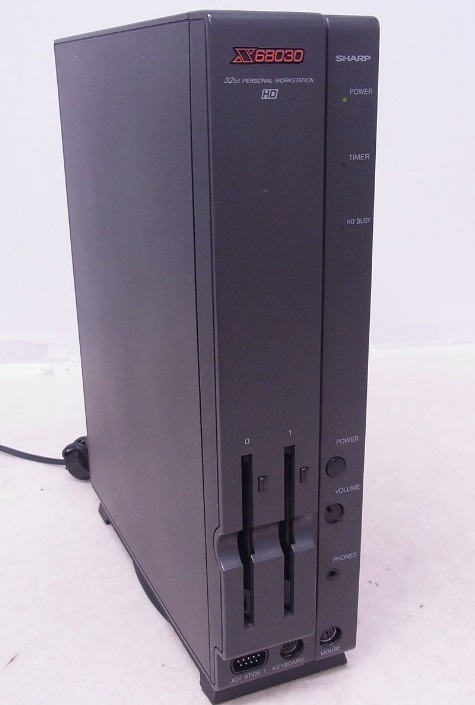
Another motivation for Sharp in this instance is that 1993 saw the release of their soon-to-be final mainline X68000 system, the X68030. While plans initially involve a successor (in the form of the Power X), between strong sales of the X68000-CC and (soon-to-be) healthy sales of the consolized system in 1994, Sharp decide that the X68K's future is better served in the console gaming & entry-level/legacy computer market, as higher-end computer focus and newer architecture can be focused on the Windows software & OS ecosystem.

[NOVEMBER]

1920px-Atari-Jaguar-CD-wPro-Controller.jpg
1920px-3DO-FZ1-Console-Set.jpg

Atari's Jaguar (left); The 3DO Company's 3DO (right). Both see a release in October.

>After their respective American launches last month, both the 3DO and Atari Jaguar are already showing problems with solidifying their positions in the market. The chief complaint with 3DO is that it is simply too expensive, but the Jaguar is seeing harsher criticisms in that its claims of 64-bit power are coming under fire. Additionally, Atari have had difficulty in securing top software houses to prioritize their system, and some aspects of Jaguar were left buggy in order to rush the system to market. The launch for Jaguar may be on a more local test market range (national deployment is not expected until January 1994), but signs aren't good.

For 3DO, a silver lining exists in the form of their recently-established partnership with SNK. Several SNK home conversions are on the way exclusively for the 3DO platform (in terms of 5th-generation support; SNK's own Neo Geo AES will still be seeing many of these same games albeit in cartridge format), while work on SNK's 3DO console variant is steadily underway, as is that of an arcade-based board. However, future developments within The 3DO Company will convince SNK to shift the technology basis for their arcade hardware to a newer, more powerful specification, but initial word on any of this getting out won't happen until at least 1995.

[DECEMBER]

>EOY sales for the NEC PC-98 Kantan amount to ~ 125K. NEC originally planned for only around 75K units for the March - December 1993 period, anticipating this would have been enough to combat DOS/V encroachment in Japan with a lower-margin entry-level PC-9821 based computer product. However, the competition from Sharp's X68000-CC and later Fujitsu's FM Towns Marty (February 1993) put NEC in a precarious position where the PC-98 Kantan also needed to compete against these devices as well, though initially throughout 1993 NEC felt the PC-98 Kantan-I add-on card was enough to lock-in NEC market share (plus bolster sales of higher-margin PC-9821 mainline computers), placing more limited priority on the PC-98 Kantan. Higher-than-expected sales from the X68000-CC in particular, though, would lead NEC to increase PC-98 Kantan supply in the latter half of the year.

As more content targeting the Kantan design begins to arrive late in 1993, NEC also consider building a new PC-9821 desktop SKU with the Kantan-I add-on bundled in and pre-installed. However, Sharp's announcement of an X68K-C^3 (and later, the reveal of the Sony PlayStation) puts a stress point on NEC WRT the PC-Engine's successor, and then noticing that Sharp's strategy actually sees them leveraging software compatibility between their home computer and console market. Eventually they realize this is a good example to go by and they shift plans from a PC-98 Kantan-EC refresh towards leveraging the PC-Tajigen as an entry-level bridge to the PC-9821 environment (and also expanding licenses for PC-Tajigen + PC-9821 hybrid variants to partners like Pioneer, who already have a PC-Engine module for their newly introduced LaserActive system).

>Combined sales of the TurboGrafx-16 and Turbo Duo in America hit just north of 3 million lifetime (3.1 million to be more specific). Once again, strong holiday sales combined with continued expansion & refinement of Operation Turbo Mode are largely to thank for this, combined with a better advertising campaign and larger provision of funds to get operations up to scale. TTI expect 1994 to be an even bigger year for the two systems, with guidance providing a total install base of 5 million reachable in the next 12 months.

==================================================================

This concludes Part 3 for the 5th-generation alternate timeline. Once again I had to break it up into two halves, and 1994 will be even more sub-parts in that regard. A lot of developments have occurred and now you can finally see why I had Sharp go through the paces with the X68000-CC; it was a stepping stone to the X68K-C^3. One technical detail about X68K-C^3 is that while it uses the same CPU that was used in the Amiga CD32, it avoids the limitations of the 68EC020 in that system (in terms of reduced address space and overhead for any bank-switching operations) thanks to the aforementioned MBSU.

So, for tomorrow I likely will not post the '1994' part of the timeline just yet. Instead I'll provide a technical document for the X68K-C^3, so if any of you are interested in getting an idea of how the architecture works in deeper detail, you can read it with the post on Sunday. I'll do this with the other systems in due time, but for now just the X68K-C^3 since that is the first (aside from FM Towns Marty, 3DO, and Jaguar, which are known quantities and unchanged vs. OTL, so no need to list specifications for them here...until we get to the SNK 3DO variant anyway). The technical specifications for NEC's system will be particularly in-depth, so anyone who ever wanted to see what a PC-FX that went through proper redesign between the 1992-1994 period could've potentially looked like architecture-wise, please look forward to that system's technical specifications in particular.

Hell, even the Saturn will have some important changes vs. OTL, just enough to not make it a complete nightmare of engineering and shaving a bit of costs off the BOM. As ultimately, it was SEGA's inability to effectively cost-reduce when competing with Sony's aggressive price cuts that pushed them into abandoning the system early. They were simply losing too much money.


Look forward to the Sharp X68K-C^3 technical documentation tomorrow; 'till then, peace!

(Link to Part 4 (1 of 2))
 
Last edited:
(Link to Part 3 (2 of 2))

[AVGT: PART 4 (SPECIAL)]

==================================================================


XjWnAnjwqPoeCO9T.png

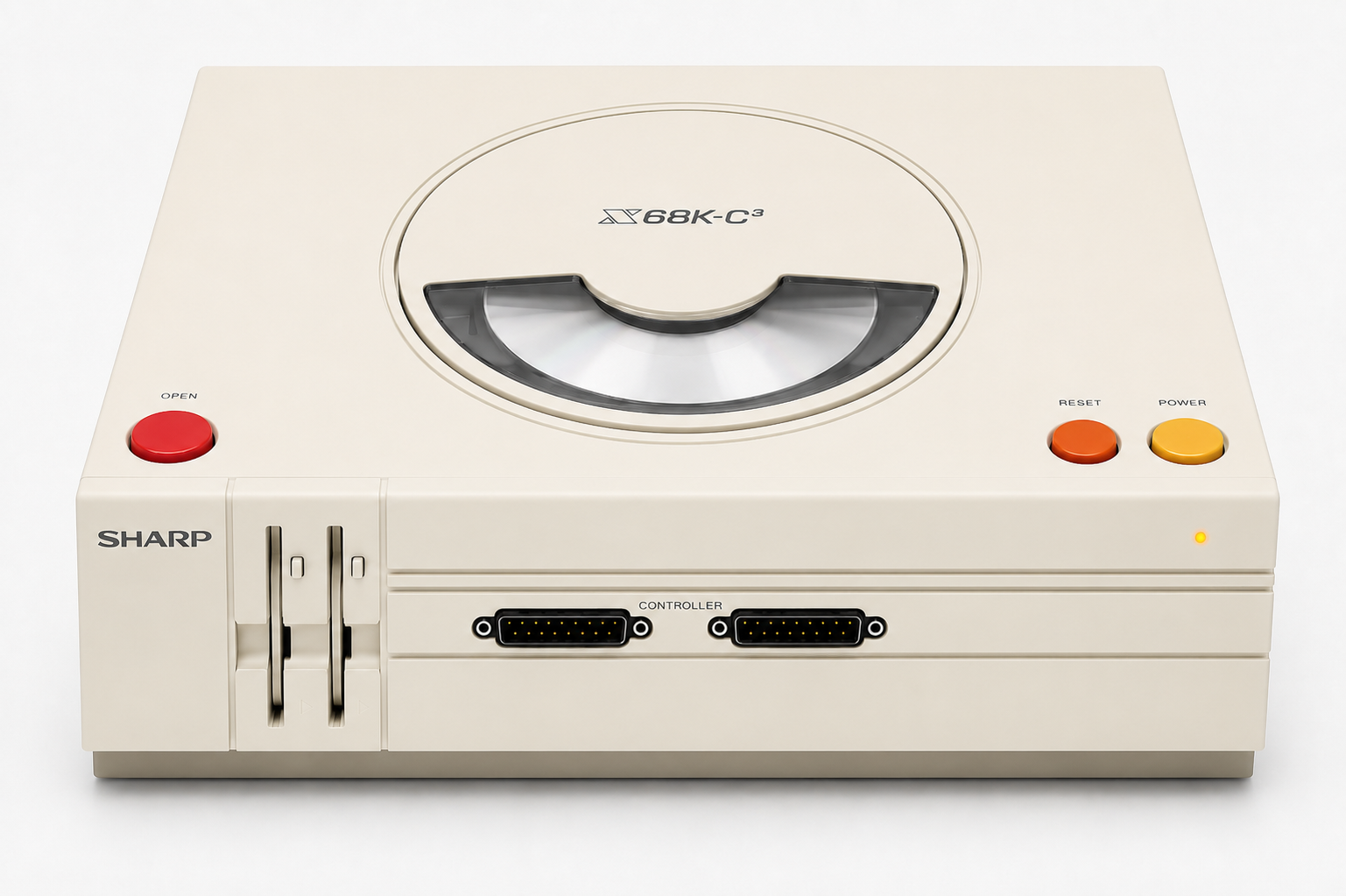
Sharp X68K-C^3 Cream-White Model (releases Summer 1995 in Japan)

[SHARP X68K-C^3]

[ARCHITECTURAL SPECIFICATIONS DATASHEET]
[GENERAL]
RELEASE DATE: April 1994 (Japan), TBA (NA, Europe)

MANUFACTURER: Sharp Corporation

INTRODUCTORY PRICE: ¥35,600 ($349)​
[CPU]
MODEL: Motorola 68EC020

CLOCK SPEED: 25 MHz

ON-CHIP INSTRUCTION CACHE: 256 B (zero wait state)

EXTERNAL ADDRESS SPACE: 24-bit (16 MB)

FPU: N/A

CACHE CONTROL: CACR (Cache Control Register; supports cache lock & cache freeze)

SPECIAL INSTRUCTIONS: (Bitfield) BFEXTU, BFINS, BFCHG

NOTES:
-Lack of FPU demands 3D geometry, physics etc. be processed using fixed point approximates

-Bitfield instructions enable extraction & insertion of arbitrary-width bit fields from packed data (useful for compressed 3D vertex data formats)

-CACR enables routine-specific cache locks/freezes for retaining hot code paths (i.e matrix-multiply loops, inverse square root approximates) in zero wait state cache

-BMA ASIC extends effective memory reach of 68EC020 CPU via bank-switched windowing into CD-ROM​
[BANK MAPPING ASIC]

The Bank Mapping ASIC is central hub of the X68K-C³ architecture. Manages all memory address translation, DMA transfers, and peripheral interfacing; operates synchronously with the CPU at 25 MHz.
CLOCK SPEED: 25 MHz

ADDRESS TRANSLATION: Mux, shifts & adds (no MMU, no TLB; single-cycle)

BANK WINDOWS: 4 total; 4 MB map chunks of 16 MB CPU address space per window

BANK REGISTER WIDTH: 18-bit (BR1, BR2, BR3)

SECTOR ALIGNMENT: 11-bit shift (2 KB); enables 2048-byte CD sector align

PREFETCH BIT: Bit 31 of each Bank Register triggers CD-ROM DMA auto-prefetch

WRITE PROTECTION: Hard-wired write protect (100000h-3FFFFFh); unauthorized writes trigger NMI

[INTEGRATED CONTROLLERS]
DRAM CONTROLLER: Manages 1 MB system RAM

CD-ROM DMA ENGINE: Works in tandem with 4x bank registers for CD data streaming

CD-ROM SRAM CACHE CONTROLLER: For 64 KB SRAM data cache

SRAM SAVE CARD INTERFACE: Manages battery-backed SRAM save cards​

[BANK WINDOW CONFIGURATION]
WINDOW 0: Fixed; kernel, stack, interrupt vectors, CD-ROM buffers, VRAM aperture, I/O registers

WINDOW 1 (BR1): General banked; sliding 4 MB viewport into CD-ROM data region

WINDOW 2 (BR2): General banked; sliding 4 MB viewport into CD-ROM data region

WINDOW 3 (BR3): General banked; sliding 4 MB viewport into CD-ROM data region​

[MEMORY MAP (WINDOW 0 (FIXED)]
000000h-0FFFFFh: 1 MB, system RAM (main DRAM); kernel, stack, heap, interrupt vector table

100000h-10FFFFh: 64 KB, CD-ROM SRAM cache; high-speed scratchpad (CPU & BMA DMA Engine)

110000h-18FFFFh: 512 KB, BIOS ROM; system startup, low-level I/O drivers

190000h-1AFFFFh: 128 KB, SRAM Save Card; CPU direct access to battery-backed save data

200000h-2FFFFFh: 1 MB, Cynthia+ VRAM; CPU-direct VRAM write aperture (50 MB/s)

300000h-3FFFFFh: 1 MB, I/O & Registers; BMA, Cynthia+, audio, Parallel IC control registers​

[CD-ROM WINDOWING REGISTERS (BR1 - BR3)]
ADDRESS RANGE: 400000h-FFFFFFh (3x independent 4 MB windows)
-Each bank register 18-bit; 11-bit shift leftwards maps a 4 MB window to begin at any 2048-byte sector boundary on disc​

-PREFETCH BIT (Bit 31): BMA monitors CPU read pointer when set. When CPU reads last 16 KB of current window, BMA triggers CD-ROM DMA engine to pre-fill 64 KB SRAM cache with next sequential sectors automatically

-DELTA COMPRESSION MODE: Allows BMA to perform simple add ops on incoming CD-ROM data against existing cache during DMA (enables real-time delta texture decompression with zero CPU involvement)

-DIRECT BMA TO VRAM PASSTHROUGH: DMA Engine can stream data from a CD-ROM window directly to 200000h VRAM aperture; allows main RAM bypass for zero-CPU graphics transfer operations​

[MEMORY SUBSYSTEM]
[MAIN SYSTEM RAM]
TECHNOLOGY: DRAM

CAPACITY: 1 MB

CONFIGURATION: 2x 512 KB

CLOCK RATE: 25 MHz

BANDWIDTH: 50 MB/s

MAIN USE: CPU kernel, game logic, heap, AI logic, temporary geometry buffers​

[CD-ROM DATA CACHE]
TECHNOLOGY: SRAM

CAPACITY: 64 KB

CONFIGURATION: 4x 16 KB (8-bit width per)

CHIP SPEED: 55 ns

BUS WIDTH: 32-bit

CLOCK RATE: 25 MHz

BANDWIDTH: 100 MB/s

INTERFACE: BMA ASIC dedicated memory controller

SECONDARY ROLE: L2/L3 scratchpad RAM for hot textures, frequently used sprites, critical variables​

[MEMORY BANDWIDTH SUMMARY]
SYSTEM DRAM: DRAM, 16-bit, 25 MHz, 50 MB/s

CD-ROM SRAM CACHE: SRAM (55 ns), 32-bit, 25 MHz, 100 MB/s

CYNTHIA+ VRAM: SRAM (70 ns), 32-Bit, 50 MHz, 57.14 MB/s

Z380 AUDIO SRAM: SRAM, 8-bit, 16 MHz, 18 MB/s​
[CD-ROM SUBYSTEM]
DRIVE SPEED: 1x (optimized)

RAW TRANSFER RATE: 150 KB/s

EFFECTIVE TRANSFER RATE: 450 KB/s (BMA ASIC delta-compression)

INTERFACE: BMA ASIC CD-ROM DMA Engine

FIRMWARE: Continuous Seek (drive maintains constant linear velocity (CLV), BMA pre-fills 64 KB SRAM cache in background)

NOTES:
-1x-speed drives use lower-tolerance motors & consumer-grade pickup lasers, reducing costs

-Latency penalty is masked by BMA ASIC prefetch logic

-BMA delta-compression allows decompression of textures stored on disc as frame deltas (difference-only) in real-time; multiplies effective perceived visual bandwidth by 3x - 4x​

[GRAPHICS SUBSYSTEM (CYNTHIA+)]

Custom Sharp ASIC based on the X68000-CC's Enhanced Cynthia (itself based on the X68000's Cynthia). Retains all of Enhanced Cynthia's 2D sprite & tile capabilities; adds a Texture Mapping Unit (TMU) & expanded blitter functionality for 3D rendering
CLOCK RATE: 50 MHz

PRIMARY 3D PRIMATIVE: Quad (native); supports triangles via subdivided/degenerate quads

TEXTURE MAPPING: Affine (linear)

HARDWARE SHADING: Flat & Gouraud Shading supported

ALPHA BLENDING: 1-bit stencil, 5-bit alpha (32 levels)

BLENDING MODES: Additive, Subtractive, Multiplicative, Average (50/50)

INTEGRATED BLITTER: Yes (alpha-blending & VRAM-to-VRAM copy)

LEGACY 2D: Text & Sprite layers processed during video signal output (no bandwidth cost to 3D pipeline)

DATA SOURCE: CPU via BMA ASIC from main system RAM, CD-ROM windows, or 64 KB SRAM cache

CPU DIRECT WRITE: Yes (Window 0 200000h aperture @ 50 MB/s)

[DATA PIPELINE]
-CPU issues rendering commands to BMA ASIC

-BMA fetches graphics data from either main system RAM, CD-ROM drive (sliding bank window registers), or 64 KB CD-ROM SRAM cache

-BMA can DMA directly into Cynthia+ VRAM to bypass main system RAM (CD -> VRAM passthrough)

-CPU can write directly to VRAM via Window 0 200000h memory aperture @ 50 MB/s

-BMA ASIC builds display list from CPU instructions in main system RAM; can then asynchronously blast completed command list to Cynthia+ VRAM via DMA as CPU handles
other tasks for next frame​

[AUDIO SUBSYSTEM]

The X68K-C^3 audio subsystem is built around a Zilog Z380 sound controller, offloading audio management from the 68EC020 CPU. FM & ADPCM chips are similar to those found in classic Capcom & Konami arcade boards.
[COMPONENTS]
-ZILOG Z380: Sound controller/audio sub-CPU (16 MHz)

-YAMAHA YM2151 (OPM): FM synth (8-operator, 4-algorithm) (4 MHz)

-OKI MSM6258V: ADPCM voice synthesis (8 MHz)

-YAMAHA YM3012: External floating-point DAC​

[ZILOG Z380 SUB-CPU SPECIFICATIONS]
CPU CORE: Z380 (Z380 class; 32-bit internal bus, 16-bit external bus)

CLOCK RATE: 16 MHz

PRIVATE SRAM: 64 KB

SRAM WIDTH: 8-bit (utilizes Z380's bus-sizing feature)

SRAM CLOCK: 16 MHz

SRAM BANDWIDTH: 18 MB/s

MULTIPLIER: Hardware 16-bit x 16-bit -> 32-bit (signed or unsigned)

DIVIDER: Hardware 32-bit / 16-bit = 16-bit quotient & 16-bit remainder

ADDITIONS: 32-bit register set, expanded addressing modes, enhanced interrupt controller

BANK-SWITCHING: Handled by BMA ASIC; accesses audio data in 1 MB main system RAM

MLT INSTRUCTION: Multiplies 2x 8-bit registers to form 16-bit product (17 clock cycles)*
*This instruction's only meant for Z80 & Z80182 code needing specific 17-cycle mults for compatibility & timing purposes. Z380 has its own, faster multiply hardware.

NOTES:
-Can serve as a general math coprocessor for 3D geometry thanks to its single-cycle 16-bit x 16-bit > 32-bit multiplier & 32-bit registers.​

[I/O, STORAGE, PERIPHERALS]
[BIOS ROM]
CAPACITY: 512 KB

TYPE: Mask ROM

INTERFACE: Parallel IC (shared with controller subsystem)

BUS CONNECTION: 68EC020 system bus (Parallel IC)​
[CONTROLLER SUBSYSTEM]
INTERFACE IC: Dedicated Parallel IC on 68EC020 external system bus

CONTROLLER PORTS: 2

MULTI-CONTROLLER SUPPORT: Yes (external peripheral, allows 1x port to support up to 3x controller inputs)

SYSTEM LINK SUPPORT: Yes (via controller ports for inter-system communication)​
[SRAM SAVE CARDS]
MAXIMUM CAPACITY: 128 KB

BATTERY-BACKED: Yes

INTERFACE: BMA ASIC

BUILT-IN SLOTS: 2 (certain peripherals may utilize both slots or block off access to 1)

EXPANSION SUPPORT: Optional multi-slot peripheral (blocks 1x of system built-in slots, but expands slot count to 4x)​
[VIDEO/AUDIO OUTPUT]
OUTPUT PORT: 1x proprietary multi-AV

SUPPORTED SIGNALS: Composite, RGB, S-Video

SIGNAL CONVERSION: Internal DACs; automatic conversion based on connection type detected at insertion point​

[PERFORMANCE PROFILE]

Three tiers of performance accounted for: Theoretical (Cynthia+ hardware limit only), Standard Real-World (typical unoptimized pipeline), & Mastered (fully leveraged hardware, all programming tricks applied)
[3D VERTEX TRANSFORM RATE (VERTICES/SEC)]

Bottleneck is 68EC020 fixed-point matrix math. 700-900 cycles per vertex transform (4x4 matrix) w/o cache optimizations
[UNLIT/UNTEXTURED]
THEORETICAL: 650K

STANDARD: 35K

MASTERED: 115K
[1 LIGHT/1 TEXTURE]

THEORETICAL: 450K

STANDARD: 22K

MASTERED: 90K​

[2 LIGHT/1 TEXTURE]
THEORETICAL: 380K

STANDARD: 15K

MASTERED: 52K​

[POLYGON THROUGHPUT (QUAD)]

Native primitive, 50-pixel polygon size, 16-bit color depth
[UNLIT/UNTEXTURED]
THEORETICAL: 220K

STANDARD: 18K

MASTERED: 58K​

[1 LIGHT/1 TEXTURE]
THEORETICAL: 150K

STANDARD: 12K

MASTERED: 48K​

[2 LIGHT/1 TEXTURE]
THEORETICAL: 110K

STANDARD: 8.5K

MASTERED: 29K​

[POLYGON THROUGHPUT (TRIANGLE)]

Cynthia+ handles triangles as subdivided or degenerate quads
[UNLIT/UNTEXTURED]
THEORETICAL: 185K

STANDARD: 28.29K

MASTERED: 42K​

[1 LIGHT/1 TEXTURE]
THEORETICAL: 125K

STANDARD: 19.32K

MASTERED: 36K​

[2 LIGHT/1 TEXTURE]
THEORETICAL: 95K

STANDARD: 13.685K

MASTERED: 21K​

[FILL RATE]
PIXEL FILL RATE (FLAT SHADING): 28.57 Mpixels/sec (Theoretical), 26 Mpixels/sec (Mastered)

PIXEL FILL RATE (AFFINE): 14.28 Mpixels/sec (Theoretical), 12.5 Mpixels/sec (Mastered)

ALPHA BLENDING (50/50 AVERAGE): 9.52 Mpixels/sec (Theoretical), 8.2 Mpixels/sec (Mastered)​

[2D SPRITE PERFORMANCE (60 FPS)]
8x8: 3700 (Standard), 4200 (Mastered)

16x16: 930 (Standard), 1250 (Mastered)

32x32: 230 (Standard), 310 (Mastered)

64x64: 58 (Standard), 75 (Mastered)​

[SCENE COMPLEXITY SCENARIOS]
STANDARD REAL-WORLD: ~ 400-600 quads per frame

OPTIMIZED (30 FPS, 1 light/1 texture): ~ 700-900 quads per frame

MASTERED (30 FPS): ~ 900-1000+ quads per frame

2D/3D HYBRID: 3D TMU handles character & floor geometry. Legacy sprite layers render backgrounds & UI at zero bandwidth cost to 3D pipeline​

(Link to Part 4 (2 of 2))
 
Last edited:
(Link to Part 4 (1 of 2))

[PROGRAMMING OPTIMIZATION STRATEIGES]

The X68K-C^3's real-world performance ceiling is determined not by its specifications alone, but by the degree to which programmers can exploit the specific architectural interactions between the 68EC020, BMA ASIC, Z380, and Cynthia+ chip.
[68EC020 STRATEGIES]
[CACHE LOCKING (CACR)]
-Critical inner loops (matrix multiply, perspective projection) are hand-optimized in assembly to fit within the 256-byte instruction cache.

-The cache is then locked via the CACR, ensuring the loop never fetches instructions from the 50 MB/s Main DRAM bus.

-Performance gain: 30–50% increase in vertex transformation speed; revises 1-light/1-texture rate from ~22,000 to ~33,000 vertices/sec.​

[BITFIELD INSTRUCTIONS (BFEXTU, BFINS, BFCHG)]
-3D vertices stored in packed 10-bit or 12-bit formats in Main RAM to conserve memory.

-BFEXTU extracts a 12-bit coordinate from a bitstream in a single instruction, replacing multiple AND/OR/LSR sequences.

-Significantly reduces geometry setup time and frustum clipping overhead.​

[SELF-MODIFYING CODE/POLYMORPHIC JUMP TABLES]
-Transformation routines rewrite their own assembly instructions based on the current object's properties (e.g., deleting transparency checks for opaque objects).

-Eliminates IF/ELSE branching inside inner loops, preventing pipeline stalls.

-Potential vertex throughput: 40,000+ vertices/sec.​

[INVERSE SQUARE ROOT CACHE FREEZING]
-A branchless approximation of 1/√x (similar to fast inverse square root later used in Quake) is written, executed once, and frozen in the cache.

-Ensures the most critical math routine in the engine always runs at zero-wait-state speed, creating a virtual FPU effect.​

[RASTER-TIMED VRAM WRITES (H-BLANK EXPLOIT)]
-The BMA ASIC signals the CPU via interrupt exactly when the Cynthia+ enters its Horizontal Blank interval.

-A pre-compiled write loop held in the 256-byte cache bursts pixel data or texture updates into VRAM precisely during H-Blank, when the Cynthia+ is not reading VRAM.

-Result: Free bandwidth; the CPU inserts data without competing with the GPU.​
[BMA ASIC STRATEGIES]
[DOUBLE-BUFFERED ASYNCHRONOUS DMA]
-While Cynthia+ rasterizes the current frame, the CPU calculates the next frame's vertices and stores them in a 64 KB segment of Main RAM.

-Once the GPU is free, the BMA blasts the completed command list into Cynthia+ at the full 50 MB/s bus speed.

-Performance gain: Polygon rate from ~12,000 to ~19,000+ polygons/sec (1 light/1 texture) (Standard).​

[DMA-INTERLEAVED TEXTURE SWAPS]
-BMA is set to Burst-Mode DMA during V-Blank, synchronized to 68EC020 internal clock cycles.

-DMA cycles are interleaved between CPU memory fetches, stealing unused clock cycles to move texture data from the 64 KB SRAM cache to VRAM.

-Result: Zero-latency texture streaming — high-resolution textures flow into Cynthia+ in the background.​

[DELTA-COMPRESSION CD-ROM STREAMING]
-Textures stored on disc as frame deltas (difference-only data).

-BMA performs addition of new delta data against existing cache contents during the CD→cache DMA transfer.

-Effective CD bandwidth increases from 150 KB/s to ~450 KB/s equivalent visual detail.​
[Z380 COPROCESSOR STRATEGIES]
[GOURAUD SHADING OFFLOAD (MLT INSTRUCTION]
-Z380's 16×16 multiply executes in 3 cycles

-complete lighting calculation (dot product, intensity scale) now requires roughly one‑third the cycles.

-Performance gain: ~35% reduction in per‑vertex lighting overhead; sustained 80 000–90 000 vertices/second in optimised engines.​

[ASYNCHRONOUS NEAR/FAR GEOMETRY SPLIT]
-3D scene divided into Near Field (handled by 68EC020 at 32-bit precision) and Far Field (handled by Z380 at 16-bit precision).

-BMA scavenges completed vertices from both CPUs simultaneously via DMA, merging them into a single command stream for Cynthia+.

-Result: Effectively increases system geometry throughput to 68,000+ vertices/sec.​

[V-BLANK Z-SORTING]
-During Vertical Blank, when FM registers are already set and the Z380 has no audio tasks, it is assigned display list Z-sorting duties.

-Polygon depth sorting (back-to-front) is performed in the Z380's 64 KB private SRAM before the BMA sends the list to Cynthia+.

-Eliminates overdraw: every pixel the Cynthia+ draws is a final pixel, mathematically doubling or tripling effective fill rate.

-Result: Effective fill rate approaches 25+ Mtexels, near the 28.57 Mpixel/s theoretical peak.​
[CYNTHIA+ 2D/3D HYBRID STRATEGIES]
[DIRTY RECTANGLES & VRAM-TO-VRAR BLITS]
-Instead of clearing the entire framebuffer each frame, programmers track only screen regions that changed (Dirty Rectangles).

-Cynthia+'s integrated blitter moves data within the 1 MB VRAM pool at near-theoretical speeds without involving the BMA or Main RAM.

-Pre-rendered 3D objects and repeated background elements are cached in hidden VRAM regions and stamped onto the framebuffer by the blitter.

-Result: Sprite count and UI throughput approach the theoretical ~1,700 sprites/sec.​

[HARDWARE DITHER (BANDWIDTH REDUCTION]
-Ordered dither patterns of opaque pixels simulate transparency for distant or fast-moving objects.

-Dithered transparency requires only a standard Write operation (no Read-Modify-Write cycle).

-33% faster than true alpha blending; frees 5–8 MB/s of VRAM bandwidth for additional polygons or texture detail.​

[BILL OF MATERIALS (1994 LAUNCH)]
Motorola 68EC020 CPU: $16

LOGIC ASIC (BMA; custom Sharp gate array): $18

Sharp Cynthia+ (TMU, Blitter): $22

Main System DRAM: $22

VRAM (4x 256 KB 70 ns SRAM): $55

CD-ROM Cache (64 KB 55 ns SRAM): $8

CD-ROM Drive: $33

Z380 Audio CPU: $6.50

Audio SRAM (64 KB): $6

Audio Chips (Yamaha, OKI): $10

BIOS ROM (512 KB MROM): $3.50

Miscellaneous (PSU, PCB, shell, controller, I/O IC etc.): $45

BOM TOTAL: $245​

*Note that BOM is only part of total costs. It does not include shipping & handling, retailer margin cuts, or advertising dollars per unit. Factoring all of that in combined with Sharp historically selling hardware at a profit margin, is why they pursue an equivalent $349 launch price in Japan despite BOM being much lower than that (for reference, the PS had an equivalent of $380 launch price in Japan, and SEGA Saturn equivalent $440)

==================================================================

Next weekend I will pick up with 1994, but it might take a couple weeks to post everything in the 1994 part of the timeline. Hope you all have been enjoying things so far; as usual if you have any thoughts, ideas, input or corrections, feel free to share them. Now it's time to chill. Peace!
 
Last edited:
gX4cOCnAoCJchTCB.jpg


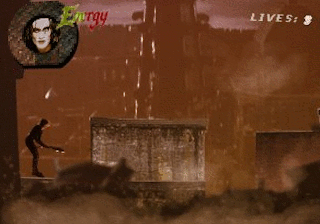
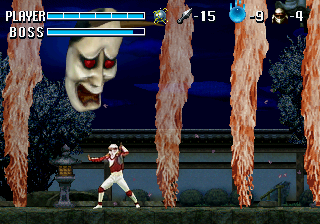
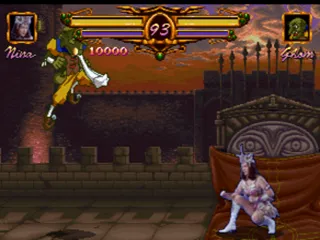
I've decided on doing some mock gameplay screenshots of various games featured in this timeline that don't have real-world equivalents (or ones of the type that can be easily re-used here), and at least for this image I didn't use AI. IMO, AI isn't very good for this type of stuff unless it's very simple, but in this case I had to source, crop, edit, transform, and coloring filter re-tone of pieces from a bunch of source images into something that feels like a side-scrolling digitized gameplay screenshot.

Tried keeping the resolution system-accurate, so 320 x 224 (I know the

And I know there was a Crow game for Saturn (and I think PS1) in OTL, but it's pseudo-3D (RE-style prerendered backgrounds & tank controls), and also really shitty. It's also based on the inferior sequel instead of the awesome original with Brandon Lee (RIP) and Ernie Hudson (alongside other greats like Tony Todd (RIP), Michael Wincott, and Bai Ling), so in this ATL we're making a game based on that first film instead.

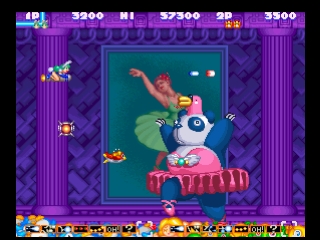
I'll try making another screenshot from a "retail build" (this is one from an in-progress mock-up), and it's going to be one of the early launch-period titles for SEGA Saturn. So, tried keeping it accurate i.e 320 x 224 output framebuffer (Saturn supported higher but I dunno how many early titles used things like Hi-Res Mode), 16-bit color depth (at least, tried to; did an Indexed color mode edit once everything was in place), slight dithering to help reduce color depth a bit more, some intentional blockiness/artifacting, lens distortion. It'll show up at some point once we get to 1994 in the timeline.

There are quite a few other instances like this throughout the timeline with additional games, so it should be fun trying to do this with those too. And most likely, won't be using AI for any of those unless they're very simple final edits. Though like I said earlier, for this particular part of things, I don't think it's a very good fit especially if I want the images to "feel" accurate to the time period and systems they represent.
 
Okay, so I've done some thinking, and I'm working on ways to integrate some aspects of Amiga into this timeline. Specifically the Hombre architecture which was supposed to succeed AAA until, well, Commodore went bankrupt.

It can't change too much, but I think there's a very good path to work Amiga's Hombre into the timeline as an influencing factor for at least one of the platform holders. Won't say which one yet, but a hint: they've already been mentioned extensively up to this point in the alternate timeline.

Will start posting Part 4 on Saturday, but it might spill over across two weeks. We'll see what happens.
 
(Link to Part 4 (2 of 2))

[AVGT: 5TH GEN (PART 5 (PART 1))]

==================================================================


[1994]

[JANUARY]

The_Future_Is_Now%2C_SNK_logo.png
3do_logo.png
Panasonic-logo.png

SNK and The 3DO Company (alongside Panasonic) make their partnership known to the world

>The 3DO Company and SNK formally announce their partnership for the 3DO system in January 1994 at Winter CES. As mentioned prior, the two companies entered talks in the back half of 1993, with SNK looking for a viable 3D chipset to license upon "favorable terms" for use in both a home console and arcade platform, and with fast turnaround time. However, they also wanted something that could be integrated with their Neo Geo technology. Seeing a good opportunity, The 3DO Company made a deal with SNK, and work on an SNK hybrid Neo Geo/3DO system began in the last quarter of 1993.

The SNK 3DO, also known as 3DO-NG, will combine the 3DO and Neo Geo chipsets, enable compatibility with 3DO titles and also get SNK's software support for the 3DO platform. To ensure 2D SNK games run smoothly, the NG will pack a whopping 10 MB of RAM, with 7 MB of that for the integrated Neo Geo chipset components, satiating SNK fans who want perfect 2D of the company's arcade conversions. Another aspect of the design is that it will feature both the 3DO's ARM60 CPU as well as the Neo Geo's 68000, and a custom bus interface will enable the two CPUs to communicate & function together.

Despite the massive RAM difference between NG and other 3DO systems, SNK will make games compatible with all 3DO consoles. To do this, they plan on developing a NG Dock for the expansion port of other 3DO models containing the additional 7 MB of RAM, allowing them to play perfect conversions of Neo Geo games.

An aggressive September 1994 launch window is set for 3DO-NG in Japan, while 1995 is set for Western markets. In order to hit this time frame, SNK are working directly with Panasonic, who are currently at work on a slimline 3DO revision of their own (FZ-10) scheduled for roughly the same time as the NG's Japanese launch. In doing so, SNK have granted Panasonic rights to manufacture their own NG variants, and retain exclusive manufacturing rights for NG models outside of SNK themselves.

Non-SNK & Panasonic 3DO systems can still obtain similar functionality with the NG Dock. Meanwhile, SNK also plan to adapt the 3DO chipset to the arcade market via the NG-3D. The NG-3D is expected to launch in the back-half of 1994, and act as a high-end successor to the Neo Geo MVS but not a replacement for it (MVS will serve the entry-level point of SNK's arcade business market strategy).

Part of the reason for the announcement at this time is to drum up confidence in the 3DO from the Japanese market, by having a well-respected Japanese software & hardware developer already involved with the platform, signaling a greater appeal in the Japanese market. It's also done in order to take some of the wind out of Sony's PlayStation announcement and keep 3DO in position against upcoming systems from NEC, Sharp, Fujitsu, and SEGA.

1920px-SEGA_logo_JPN.svg.png

SEGA's 32-bit console news cycle gets very active starting beginning of 1994

>SEGA (via SEGA of America) also have a presence at January's Winter CES, to announce the existence of the SEGA 32X. This add-on promises to provide a significant boost to the base
Genesis's processing capabilities, plugging right into the cartridge slot. The company aims to have the device available by the end of the year, and will show off the add-on at the June Consumer Electronics Show (CES); while some merely see the 32X as a natural booster to Genesis in light of advances from software on Nintendo's SNES, others feel it to be SEGA's attempt at revitalizing the Genesis's add-on market given the slowdown in SEGA CD sales.

Yet others begin to pontificate that the 32X is actually a response to Atari's Jaguar and The 3DO Company's 3DO, both having released just a couple months prior in Late 1993 for the American market. SEGA of America likely felt they could not wait for Late 1995 to get Saturn to Western shores, and that Genesis needed a substantive power-up system in the meantime to retain its competitive standing.

Indeed, SEGA of America' Joe Miller had been considering the potential of another Genesis add-on as early as June 1993, in the wake of build-up for Atari's Jaguar and the 3DO. The earliest ideas for 32X actually involved a SEGA CD with additional processing functionality built-in, but this was scaled back for cost reasons and that additional processing power moved to an add-on unit with just a port for the Genesis cartridge slot (but still technically compatible with the SEGA CD if one was also connected to a Genesis).

While the 32X has a favorable development lifecycle for it at current time (plans for a combination 32X/Genesis unit are also getting underway, thanks in part to suggestions from Hideki Sato-san and his group's visits to SEGA of America in Early 1994 to aid in 32X design work), this is unfortunately (or perhaps fortunately?) not set to last.

meJqxJwx0moyKThD.jpg

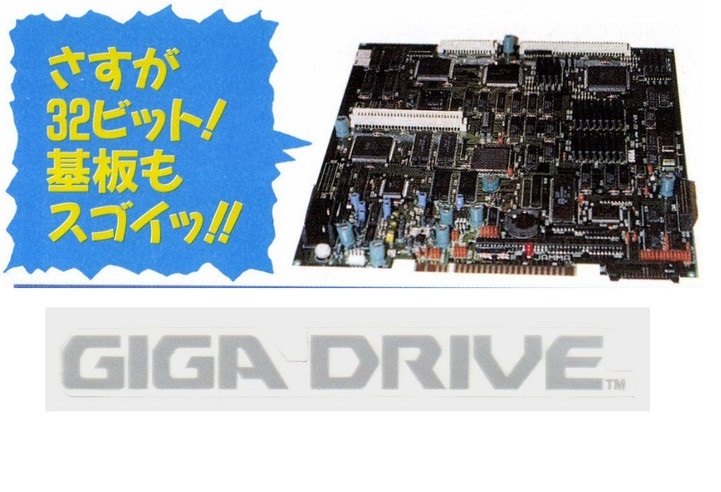
Early system prototype dev board for the Saturn around time it was internally known as GigaDrive (1992-1993)

>SEGA provide an update on the GigaDrive specifications, now known as the SEGA Saturn, in January 1994. It now features 2x Hitachi SH2 processors in a dual config (Master/Slave both operating at 28 MHz. Also in the design is a revamped VDP1 sprite/polygon chip (now handling perspective distortion transformation of quad sprites for a pseudo-3D effect, making it more advanced than the Warp Transform Engine in NEC's system), a beefed-up VDP2, and also has a SH1 for the CD-ROM drive (alongside a 512 KB CD-ROM cache buffer), a 68C000 as the audio CPU, 1.5 MB VRAM (1x 512 KB VDP1 texture cache, 2x 256 KB VDP1 framebuffers, 1x 512 KB VDP2 texture cache), a 512 KB BIOS ROM, and a SCU with a 85 MIPs DSP alongside a 32-bit external cartridge bus for future peripheral designs & products.

However, as comes to be known later, the initial update of SEGA Saturn specifications actually has an error in it: to try reigning in high production costs, SEGA have actually removed the 68000 CPU from the design, and have the SH1 on double duty for both the CD-ROM controller as well as audio CPU. The external cartridge port has also been moved from the A-bus to the B-bus. The corrected specifications are provided in a February press release update, and have their own implications for Saturn going forward

NwCuefaZpzwk7zov.png

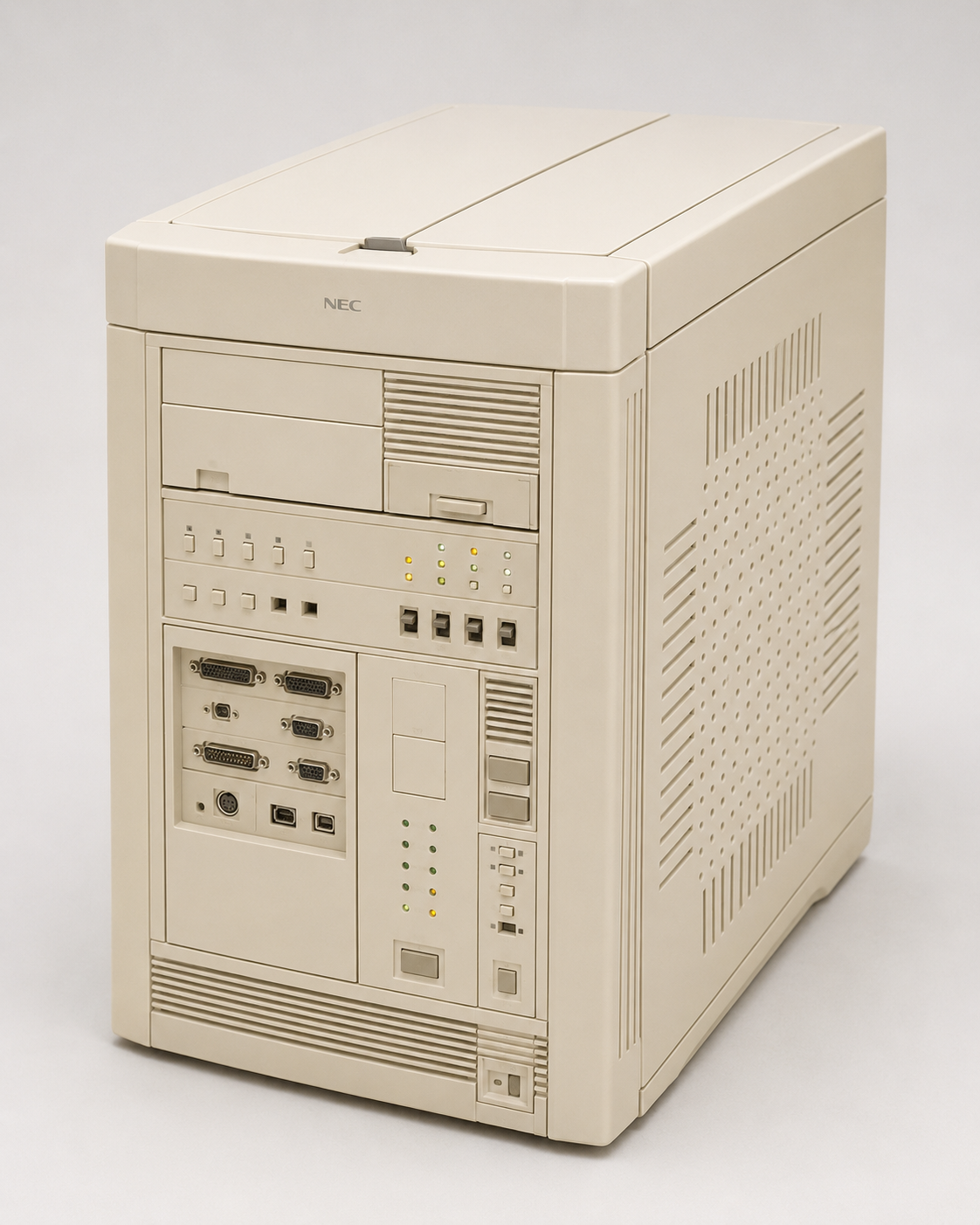
A custom development workstation unit for NEC's 32-bit games machine

>Also in January 1994, Turbo Technologies Inc receive their first official communication from NEC Home Electronics back in Japan as to the existence of the company's 5th-generation 32-bit games console. This comes in the form of a partially translated set of briefings & documents, as well as a development model of the near-finalized architectural chipset. As NEC's plans are to release the system in Japan by EOY 1994 and in America around Late 1995, now is the best time to finally bring TTI into the fold so they can start getting familiar with the system and prepare.

Given recent moves from Atari (Jaguar launch in Late 1993), 3DO (launch in Late 1993) alongside 3D arcade developments with SEGA and Namco, not to mention Sony's reveal of the
PlayStation AND SEGA revealing the Saturn in January of 1994 (the same month), Michael Katz and Steve Garwood were getting a bit antsy as to what was happening with the PC Engine/TG-16's successor. Sure, they KNEW a successor of some kind was in development, and small bits of details had been communicated with TTI over the course of 1993, but NEC Corporation were waiting until Project Tetsujin E specifications were near finalization before presenting everything in full to the Americans.

That said, this drip-feed of info between sides through 1993 meant that TTI could not really answer what NEC's response to the aforementioned developments was going to be. In a
way, this was good: TTI were building towards a crescendo in terms of market growth for the TG-16 and recently-releases Turbo Duo, the latter only being a little over one year old. It would have been premature to begin hyping up a 32-bit replacement for these systems considering Operation Turbo Mode only really started kicking off in H2 1992, and the Turbo Duo was seeing some good momentum thanks to moves like the release of Street Fighter 2 Super Champion Edition. It also helped that rival Nintendo were simply trucking along with the SNES and mostly staying out of the 5th-gen news cycle aside from their partnership announcement with Silicon Graphics back in June 1993.

Michael Katz, Steve Garwood and others at TTI begin reading the provided material and getting other parts translated as they wait for the Japanese side to send more data and product samples over the following few months. NEC Home Electronics Ltd. are also interested in getting TTI's impressions on the machine, but will be somewhat surprised when some of the impressions are not as what were expected.

In any case, the providence of early material and hardware allows for NEC Home Electronics to proceed with the console's full reveal the following February, where at least the final name, controller, and some footage of in-development titles (all being things provided to TTI in January or between January and early February) shall be presented.

[FEBRUARY]

zeiram-master.png

One of the main pushes of NEC's 32-bit console is to provide near Laserdisc-quality FMV on CD format. Footage of 1991 film Zeiram, under license from Toho Co Ltd., is used as demonstration, claimed running off NEC's actual hardware
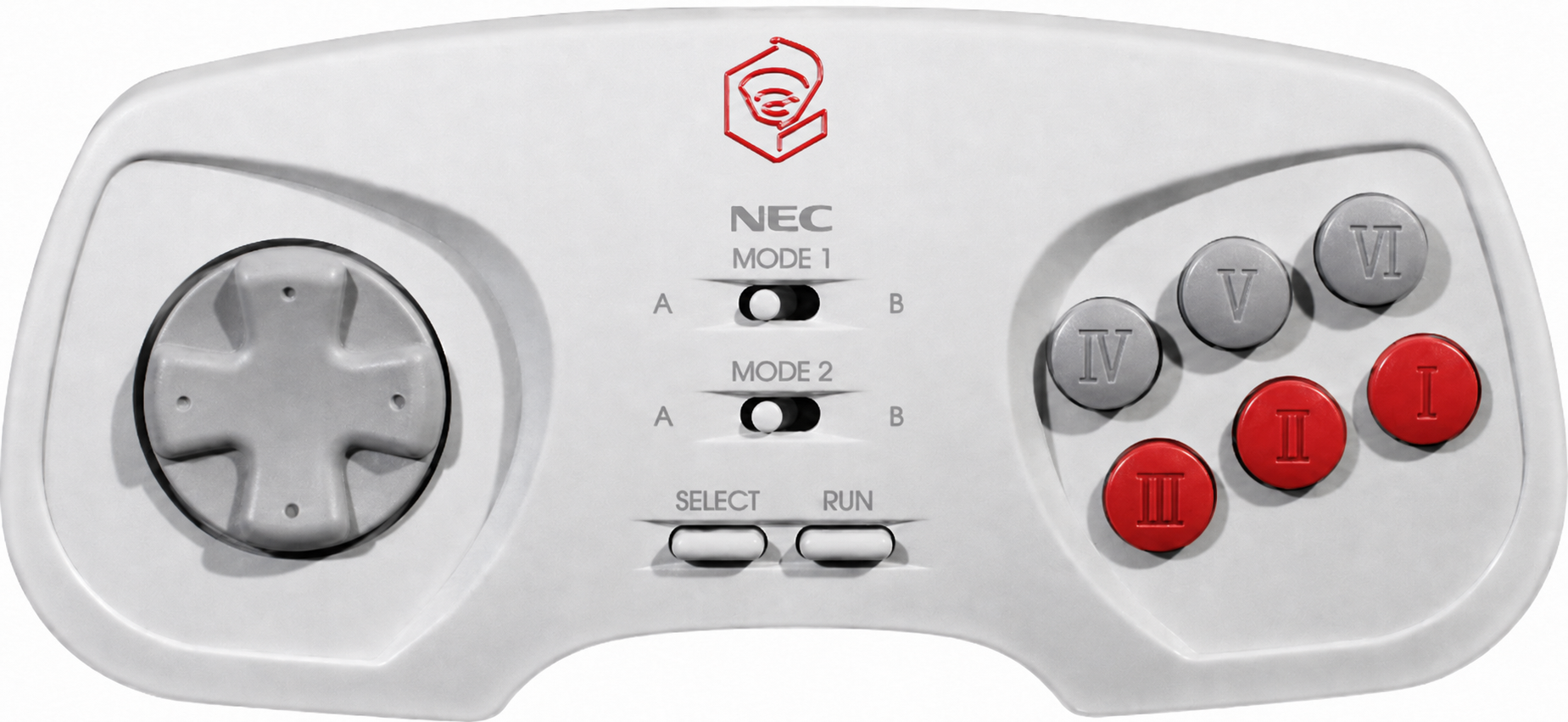
>NEC finally unveil the PC-Engine's successor, the PC-Tajigen, in a February press release statement and TV broadcast special. In light of Sony's PlayStation announcement plus SEGA's recent details on the Saturn, NEC's HCDDG have been working on a way to frame the system's reveal in a strong way which can direct the focus of conversation to their benefit. The timing of this reveal is also convenient in being able to get in front of Sharp's impending X68K-C^3 Japanese launch, and knocking wind out of the 3DO/SNK announcement from back in January.

The heart of the PC-Tajigen's performance is in its unparalleled MJPEG video support. With 2x HuC6271 'Rainbow' decoders, both of which can write macroblock data to the King ASIC 'KRAM' or bypass it directly to the 'Iron Guanyin PCT' Mixer, it gives the PC-Tajigen a level of 2D and even 3D depth previously not seen in the gaming space. One way to think of the HuC6271 decoders is that they can act as background tile or sprite engines with the King ASIC's ability to perform macroblock tiling of decoded video content, effectively using MJPEG video as a texture sheet canvas.

Or, another way to picture them are as two video background layers for full-motion parallax effects in a 2D game; the random access and intra-frame nature of MJPEG and the Rainbow decoders allows them to even simulate 3D depth in a game world by accessing frames based on player input and game logic context. With the MJPEG decoders, the PC-Tajigen can also provide significantly higher FMV playback resolution than any other console on the market or set to release in the near future, as well as true 60 FPS video playback support if desired.

WqkIntccHTfiGO3S.jpg

An in-game screenshot of NEC's in-development 2D/FMV RPG dungeon-crawler for PC-Tajigen

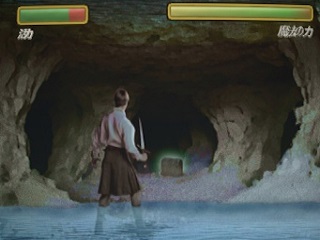
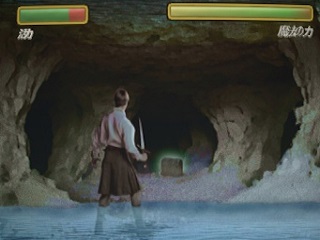
To demonstrate the new system's capabilities, NEC show off footage of one of the in-development titles, an unnamed dungeon crawler-style RPG with a third-person viewpoint and with an on-screen character viewed from behind. The character seems to be a high-resolution digitized, scaled sprite, with the actual dungeon background being a MJPEG video file. One of the key features of the dungeon area shown is the ceiling has light refraction of the water texture on the floor below; since the MJPEG decoders can push video frames to the King's KRAM at a fast rate, animated water textures reflective of the wall can be mapped to other surfaces with clever hardware programming. This creates an atmospheric impression.

As well, despite being FMV and only being 30 FPS, the actual frame-pacing of the video background is very smooth, showing that the other strengths of MJPEG is that frames can be individually, randomly accessed and parameter-controlled by the game logic via the CPU. This type of function would not be possible on other consoles or with MPEG, as other consoles lack video decode bypass (to a direct analog mixer circuit), and MPEG uses inter-frame encoding. The gameplay demo also displays that the player character can turn about corners and reverse course; when doing so, the character appears to actually turn based on the player input and then the camera pans around them to re-center behind their back.

The name of the game demo is not provided in the footage, but more details will be shared at the upcoming Tokyo Toy Show in June. Additionally, the television program does not show off the design of the PC-Tajigen, but it does have some members of the HCDDG speak about ideas behind the design. Some preview footage of what looks like a new 2D Bonk game can be seen as well, but it's rather grainy and obscured, so details can't be made out, and it's not even acknowledged in the program directly. Additional specs are presented, such as information on the V810 CPU that powers the system, and Soundbox audio processor features.

Regarding the V810, it is mentioned that the one in PC-Tajigen has had the FPU functionality reduced in order to make it cost-effective, and that it will operate at a very fast 21.5 MHz clock, as will the King ASIC. The Soundbox is stated to be an improved version of the one seen in the PC-98 Kantan product line, and will feature 32 channels of operation (the specific composition of those channels is not shared in the television broadcast). Also mentioned in the program (and press statement) is that more games and details will be made present at the upcoming Tokyo Toy Show later in June.

ra2-shooting.jpg
ra2_screen02.jpg

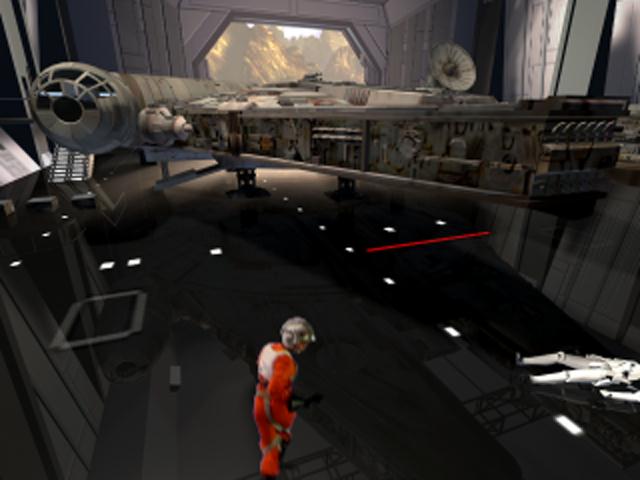
Turbo Technologies Inc's Steve Garwood feels NEC's PC-Tajigen could be a console haven for original IP (and ports) of games like DOS's Star Wars: Rebel Assault (above)

>Also in February, Michael Katz & others at TTI begin having internal discussions as to the PC-Tajigen as they prepare to parlay these with NEC Home Electronics (Japan) in a scheduled meeting early March. In terms of the PC-Tajigen's overall design, reception is...somewhat mixed. While various aspects of the architecture still need to be parsed over and caught up on (to this end, Junji "Jim" Namiki is brought over to help with more technical parts of the analysis), the prevailing thought is that the PC-Tajigen seems more like a console focused on 2D and FMV, things the Turbo Duo can already do, rather than what feels to be an impending market shift towards polygonal 3D.

Mind, PC-Tajigen clearly seems much more capable at both 2D and especially FMV than the Turbo Duo could dream of, and the dual-HuC6271 Rainbow MJPEG decoders are viewed as real pieces of work. However, Katz & Garwood have seen that FMV favor in the American gaming market has not been particularly great, looking towards the CD-i and SEGA's CD add-on as examples of this. The PC-Tajigen could be a haven for FMV-based PC game ports to the console market, building off the nice niche the Turbo Duo has been establishing in getting (albeit mostly non-FMV) PC and computer title ports over the past year.

However, Katz & Garwood are not oblivious to the talk of the trades and among gamers. They are noticing a growing number of American press openly express favored interest towards the SEGA Saturn and especially Sony PlayStation because of their focus on 3D. While the Atari Jaguar is badly struggling on the market, one of its most anticipated upcoming titles is Rebellion Development's Alien vs Predator, due for release later in the year. Meanwhile, 3DO is leaning harder into its 3D capabilities for marketing and have upcoming releases like The Need for Speed and Road Rash.

As things are, Katz can't necessarily see a window of opportunity for the PC-Tajigen in the American market if things continue shifting the way they seem they will. Garwood is more optimistic, particularly for what PC titles could benefit from the system's FMV hardware, but is ready to admit that such could be a niche and still challenging to bring over. Both men are also keenly aware of how TTI lacks its own software development house when competitors like SEGA have STI (SEGA Technical Institute), though are hopeful that budgets can expand to build upon the PC ports to Turbo Duo by commissioning devs to make original content for NEC platforms outright, especially if they can specifically serve the needs of the American market.

But perhaps most pressing, and in light of the PC-Tajigen's official reveal, is the quandary presented to TTI in messaging for the system. It's only a matter of time before American press pick up on the Japanese reveal presentation, which means that TTI will have to start fielding a lot more questions about PC-Tajigen while actively trying to prevent coverage & anticipation for it from eating into the active sales market of the TurboGrafx-16 and Turbo Duo. It'll be a true balancing act, but Katz & Garwood are up for the challenge and have some ideas in that regard.

Sharp-logo.png
t3RZ0HAQACkD2mpz.jpg

The X68030 Compact-HD represents one of the very final model releases in the original X68000 series line

>Sharp officially end manufacturing of new X68000 desktop systems in February 1994. The combination of low sales, high (relative) production costs, sales success of the X68000-CC and impending release of the X68K-C^3 combined with a re-evaluation of X68K in the shifting Japanese computer market have Sharp re-evaluate the platform.

In doing this, they pivot it as an entry (and with some variants, mid-range) computer offering with their proprietary design, saving IBM PC-compatibles for other mid-range and high-end computer products from among their offering. As well, it allows them to leverage future X68K developments as an incubation bed for console-based designs, retaining a clear pricing structure value difference between them and the X68000-CC products to come.

[MARCH]

1920px-Fujitsu-Logo.svg.png
fm-towns-marty-413.jpg

Fujitsu's upcoming revision for the FM Towns Marty, the FM Towns Marty 2, eventually disappoints due to lack of upgraded features.

>Market performance of the Fujitsu FM Towns Marty has not been strong. A year after its launch, a total of ~50K units have been sold across Japan. The main reasons cited for this are competition from Sharp's X68000-CC and NEC's PC-98 Kantan, plus the increase in low-cost DOS/V IBM PC-compatible PCs in the Japanese market beginning around H2 1992. An FM Towns Marty 2 is planned for a June 1994 launch, but internally (and quietly), Fujitsu are seemingly ready to wind down the FM Towns Marty platform operations altogether, as their consumer line focuses to more DOS/V IBM PC-compatible computer systems and preparing for Microsoft's upcoming Windows 95 operating system.

In the meantime, Fujitsu continue working with SEGA on their arcade hardware, such as the various Model 2 arcade board revisions. This combined with them securing a manufacturing & design license for Video Logic's PowerVR graphics architecture, will put them in a favorable position to partner with SEGA on future project initiatives.

1771395221557
TTi_logo.png
duomem1.jpg

Michael Katz, Steve Garwood & TTI prepare for an impending generational shift as NEC Corporation brings them into the PC-Tajigen fold.

>Michael Katz & Steve Garwood present their thoughts on PC-Tajigen to representatives of NEC Home Electronics (Japan) in early March 1994. Asked to speak candidly, the duo state what aspects of the system are exciting, and what aspects leave them with concern. They also state that TTI will need to see a great deal of expansion if it is to provide the PC-Tajigen with all of the support it needs, under the assumption that goals for market share will continue to shift upwards from what the TG-16 and Turbo Duo are already managing.

In spite of some concerns, Katz, Garwood, and the rest of TTI are generally receptive of the PC-Tajigen; Garwood in particular thinks it could be a boon for "proper" FMV-style games, unlike the ones that have plague the SEGA CD. Between the system's MJPEG capabilities and 2D prowess (between the King ASIC, HuC6270 VDC cores, and PEGC blitter), there would likely be some RPG game developers from the PC and Amiga scene very interested in working with the platform, especially if they have already enjoyed working with the Turbo Duo. TTI also feel that the PC-Tajigen could serve well in both continuing and growing Operation Turbo Mode, as the program itself has been steadily shifting into a rewards-based subscription service for dedicated customers in the ecosystem.

Eventually, TTI are asked three main questions: are they able to get things ready for a Late 1995 American launch, what aspects of the PC-Tajigen do they feel can best be marketed against the competition, and what resources are needed not currently present in order to meet what they feel is necessary to make the PC-Tajigen competitive in America in a way the TurboGrafx-16 was not. NEC Corporation are also considering bringing the PC-Tajigen to the European market; plans to do this with TurboGrafx were ultimately abandoned in 1992 despite success with Operation Turbo Mode because NEC did not have facilities set up in the region to handle sales & operations.

In fact, even at current they have no such thing, and Hudson Soft lack a European branch themselves. The current plan is to mirror the current American setup, and have NEC Europe set up an internal regional branch for PC-Tajigen. To assist in this, NEC Corporation also want TTI to help in getting the European unit up and running in time for a European launch, currently set internally for Early 1996. So even if TTI had no other reasons for expansion, this would be reason enough.

However, TTI did indeed have other reasons for expansion. The idea for expansion rested a lot on ensuring the PC-Tajigen could be effectively competitive in America; having learned from the Turbo Duo, Katz wanted to tap into Garwood's experience with Universal Music & Video Distribution. Simultaneously, Hudson Soft were looking to scale down & sell off their American office, and a 45 RPM record company named American Pie was looking for a buyer. Katz and Garwood felt this was the best time to expand TTI into its own subsidiary branch, and provide it its own offices, while still retaining close affiliation with the NEC Technologies USA branch. This would give TTI better means of managing distribution of supply, organizing marketing efforts, and arranging for region-specific ports, translations, and original titles.

In essence, Katz and Garwood would like this expansion to provide TTI with a degree of operational freedom, flexibility and scalability of competitors like SEGA of America and its SEGA Technical Institute, but within the management principalities of what TTI has already managed (and succeeded with) thus far. Details in terms of expansion and setting up a European gaming arm within NEC Europe are hashed over over the March - June 1994 period.

==================================================================

That's all the time I have for an update for now. Like mentioned previously, 1994 (and from the looks of things, 1995) will have to be broken up into multiple parts, and currently I'm handling that with covering just 2-3 months per part, so the years going forward could take 2-3 weeks to be fully complete. Another reason for this is because for hypothetical game releases, I want to create gameplay screenshots for them. You've seen some efforts of this with that "The Crow" gameplay screenshot in an earlier post, but I've been working to refine that with other titles, like the unnamed game (dungeon crawler/RPG) mentioned above for the PC-Tajigen's February television broadcast reveal.

There'll be more of that going forward just to try making the timeline feel more authentic, but NGL it's been a bit of a bitch to try doing this for 3D games. I think I have a method that'll work, but I'm not using any actual 3D modeling program for these. Just regular 2D drawing programs and trying to analyze best how 3D on these 5th-gen systems both actually looked and how we tended to see them on CRT screens and in game magazines from the day. So, I'm applying everything I can through observation and approximations, and like I said before I'm not using AI for any the gameplay screenshots because it's just not very good at making things the way I need these screenshots to look. The AI's been very helpful for the console and controller renders tho ;)

I'll post again on Sunday with more of the 1994 timeline. Most likely, the Sunday post will cover April-June 1994, but only have a briefing for the 1994 June Tokyo Toy Show. Then likely next Saturday, I'll post the full Tokyo Toy Show info alongside pictures/screenshots, because I'm actually still working on the gameplay screenshot for one of the games shown off at the event. Hoping for that one, the 3D elements can look convincingly 3D; another added complication in all of this is that I have to try getting the games to appear reflective of the performance features & capabilities of their respective systems, too, so there's basically a shit ton of steps involved and jumping between two programs to get everything looking right.

Hope you all enjoy; as usual definitely share any of your own thoughts or ideas, or any corrections if you noticed I posted a contradiction between any of the posts. Will be back Sunday; peace!

(Link to Part 5 (2 of 2))

 
Last edited:
(Link to Part 5 (1 of 2))

[AVGT: 5TH GEN (PART 5 (PART 2))]

=================================================================


[1994]

[APRIL]


YLMrzTtB2JMWLQ9i.png
rNzhoROqFg8YHaNl.png

A deep Navy Blue Sharp X68K-C^3, and its accompanying controller. The new model is teased at Tokyo Toy Show and debuts in Japan towards the end of 1994

>Sharp release the X68K-C^3 in Japan on April of 1994. The initial launch total is smaller than some suspected, apparently due to production limitations and some system components only being finalized very late into development. Additionally, some early hardware bugs took longer to iron out than anticipated, delaying early manufacturing volume totals. Sharp also assume that demand for the system will be lower in Japan due to continued sales of the X68000-CC (which brings more profit anyway), combined with the fact the true market aim for the X68K-C^3 is the West (America & Europe).

For launch, the following titles are made available:

-Geograph Seal (D: Exact; P: Sharp Software Label)​

xm6g+2020-06-01+18-17-39-66.png
xm6g+2020-06-01+18-26-30-19.png
1*WT3UVZkxc6I3IBFSW6NfJg.png

Exact's Geograph Seal takes rank as the most impressive of Sharp's launch titles for the X68K-C^3 in Japan

The only 3D title available at X68K-C^3's Japanese launch, it comes from esteemed developer house Exact. For the X68K-C^3 version, the game's software-based rendering has been replaced, taking advantage of the Enhanced Cynthia's capabilities and various other parts of the system design to provide hardware-accelerated 3D.

While the game retains its flat-shaded approach (textured polygons and Gouraud shading would technically be possible if not for time constraints), the frame rate is a surprisingly rock-solid 60 FPS with screen resolution set at 320x240; with Sharp's assistance, Exact would prioritize stable framerates and, expectedly, CD-quality music & sound effects for the console version over application of texture-mapping or more advanced shading.

Aside the 60 FPS and CD-quality audio, Geograph Seal on X68K-C^3 is identical to the X68000 & X68000-CC versions. Reviews go on to compare this version to the game's performance on the X68030 and X68030 Compact-HD, an impressive feat for Sharp's new console considering the limited time available to Exact to curate a build in time for the X68K-C^3's launch.

Due to an updated showing at June's Tokyo Toy Show, rumors begin building of a potential update of Geograph Seal for the system later in the year featuring texture mapping and a higher-resolution mode option, but this does not come to be. Rather, Exact put the experience gained towards a new project, which is teased at Tokyo Toy Show, and fully revealed towards the end of the year.​

-Dragon Slayer: The Legend of Heroes (D: Nihon Falcom Corp; P: SPS Co Ltd/Sharp Software Label)​

BZvFS4mgBVdHIgny.jpg
16448515-dragon-slayer-the-legend-of-heroes-sharp-x68000-time-to-go-shopp.png

The enhanced visuals of Dragon Slayer's X68K-C^3 port (left), versus the X68000 version (right)

A port of the X68000 version from 1993 (itself a port of the PC-98 release from 1989), the X68K-C^3 version trades resolution (384x288 vs 512x512) for visual polish. As in, the X68K-C^3 version has updated sprites and color detail, and also reduces screen borders in comparison to the X68000 edition. With it also incorporating improved versions of the PC-Engine Duo version's 2D cutscene graphics & animations, this makes the X68K-C^3 port the definitive version in visual terms. In fact, some reviewers consider it the best-looking installment in the series up to this point, despite the game's sequel already being available and the 3rd Legend of Heroes entry also available on NEC's PC-98!

The X68K-C^3 version also features additional music tracks and some altered sound effects over NEC's console version, some gameplay balances, and a couple of additional gameplay features that were introduced in its sequel. It also features a revamped saving system to make better use of the X68K-C^3's save card format. With great reviews, SPS Co. Ltd and Sharp (who commissioned for the port) eye bringing similar treatment to a port of the second entry to the fresh new console.​

-Asuka 120% Burning Fest (D: Fill in Cafe Co Ltd.; P: Family Soft Co Ltd)​

3Z4UJFjc2owSw1ln.jpg
ThpIyYkEQOL4UEWf.jpg

Fill in Cafe's Asuka 120% Burning Fest provides some much-appreciated Street Fighter-style action for Japanese fans on Day 1

Every system needs a fighting game at launch to give it some gusto, and for Sharp's X68K-C^3, that game is Asuka 120% Burning Fest. Based on the X68000 version, this one has enhanced sprite graphics, smoother animations (including some additional animation frames for character attacks), and CD-quality soundtrack renditions. Some of the move inputs have also been adjusted, and a 'UI Settings' mode has been added allowing players to adjust sizing and placement of UI display elements.

All of the characters from the X68000 edition of the game are accounted for here, and all of the OST soundtrack options of that version as well. However, this edition of the game lacks the new special moves, speed option settings selection, and adventure/visual novel gameplay features in the story mode that make it in the eventual FM Towns release in December 1994. In spite of this, reviews are quite good, though as per the earlier editions it is seen as a more lighthearted & less "in-depth" fighting option compared to Capcom's Street Fighter 2 or SNK's Fatal Fury & Samurai Showdown titles.

Additionally, while Asuka does get chosen as one of the American launch titles later in the year, some American review outlets are harsher on the game, comparing it directly to SEGA's port of Virtua Fighter for Saturn's Japanese launch, rather unfavorably at that. This, despite, them being two clearly different types of fighters, simply because one is 2D and the other is 3D. Perhaps a sign of things to come for Sharp's system in terms of optics overseas once the action with competitors heats up?...
A total of 80K X68K-C^3 units sell in Japan during the three weeks of April wherein it is available, with Sharp able to increase supply later into May and then June. The launch is generally considered a success, though the initial launch lineup is limited and consists of only ports of existing X68000 titles. In this sense it'd appear the business model is closer to Fujitsu's FM Towns Marty.

However, plans for the American market are decidedly different, and Sharp plan on increasing X68K-C^3 supply in Japan closer to the American launch timing. They also have plans for gettig doujin games verified and distributed on the system (despite having shared X68000 architecture, the X68K-C^3 has a different BIOS (more in line with the X68000-CC's, but also modified for authorized CD-ROM discs in a way not present for the X68000-CC or X68000 computers), which will be announced at the upcoming Tokyo Toy Show.

1280px-Commodore_Amiga_US_Logo.svg.png
1920px-Amiga_4000T.jpg

The storied & legendary computer company Commodore, and its acquired historic platform of the Amiga, come to a sudden and sad end. Yet, fate will enable at least something of the legacy to continue into the future

>Commodore International, the parent company of Amiga, officially file for bankruptcy in April 1994. The company's newly-released Amiga CD32 (in Europe) had been caught up with customs via a large shipment stuck in the Philippines due to fee-related issues. As Commodore were unable to reach an agreement with Philippine customs in time, the company was not able to bring a product to American shores to sell in order to generate funds for paying off debts to suppliers, leading to bankruptcy. This compounds on the patent judgement that was issued against the company earlier, which it was unable to pay (they had hoped the CD32 would be their ticket in procuring funds to make that payment in time).

However, even amid an unfortunate end of an empire, Commodore's Hombre technology manages to live on, finding new life at an odd new home: Atari Games. Atari Games spent a great deal of time the past few years getting familiar with Texas Instruments DSPs and graphics processors for digitized 2D and heavy sprite-based 3D arcade titles, but the company is also heavily interested in moving on to higher-performance architecture for the arcade market.

In particular, they are getting a bit antsy in light of newer-generation 3D arcade hardware from competitors like SEGA and Namco*, while Midway are also shifting on to higher performance specifications. Atari Games have been exploring options, tho nothing to the extreme of partnering with a giant tech firm the way SEGA and Namco have. Interestingly, Atari Games had actually considered licensing out the 3DO technology back in 1993, but terms were not favorable with The 3DO Company. Shortly after that, some people at Atari Games became aware of the Amiga Hombre architecture in a private demonstration back in Summer 1993; while the company was already underway of adapting Atari Corporation's Jaguar for the arcade market (known as the Co-Jag), internally Atari Games were not pleased with the Jaguar's architecture and chaotic development environment suite.

*Atari Games are acquired by Time Warner around very late 1993, with the full acquisition having taken place in March of 1994, similar to OTL (well, I don't know specifically in 1994 when the acquisition was fully complete in OTL). Similar to OTL, the acquisition involves Namco USA being given exclusive distribution rights of Atari Games arcade machines in the North American coin-up market, and Atari Games are folded into the Time Warner Interactive branch. Despite that deal, it still makes Atari Games and Namco basically competitors in the arcade since there's nothing in it for Atari Games i.e getting to distribute Namco arcade games in NA region that Namco USA don't bring over.

There was no specific contract in place for Atari Games to support the Jaguar with arcade ports, as both they and Atari Corporation had been operating as separate entities for several years by this point. As such, even if there was an expectation on Atari Corporation's end to get some ports of Atari Game's arcade titles, Atari Games were very much still open to exploring additional options, such as a 3D-capable arcade board that was generally easy to develop for. At the time Atari Games have been making this decision, though, no PC 3D graphics cards were available (and none will even be available until later into 1995 at earliest), and the company had no particular interest in pairing with one of the console companies (outside of the aforementioned 3DO) to adapt their 3D for the arcade market as Atari Games either knew little of the alternatives, or was not finding the alternatives appealing.

Commodore were hoping at the time of the private demonstration that Atari Games would have agreed to adapting Hombre to an arcade system shortly after. Atari Games didn't actually commit to an agreement until Late 1993, at which time Commodore's financial future was very much coming into large doubt. Atari Games' dealings with Commodore also came under fire from Sam Tramiel and Atari Corporation, who saw no point in them licensing chipsets from a competing (to Atari Corporation) computer company.

However, Atari Games eventually won out the debate towards Late 1993 since their agreement with Atari Corporation only specified that Atari Games could not use the Atari logo or name branding in the home consumer market space, hence why Atari Games created the Tengen label years ago. Nothing in the legal framework between both companies prevented Atari Games from using non-Atari technology in hardware for the arcade market (or other things like locking Atari Games home ports to Atari console in an exclusive fashion).

Due to Commodore's bankruptcy, Atari Games' licensing agreement for Hombre turns into an outright acquisition of the IP rights to the technology, with Atari Games' plans actively being to use Hombre as their high-end 3D arcade platform, with Co-Jag being for their lower-end 3D and 2D arcade games going forward. However, this is just the beginning of plans between Atari Games and the Hombre chipset, as future plans come to include providing a stream of arcade game ports to "various systems", and even contemplating interest in the burgeoning PC 3D accelerator market and perhaps...even a home console?* 👀...

Don't take this to mean Atari's, btw 😁

[MAY]


ArcadeCardPro_PCE.jpg

NEC/Hudson Soft's Arcade CD-ROM^2 HuCard; despite it being ready to go, NEC Corporation decide against a release due to close proximity of the PC-Tajigen

>Details of the PC-Engine CD-ROM^2's now-cancelled Arcade HuCard enhancement leak out around May 1994. This was to be something similar to the Super CD-ROM^2 HuCard that
released some time ago; in case of the Arcade HuCard, NEC implemented a uPD77C25 DSP core at 10 MHz alongside a custom gate ASIC enabling the uPD77C25 to interface with 512 KB of uPD44012 RAM, and the HuC6280 CPU interfacing with the HuCard through the aforementioned custom gate ASIC.

Due to readying the PC-Tajigen for its Late 1994 Japanese launch, NEC Corporation's Home Electronics division cancel plans to release the Arcade CD-ROM^2 HuCard despite the
fact it is "practically finished"; however, Michael Katz and Steve Garwood over at Turbo Technologies feel it would be of help to bring the peripheral stateside, for garnering additional Western software support for the TurboDuo and give that system leverage against new arrivals like the Atari Jaguar, 3DO, X68K-C^3 and SEGA's recently revealed 32X add-on for the Genesis.

The Arcade CD-ROM^2 HuCard can be made at a cheap enough price to provide a much more affordable upgrade path vs. what Turbo Technologies figure the 32X will provide, though the Arcade CD-ROM^2 HuCard doesn't bring benefits to the TG-16 the way the 32X seems it will for the Genesis, unfortunately. Therefore, a risk still exists to where people could be upsold on a TurboDuo & Arcade CD-ROM^2 HuCard combo, only to then be asked to buy a PC-Tajigen a year later (or less).

[JUNE]

>June 1994 brings about the Tokyo Toy Show. SEGA, Sony, NEC, Sharp, and 3DO/SNK are all present. Many developments take place at Tokyo Toy Show, but the following provides a limited, general rundown of those happenings.

-SEGA: Saturn launch date set for November 1994, physical design showcased, demonstration showings of launch & launch-period titles (Virtua Fighter, Virtua Racing, Blue Seed, Outrunners, Panzer Dragoon etc.)

-SONY: PlayStation launch date set for December 1994 (and price of ¥38,400), various titles shown off (Crime Crackers, Motor Toon Grand Prix, King's Field, Ridge Racer, Tekken etc.)

-NEC: "Q4 1994" date provided for PC-Tajigen, pricing set at ¥48,900 (~ $480), system design & controller reveal, launch peripherals outlined (controller, cables, PCT-BMP save data cartridge etc.), various titles shown (Team Innocent, Battle Heat, Lunatic Dawn, Denno Tenshi: Digital Ange etc.)

-SHARP: Sales numbers update for X68K-C^3 (140K sold-through), North American launch date confirmation (November 1994), new peripherals (Handy Mouse), various game reveals (De*ja Duo, Dragon Eyes II, Panorama Cotton, Homa Hunter Lime, Genocide 2 etc.)

-3DO/SNK: Launch of 3DO-NG set (September 1994, ¥56,100 (~ $549)), Western date "early 1995" teased, system design & controller reveal, NG Expansion Module (previous name NG Dock) revealed for standard 3DO systems, Panasonic FZ-10 R.E.A.L 3DO model reveal, various games revealed (Magician Lord 2, Guardian War, Starblade, King of Fighters '94, Road Rash, Super Wing Commander etc.)

Alongside the expected Japanese outlets such as Famitsu, several Western games magazine outlets, such as GameFan, EGM, and Edge, have reporters at the event to help bring info to audiences in America and Europe as well. Among the Japanese outlets, most would declare SEGA the winner of the show, with Sharp as a close second and the other entrants jockeying for third. For Western press, however, judgements would be quite different.

Among them, most would declare new wunderkid Sony's PlayStation as either their favorite or tied with Saturn. One would have to keep in mind, that SEGA's Saturn demonstration hedged a lot on Virtua Fighter, but SEGA's 3D fighter wasn't lighting up Western arcades the same way it did in Japan (where it has basically displaced Street Fighter as the premier fighting game IP over there). Other showings like Psygnosis's Wipeout also help Sony's system make a strong impression.

Meanwhile, Sharp's X68K-C^3 is seen a bit less favorably among some of the Western outlets due to a 2D-heavy presentation, and some of the renewed fervor thanks to things like Exact's games aren't seen as enough to override the polygonal fidelity SEGA and Sony are displaying. Even so, it's still seen as a good deal, even in light of 3DO's stronger-than-expected showing thanks to the SNK partnership. Pricing for Sharp's system is also seen as favorable by Western outlets, and many expect X68K-C^3 to take the lead in the 5th-gen American market...at least until Sony and SEGA's systems launch (SEGA's being the first).

Although most Western outlets are less enthused with the 3DO and particularly NEC presentations at the event, some like GameFan are more favorable. PC-Tajigen in particular is seen in very good light by GameFan, perhaps due to its strong intersection with the Japanese anime space and hopeful anime productions (and anime-based games) to come to the platform. While not a conclusive analysis, it'd appear NEC's system has the toughest road ahead in the Western market as-is, and this is an increasing concern for TTI back in America, to the point where even the Japanese executives will come to acknowledge this by Early 1995.


==================================================================

This will conclude Part 2 of 1994 in the timeline. Like mentioned yesterday, there will be an expanded detailing for the June Tokyo Toy Show event, but there are several things I'm working on for that ATM. I did use ChatGPT to create some higher-resolution image versions of screenshots for Asuka 120% Burning Fest and Dragon Slayer; honestly I'm kind of impressed how well it managed, though I still did some manual editing to the images for resolution and aspect ratio fixes.

I just wanted pics to show off how the X68K-C^3 would have improved the visual profile of such games, and needed some images done quickly. My intent for new original game images is that those will have to be done fully manual in the programs I use for drawing & editing, with the methodology I've figured out to use. Just prefer the granular control in those instances.

One thing about this timeline is that originally, when I started writing all of it, I was very much focused on NEC and little else. And now, we've got a situation where NEC looks the most out-of-position among the platforms in the eyes of Western press....kind of what happened with PC-FX in our real time line o.0. Don't worry though; PC-Engine/TurboGrafx fans won't have to worry too long, because we'll see NEC make a pretty strong recovery with smart decisions soon, though it'll be a long road to do so.

Also, the Commodore section is a reflection of having added aspects of them to this timeline kind of late. So, some developments that should've been noted in the 1993 part of the timeline are referred to here in the 1994 section instead. I couldn't prevent Commodore's bankruptcy, and the whole IP rights hell with Amiga still ends up happening here, but at least their promising Hombre architecture will be salvaged, though ironically by a form of Atari (that technically is no longer under Atari Corporation's or the Tramiel's management). I think Atari fans will also be satisfied with this timeline as things go on; they won't become a big player ever, but they won't be going out with the whimper they did in our timeline either. In fact, depending on how you look at it, they won't be "going out" at all.

The lack of any particular noteworthy mention of Sony and Nintendo here might be odd to some of you, but that's because developments with them, up to this point anyway, are virtually 1:1 with OTL. When deviations begin, I will mention them. I also feel they are the two most well-understood players in the mix, so you can generally infer what they are doing at this time and recognize that. I actually have some major plans of changes for both Sony and Nintendo deeper into the timeline, but that's still quite a few years off.

Oh, and 3DO fans will have a lot more to look forward to going forward vs. OTL, too. But I won't spoil anything yet. I'm trying to give all the players a win one way or another, though there will still be losers in this as well of course. Like I said much earlier, a main purpose of this timeline is to prevent a situation where one company (i.e Sony) just completely dominate everyone else, as I feel that is too simple, ultimately boring, and doesn't make for good storytelling. And ultimately, this is a story :)

More to come next Saturday. 'Till then, peace y'all!
 
Last edited:
PlayStation and it's not even close. That library was stacked. MGS, Tomb Raider, Soul Reaver, FF, Castlevania, RE, Gran Turismo, Tekken, Breath of Fire, Doom, Quake, Mega Man. There was always some new game to borrow and play, it was amazing.
 
PlayStation and it's not even close. That library was stacked. MGS, Tomb Raider, Soul Reaver, FF, Castlevania, RE, Gran Turismo, Tekken, Breath of Fire, Doom, Quake, Mega Man. There was always some new game to borrow and play, it was amazing.

I mean, as a choice it makes a lot of sense. And, we've got the power of hindsight on our side, tho even in Japan by early 1997 it was probably kinda clear that the future belonged to PlayStation.

But for myself as I've gotten older, it's been really nice to appreciate systems I either barely played much of as a kid or never played at all. There are so many nuances between many of the systems that gen and I feel all of them bring something of interest to the space these days. Even abject failures like PC-FX and Jaguar, they have a surprising amount of value to bring in a wholistic front.

Tho if we're talking just playing games, for most people if they did have to choose something 5th gen PS1 and arguably N64 would satiate the hunger for the vast majority, TBF.
 
Thick Thighs Save Lives Thick Thighs Save Lives
One of the images won't load for me:
fhXYGO7CfnyQK6Vy.jpg

Fun reads btw, great renders and screenshots. I would 100% fuck with that fmv dungeon crawler from last entry. 😁

Aye thanks for pointing that out! I'll look into it, see if I can fix it up (EDIT: went and replaced with a different image. Lemme know if the new one works). Also glad you've been enjoying the series so far, and think the FMV dungeon crawler screenshot looks good. On thing that always sticks out to me with FMV games from the era is how little blending into the environment the character sprites look unless the scene is just normal bright lighting. Even then, sometimes you can tell differences.

Some of that's probably due to limitations of the era, but I think there could've been more games with that proper blended lighting between character sprites & backgrounds for FMV titles in the gen if the style of game retained popularity on console. Obviously it did for a while longer on PC, and there are PC FMV game that achieve the look, you just (seemingly) needed a super-beefy rig to pull it off.

I think with the MJPEG abilities, PC-FX would've done some real justice to that style of game if it saw any sort of market success, so there'll be some more of that for PC-Tajigen. Tho they'll have to figure a way to make the system more competitive vs. PlayStation & Saturn for 3D as well, and quickly.
 
Last edited:
Aye thanks for pointing that out! I'll look into it, see if I can fix it up (EDIT: went and replaced with a different image. Lemme know if the new one works). Also glad you've been enjoying the series so far, and think the FMV dungeon crawler screenshot looks good. On thing that always sticks out to me with FMV games from the era is how little blending into the environment the character sprites look unless the scene is just normal bright lighting. Even then, sometimes you can tell differences.

Some of that's probably due to limitations of the era, but I think there could've been more games with that proper blended lighting between character sprites & backgrounds for FMV titles in the gen if the style of game retained popularity on console. Obviously it did for a while longer on PC, and there are PC FMV game that achieve the look, you just (seemingly) needed a super-beefy rig to pull it off.

I think with the MJPEG abilities, PC-FX would've done some real justice to that style of game if it saw any sort of market success, so there'll be some more of that for PC-Tajigen. Tho they'll have to figure a way to make the system more competitive vs. PlayStation & Saturn for 3D as well, and quickly.
Yep, the image is there now. 🙌

The fmv era gave us a few classics, some "so bad it's good" titles and a bunch of lazy cash grabs. I see some pop up from time to time to this day, but nowhere as experimental/fun/weird as in their heyday.

Is your timeline going to do anything fun with voxels btw? I've always wondered if we could've gotten some more voxel-bangers if it could've had a few more years in the limelight. I remember being impressed by Delta Force and being excited for the future ...only for it to be thrown to the side. Damn you polygons, damn you to hell. 😁
 
Yep, the image is there now. 🙌

The fmv era gave us a few classics, some "so bad it's good" titles and a bunch of lazy cash grabs. I see some pop up from time to time to this day, but nowhere as experimental/fun/weird as in their heyday.

Is your timeline going to do anything fun with voxels btw? I've always wondered if we could've gotten some more voxel-bangers if it could've had a few more years in the limelight. I remember being impressed by Delta Force and being excited for the future ...only for it to be thrown to the side. Damn you polygons, damn you to hell. 😁

Hmm...actually, there might be a development with voxels deeper into the timeline, via demoscene exploits with one system in particular. There'll even be some raymarching stuff going on there with that one, via demoscene exploits like with voxels.

But that's about all I can mention for now, as that type of stuff will come with the 6th generation. The hardware for 6th-gen in this timeline is gonna get kind of crazy because basically every single system sees spec changes vs. real-world, and some are massively different in comparison to what we got. There's just way less details filled out for 6th-gen ATM tho vs. 5th-gen, and I still have a lot from 1998-2001 to fill in too.

Glad to hear the image works now too; my personal interest in voxels might be more muted, but it's not a technology I'm as familiar with, either. I just know of games like Ecstatica on DOS (but I'm not even sure if that game used voxels at all) and Schorcer on Saturn that used it. Remember reading some magazine coverage in Next Gen for Scorcher where they were quite impressed with the voxel engine.

I'd imagine the big reason the tech never took off in gaming is because middleware & engines just prioritized polygons, and 3D rendering & programming techniques were solidifying around polygons by the time we got consoles powerful enough to do voxels justice. Unfortunate, but tends to be the way things play out in this industry.
 
Okay, so there's going to be a slight change of plans this weekend. I had to work on one of the game images longer than expected, and I have some other things I need to do today. So, the June Tokyo Toy Show 1994 update will have to be Sunday instead.

It's a substantial amount of stuff to cover for that update, and I can probably also work in the 32X Summer CES/Gamer's Day coverage there too (since that should've technically been in the last update). I'm interested to see how close to actual gameplay screenshots the fabricated ones are seen as 😁
 
Top Bottom