
• Hey Guest. Check out your NeoGAF Wrapped 2025 results here!

How to Write a “Political Correctness Run Amok” Article

Status
Not open for further replies.

Lime

Member
Really great meta-commentary on the whole "political correctness is destroying the fabric of our society." Julia Serano. It's long and there's a lot of nuance, so I strongly suggest reading it in full.

Here's a selected quote on one of the many points she makes
So as I’ve been saying all along, this story is not really about free speech. It’s about where we — as individuals, as a society — draw that unspoken line-in-the-sand with regards to what we deem to be permissible, and what (and often whom) we deem beyond the pale.

And if you can’t see that the real issue at stake here is the unspoken line-in-the-sand, then that’s most likely a sign that who you are and what you believe is already deemed permissible in our society. But as a trans person who has lived most of my life being deemed by 95-ish percent of society as being beyond the pale — who stayed closeted the first twenty-seven years of my life because I knew most people wouldn’t accept me, who attended secretly-held trans community meetings because it was not safe for us to congregate in a public space during that time and place, who still to this day faces regular discrimination and harassment that large swaths of our society condones — to me, that unspoken line-in-the-sand is blatantly obvious. It basically determines whether or not I am allowed to exist, whether or not my perspective and concerns are taken seriously.

That unspoken line-in-the-sand is right there, doing real work, directly impacting many people’s lives, even if you choose not to see it, or refuse to acknowledge its existence.

So if you want to write an article called “Feminism Needs More Thinkers Who Aren’t Right 100 Percent of the Time,” go ahead — freedom of speech and all that. And I generally agree with the sentiment expressed in your title — hell, I even wrote an entire book about how we need to be more accepting of difference (including differences of opinion) within feminism. But when accepting people who “Aren’t Right 100 Percent of the Time” is coded language for accepting someone who didn’t just say one offhand remark that made a few trans people upset, but rather someone who is fiercely committed to the idea that trans people are beyond the pale, that our identities should not in any way be accepted by society — if this is what you think we should accept — then you are not promoting tolerance. You are condoning intolerance. And you are not championing Germaine Greer’s freedom of speech (she still has that, and as a Person of Stature, she also has a platform to express it), but rather you are drawing a line-in-the-sand — a line that renders me and other trans people’s concerns as irrelevant and unimportant.

You have every right to draw the line wherever you want. Just as I have every right to try to push the line in my preferred direction (which may, or may not, include protesting people who express vitriol and disinformation about trans people, and/or people who tacitly condone that vitriol and disinformation). But don’t obfuscate this particular matter by pretending that this is about free speech, or tolerating dissenting views, or activists going too far.

This is about the line-in-the-sand.

You can’t have a society where women are fully respected, but where expressions of rampant sexism are also condoned. It is simply not possible — as a feminist, surely you can see this. By the same token, it is simply not possible to fully respect trans people while at the same time condoning people who express rampant transphobia — these things are mutually exclusive.

So go ahead and draw your line, the one that determines whether you deem trans people to be beyond the pale (as historically has been the case), or whether you deem transphobia (sans scare-quotes) beyond the pale. But you can’t have it both ways.

And once you draw that line, own it. Because this is all about the line.

But if instead of engaging in such smart and necessary conversations, you’d rather just write the flip-side of the “Internet outrage machine” article — where instead of stoking outrage about people who have allegedly committed acts of sexism, or racism, or transphobia, and so on, you instead stoke outrage about the people who are protesting these potential acts of sexism, or racism, or transphobia, and so on — and/or if you want to dismiss or condemn these activists’ and minority groups’ protests without addressing any of the Pandora’s Boxes that I have described along the way in this article, then fuck you. Seriously. Fuck you. You are a hack who does not want to have a serious conversation about these super-important and super-complex issues. You just want to be in the right.

And I think you are wrong. That is where I draw my line-in-the-sand.

https://medium.com/@juliaserano/how-to-write-a-political-correctness-run-amok-article-9b828d443018
 
Awesome text !

Specialy recomend people to read the paragraphs about the Pandora boxes, like this one:

Julia Serano said:
Repeatedly remind readers (through both blatant and subtle appeals) that Free Speech = Good; Censorship = Bad. Be sure *not* to mention that the Person of Stature’s freedom of speech is not really at stake — like the rest of us, they are free to make any bigoted comments any time they want. Even more importantly, whatever you do, *never* acknowledge the fact that protests, petitions, and social media comments critiquing the Person of Stature also constitute acts of free speech. This is Pandora’s Box #1 — whatever you do, do not open it! Because if both the protesters and the Person of Stature are seen as having free speech, then this becomes a “marketplace of ideas” issue, and your readers will then feel entitled to make up their own minds as to who is in the right and who is in the wrong. And you can’t let this happen, because you have already decided this for them!
 
Hahahaha i see this all the time in posts

Make it about the “minority group gone too far”: In this strategy, you will place the focus squarely on this one minority group (i.e., transgender people) and portray them as crossing a line that no other respectable minority group would dare cross. The advantage to this is that most people are already suspicious of transgender people and unfamiliar with trans issues, so it will be relatively easy to convince your readers that this group is up to no good and/or overreacting to things.


Damn good
 
Pandora’s Box #4: Remember earlier, when I mentioned how (in your mainstream self-identified liberal readers’ recollection) there were hardly any transgender people at all a mere five, or ten, or fifteen years ago? Well, they were actually around that whole time! It’s just that they were hardly ever given the opportunity to speak, or to be heard, in public settings. Hell, just ten years ago, it was far more common for such protests to be directed against transgender people speaking at Universities rather than the other way around.

This part resonates a lot with me. The notion that suddenly there's more and more transgender people visible everywhere was certainly an observation that popped into my head. But if you actually take a minute to think about why they're suddenly more visible things suddenly seem a lot more reasonable. Far too many people just seem incapable of taking that extra step and instead jump to preposterous conclusions (like the sudden rise in autism diagnoses and vaccines). You can probably apply this unfortunate phenomenom to a wide variety of topics and issues.
 
Good read. It's always satisfying reading something where someone takes random thoughts I've had in my head and puts them in words better than I ever could.
 
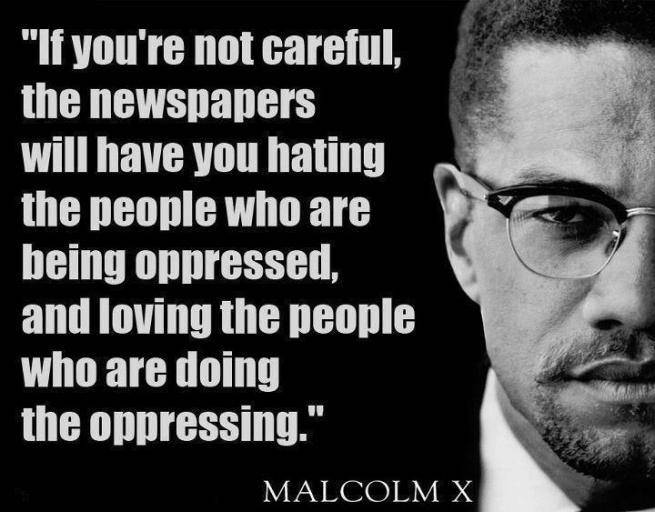
malcolm-x-quote-if-youre-not-careful-the-newspapers-will-have-you-hating-the-people-who-are-being-opressed-and-loving-the-people-who-are-doing-the-opressing1.jpg
 
thank you for posting. I think we could all do better to discuss the deep issues at hand (related to that line in the sand) with our friends and family. I know friends and family that really need this sort of discussion in their lives.
 
Saving this article. It has a lot of great points and may come in handy when talking about the PC culture outrage with people who may be uneducated on the matter.
 
I liked this article but it became too foused on that specific transgender controversy and less of an overarching analysis of the tricks used in biased reporting and editorials.
 
Thank you so much for this OP. Been saying this forever.


Great quote. It's honestly how some of these "PC culture has gone to far" threads are starting to seem. People going out of there way to defend bigots because of "freedom of speech". but taking any chance they can get too deride marginalized groups, even though they are also exercising their rights.
 
I like this article a lot, but I think its sort of missing the point of a lot of the counterarguments. This article is essentially making very similar points to what I usually make in those threads, but it takes it as a given that we agree that there is a "line in the sand", when I've had lots of people argue extensively that no, you shouldn't keep a neo-nazi or a eugenicist or whatever from speaking because they really do believe so wholeheartedly that we just have to let the exchange of ideas sort things out without inhibition.
 
Honestly after I finished reading this I just said to myself, ok, that was it?

The author attempts to throw all of these authors, instances and sources into the same pot - authors, instances and sources that often have notably different arguments and contentions being presented - and address them in the abstract. Whittling them down to a handful of generalizations. Which not surprisingly miss a lot of what is being argued on a case by case basis.

But when you read pieces in The Atlantic or NPR for instance, they often take different approaches from article to article or piece to piece. One speaking on the growing trend of disproportionate response to presumed microaggressions to the underlying goals of many protests and the problems with their aims. To the effect safe spaces and trigger warnings have on the critical thinking process. I think it is poor form to try and roll all of those pieces into one catch all "PC run amok" umbrella and generalize them. Especially when the generalizations fail to address much of what is being argued. The "line in the sand" argument can certainly be applied in a number of instances but for large number of works I have read on the topic of youth liberal activism it doesnt address a lot of them.
 
I liked this article but it became too foused on that specific transgender controversy and less of an overarching analysis of the tricks used in biased reporting and editorials.
I think you sort of got it backwards. It seems to be a (somewhat emotional and personal) reaction to that incident from the start and the more generalized talk was added due to it being a common problem. It's nice to see a reaction to that certain circumstance but yeah it would be nice to also have an article talking about the individual fallacies and tropes commonly used with probably a different example per tactic. Maybe that would be more suited for a book though or at the very least I could see it be quite a bit longer.

Either way I liked the article. I definitely saw a lot of those things happening when the specific incident came up in the first places and in other incidents of course.
 
Thank you so much for this OP. Been saying this forever.


Great quote. It's honestly how some of these "PC culture has gone to far" threads are starting to seem. People going out of there way to defend bigots because of "freedom of speech". but taking any chance they can get too deride marginalized groups, even though they are also exercising their rights.


Freedom of speech cuts both ways basically. Even if what they are talking about doesn't have much to do with the Constitutional freedom of speech.
 
Protest is free expression. Crying "free speech" as a way of attacking "political correctness" (and, of course, protecting the status quo) is literally the definition of cognitive dissonance. And stupidity.
 
I think you sort of got it backwards. It seems to be a (somewhat emotional and personal) reaction to that incident from the start and the more generalized talk was added due to it being a common problem. It's nice to see a reaction to that certain circumstance but yeah it would be nice to also have an article talking about the individual fallacies and tropes commonly used with probably a different example per tactic. Maybe that would be more suited for a book though or at the very least I could see it be quite a bit longer.

Either way I liked the article. I definitely saw a lot of those things happening when the specific incident came up in the first places and in other incidents of course.

Frankly the best posters offering dissension against aspects of the protest in the thread about the Greer talk were not making a "line in the sand" argument but tended to revolve around a number of other issues. Issues such as the function of a college and the academic process, the level of influence a student body should have on administrative processes, the tactics being used, what constitutes an acceptable level of protest to require change. Whether this actually constituted legal hate speech and whether a persons unpopular or wrong views should prevent them speaking about any topic, even if mostly unrelated to what they will be speaking on.

Very little if any of the good discussion stemmed from a "line in the sand" argument, including a lot of media commentary.
 
The "political correctness" angle only really hits at the group of people who, when they say "you must respect freedom of speech," really mean "I agree with the idea that saying ________ is okay." (insert whatever bigoted BS you like in the blank)

I think the size of the population that truly has this misunderstanding is quite large, but I don't think they're the ones most commonly engaged in the intellectual side of this conversation; that is, they're unlikely to be interested in telling you what freedom of speech should mean in a society that's trying to combat racism; instead, they just want to assert it to protect the expression of their own points of view, and are actually hostile to other points of view.

I think there's a perfectly rational argument to be made that even if "saying ________ is NOT okay," we should at least tolerate the possibility that people might say stupid, offensive, insensitive, hate-filled, and wrong shit like ________.

After all, we can't have a society where we have the freedom to criticize without the possibility that we might criticize people in a way that's really just as stupid, offensive, insensitive, hate-filled, and wrong as saying ________.
 
This article seems to have a lot of good points, but it's hard to tell when she doesn't directly connect them to specific passages of articles she's critiquing.

She mentions a couple articles off-hand, but doesn't analyze their content directly. As such, it's hard to really engage with how her arguments actually map to what's being written.
 
The author attempts to throw all of these authors, instances and sources into the same pot - authors, instances and sources that often have notably different arguments and contentions being presented - and address them in the abstract. Whittling them down to a handful of generalizations. Which not surprisingly miss a lot of what is being argued on a case by case basis.
I think that's where I'm having trouble with this as well. (Serrano is not usually someone I disagree with.) I agree with her categorizations that seem to boil down to "critique of liberalism", "obnoxious complaints about manners/politeness/protocol" and "dogwhistles". The first is good and healthy, the latter two are not. The dogwhistles are easy to pick out. But dividing things into box 1 and 2 is going to require personal judgement calls that are very likely to be identical from person to person.
 
This article seems to have a lot of good points, but it's hard to tell when she doesn't directly connect them to specific passages of articles she's critiquing.

She mentions a couple articles off-hand, but doesn't analyze their content directly. As such, it's hard to really engage with how her arguments actually map to what's being written.

Conor Friedersdorf of The Atlantic expresses similar feeling about Jelani Cobb's piece for The New Yorker (the following excerpt is from Friedersdorf's piece):

All of that is correct. Much of it is outrageous. (And really, to hell with John C. Calhoun.) Says Cobb, offering even more useful context, “Faculty and students at both Yale and the University of Missouri who spoke to me about the protests were careful to point out that they were the culmination of long-simmering concerns.”

Agreed.

Does any of that justify students spitting on people exiting a campus talk just because they object to what the speaker said? Does it mean that a professor should lose a job in residential life over an email about whether administrators or students should opine on costumes? Should it console an Asian American student whose civil right to take news photographs of a public, outdoor event was thwarted by white faculty and white and black activists who intimidated and pushed him?

Cobb doesn’t say. Instead, he stigmatizes the positions I’ve taken without bothering to rebut them. In place of a rebuttal are elegantly written but evasive paragraphs. They invoke history as if obvious conclusions follow, but never specify what they are.

Here is one of those paragraphs: “To understand the real complexities of these students’ situation, free-speech purists would have to grapple with what it means to live in a building named for a man who dedicated himself to the principle of white supremacy and to the ownership of your ancestors,” he writes. “That this issue has arisen on the rarified grounds of an Ivy League campus doesn’t diminish the example; it makes it a more pointed illustration that no amount of talent or resources or advantage can shield you entirely from the minimizing sentiments so pervasive in this country.”

What on earth do “free speech purists” have to do with the controversy at Yale? What wrongheaded claims are they purportedly making? What does it mean to live in that building? How would grappling with it cause one to change an opinion about spitting on lecture attendees or the chilling effect that would be caused by censuring a professor over a mild email? What is “the real complexity” of the situation? I’d gladly grapple with solid positions––when he takes them, I frequently find Cobb insightful––but try as I might, I cannot tell where he stands on any of this.
 
This article seems to have a lot of good points, but it's hard to tell when she doesn't directly connect them to specific passages of articles she's critiquing.

She mentions a couple articles off-hand, but doesn't analyze their content directly. As such, it's hard to really engage with how her arguments actually map to what's being written.

She goes into more depth on this in her comments section.

Multiple people complained that I didn’t address what they see as activists going too far in certain cases, or how quickly people are to call-out, pile on, protest, and “no platform” others. Those issues were not addressed directly here, as this piece was a rebuttal to a series of one-sided “hit pieces” (what I described as the “flip-side of the Internet outrage machine”), and my goal was too highlight the superficiality and gaping blindspots in those pieces. But I have written *extensively* about such issues elsewhere.

I also really like how she tackles that old arguement of "What if the roles were reversed and x wasn't allowed to speak as well?"

Which leads me to another response: Someone suggested that I am oblivious to the fact that the winds may shift some day, and that it will be me who is “no platformed.” Well, as I linked to in the piece, I actually have been “no platformed” before, specifically for being a transgender person speaking about trans identities, which some people protested because they felt that this (in and of itself) was beyond the pale. And frankly, the way that the phrase “no platform” is often tossed around is really naive. It often is used to refer to when people have already been invited to speak, but protesters try to put pressure on the institution in question to disinvite them. This ignores the countless conversations that go on behind the scenes, where people decide who might be “appropriate” or “inappropriate” to invite in the first place! And I’m sure that 95-ish or 75-ish percent of people behind the scenes, right off the bat, wouldn’t even consider inviting a transgender person to speak, or would find it (or assume that audiences would find it) inappropriate.

Alot of times Universities are already carefully curating who they want to speak. Which is why the whole "you should get to chose who speaks at you university" argument falls apart since universities are already doing that.
 
She goes into more depth on this in her comments section.


I also really like how she tackles that old arguement of "What if the roles were reversed and x wasn't allowed to speak as well?"


Alot of times Universities are already carefully curating who they want to speak. Which is why the whole "you should get to chose who speaks at you university" argument falls apart since universities are already doing that.

She actually completely sidesteps the argument of being too general. Though she does reference other works so I guess maybe in there.

On her "It can be used against you" front she isnt really saying much. Of course there are administrative processes. The issue of contention though seems to more often then not to be stemming from the what, when, where and hows of a particular protest.

What exactly is she defending here though. Of course they have a right to lobby and protest. I don't think a single credible article said they didn't. However should that protest override administrative process? Is this particular method ideal? Is it sound on various ethical fronts? Are there secondary consequences and are those secondary consequences worth the argued benefit?

That is a more complicated discussion. One that is not easily hand waved away by merely pointing out an administrative process exists or that she has more concerns for a particular no platforming over another one. Or by guilting by association. It kinda reads like a long non-answer IMO.
 
Status
Not open for further replies.
Top Bottom